On June 3, 2026, Israel’s High Court ruled that Israel must restore Red Cross visits to Palestinian prisoners. On Sept. 27, the court found that the government was not complying with its ruling. As of Oct. 12, 2026, we found nothing to show the visits had resumed. Months before the ruling, on Oct. 12, 2025, the day before Haitham Salem’s release, Red Cross representatives came to his prison to ask the prisoners to fill out a questionnaire. Salem, from Beit Lahiya in Gaza, says the prisoners refused and wondered why they had not come earlier.
This part reflects information available before publication on Oct. 12, 2026.
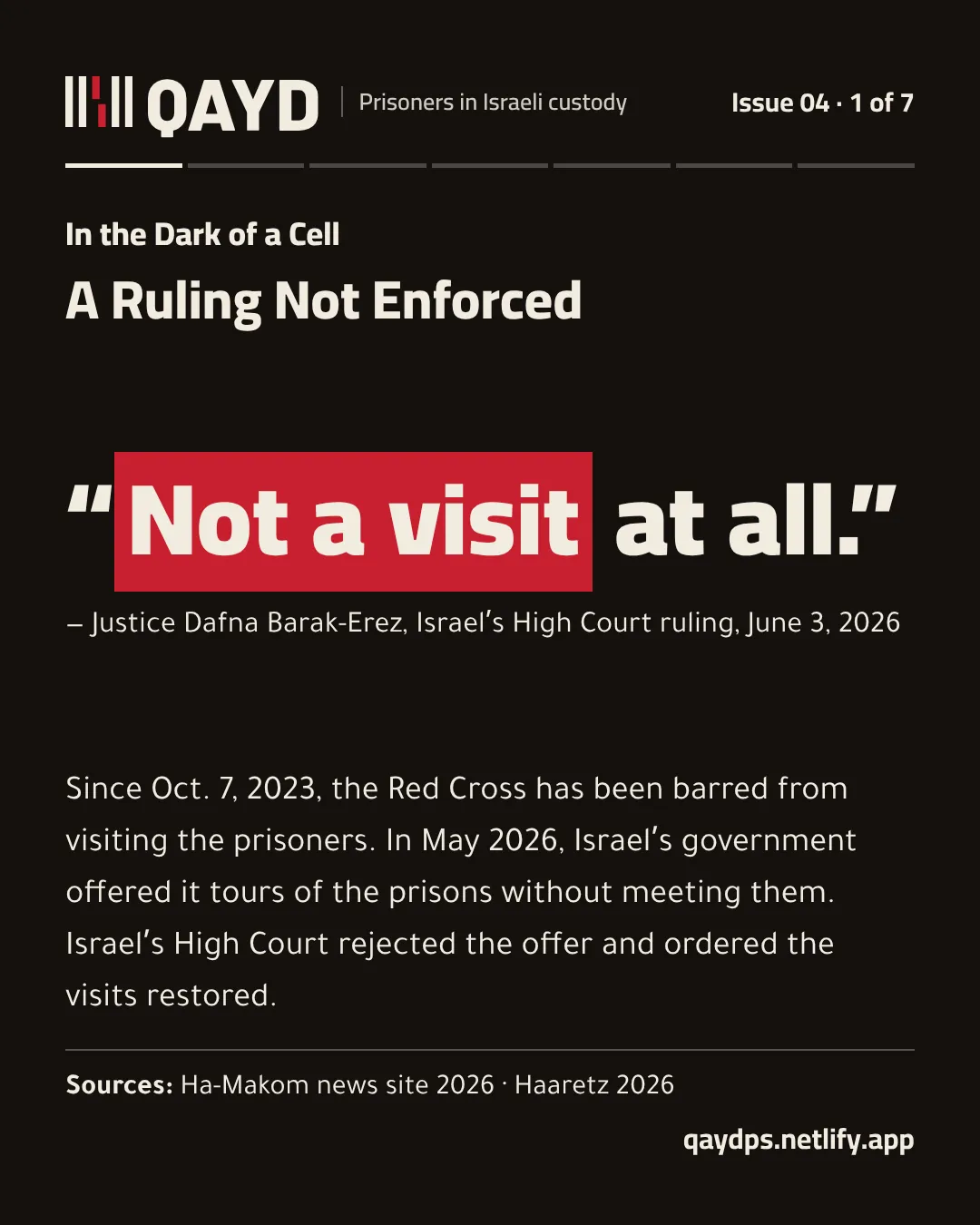
Justice Dafna Barak-Erez, Israel’s High Court ruling, June 3, 2026
Since Oct. 7, 2023, the Red Cross has been barred from visiting the prisoners. In May 2026, Israel’s government offered it tours of the prisons without meeting them. Israel’s High Court rejected the offer and ordered the visits restored.
In detail
On May 8, 2026, Israel’s government told the High Court it would let the Red Cross visit the prisons where Palestinian “security” prisoners are held, but not meet the prisoners. The offer came on the instructions of Prime Minister Benjamin Netanyahu, Haaretz reported, and the visits were to be limited to meetings with prison staff and tours of the prisons.
It ruled that in imposing this policy the government contravened Israeli and international law.
The Association for Civil Rights in Israel, one of the four groups that brought the petition, on the court’s unanimous ruling of June 3, 2026
The visits on offer were to five facilities that hold “security” prisoners, according to the Hebrew news site Ha-Makom, and only “to get an impression of the conditions of incarceration,” “without personal meetings with the detainees, for security reasons.”
The court rejected the offer. Justice Barak-Erez wrote that a visit without direct contact with the prisoners is “not a visit at all.” In Ha-Makom’s account, that holds under Israeli law and under international law alike.
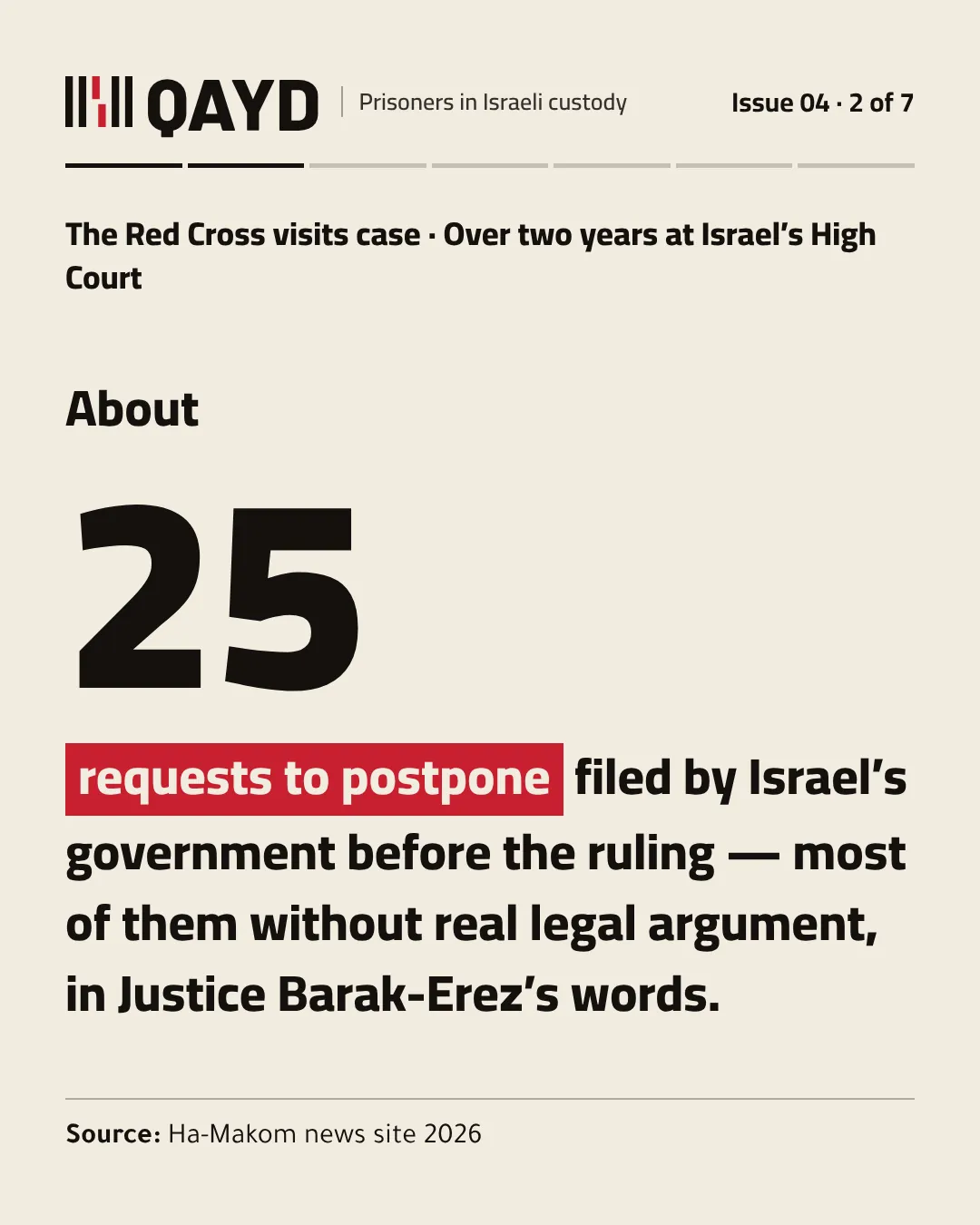
The Red Cross visits case · Over two years at Israel’s High Court
About 25
requests to postpone filed by Israel’s government before the ruling — most of them without real legal argument, in Justice Barak-Erez’s words.
In detail
The case sat before Israel’s High Court for more than two years. In that time, according to Ha-Makom’s account of the ruling, the government filed repeated requests for more time: about 25 requests to postpone its responses and the hearings.
The court issued a conditional order in the case in August 2024, Ha-Makom reports. The hearing was held only on Oct. 29, 2025, according to the Association for Civil Rights in Israel. On that same day, Defense Minister Israel Katz signed an order barring Red Cross delegates from visiting detainees classified as “unlawful combatants.”
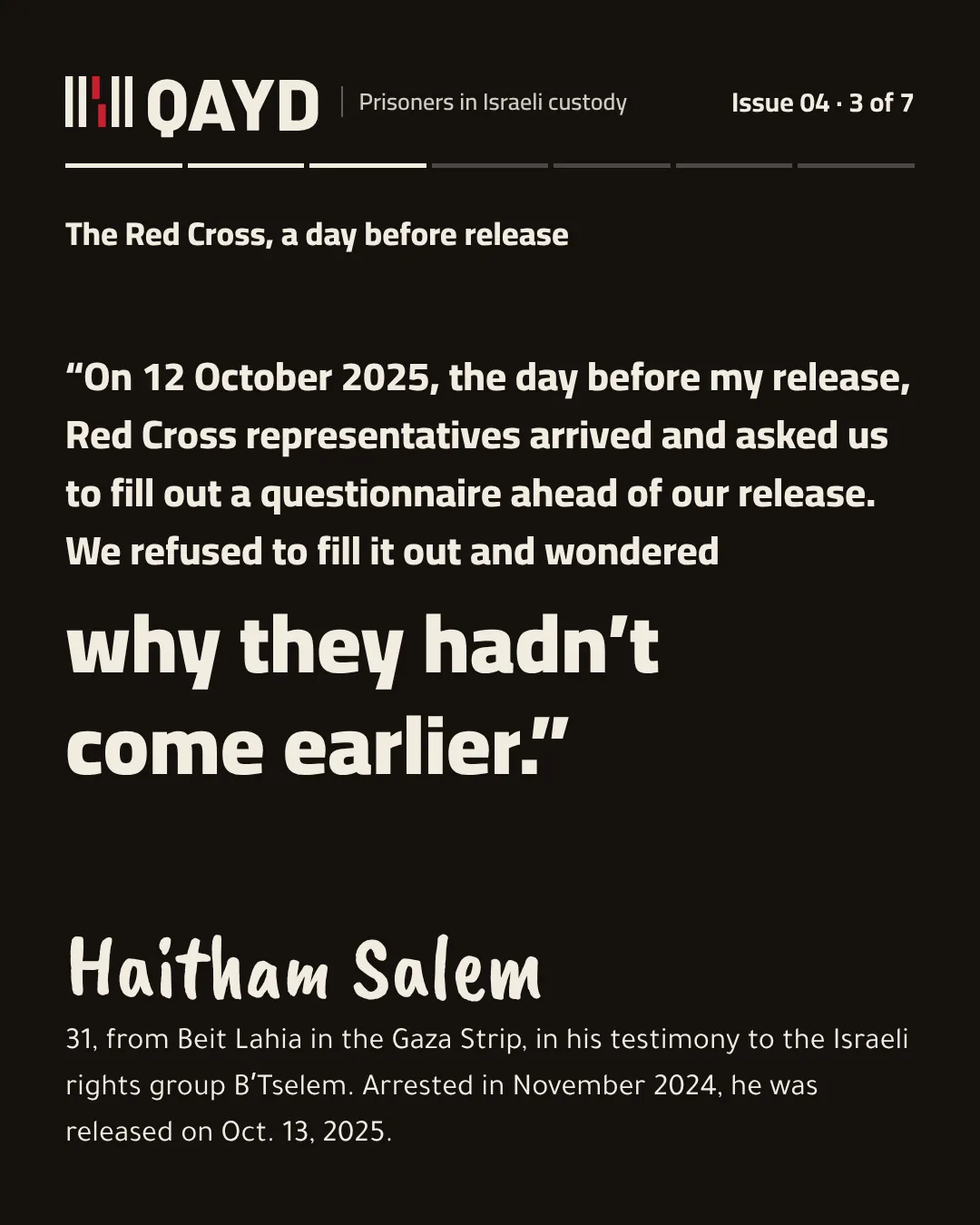
“On 12 October 2025, the day before my release, Red Cross representatives arrived and asked us to fill out a questionnaire ahead of our release. We refused to fill it out and wondered why they hadn’t come earlier.”
Haitham Salem, 31, from Beit Lahia in the Gaza Strip, in his testimony to the Israeli rights group B’Tselem
Arrested in November 2024, he was released on Oct. 13, 2025.
In detail
B’Tselem took his testimony on Oct. 31, 2025, and published it in its report “Living Hell” in January 2026.
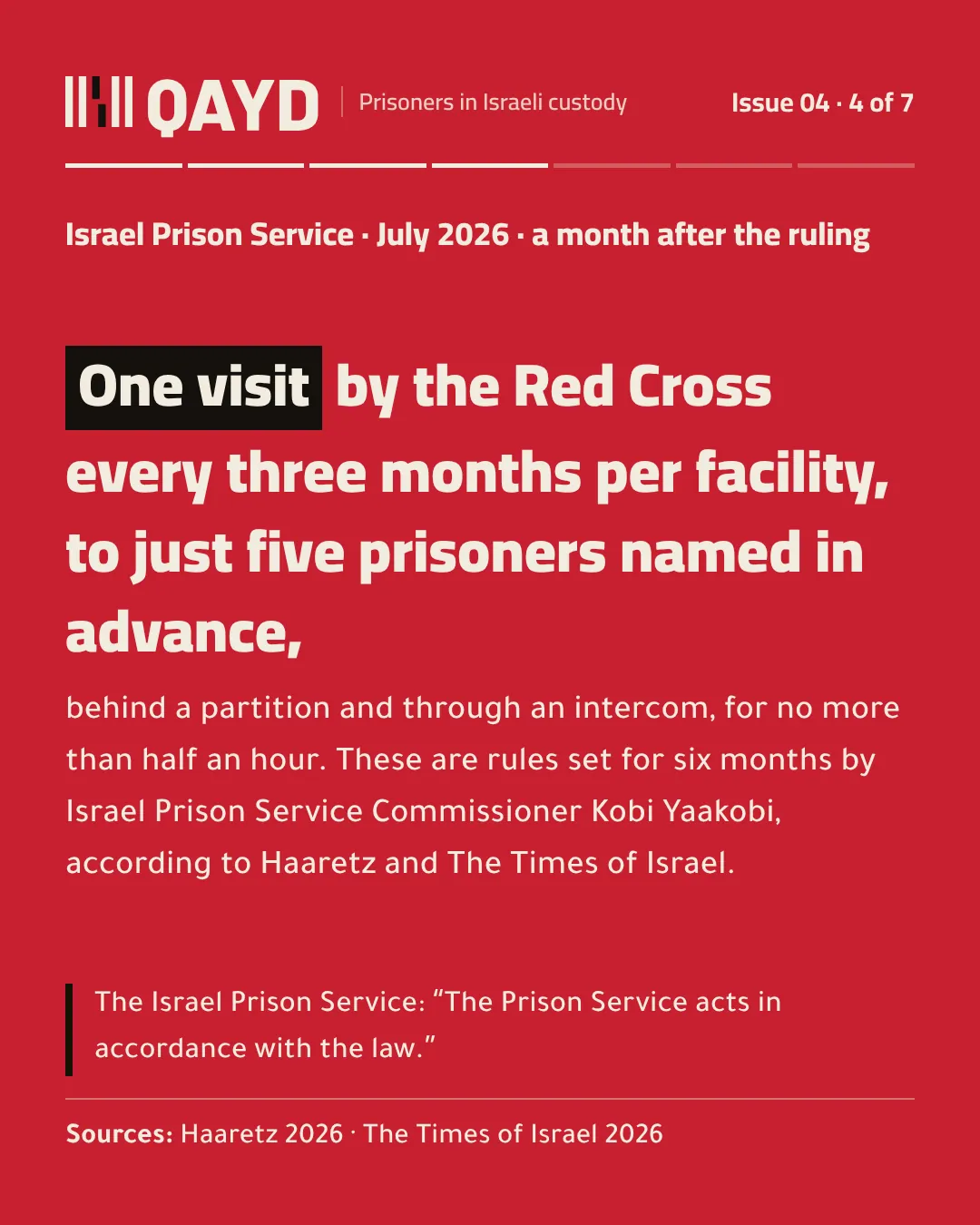
Israel Prison Service · July 2026 · a month after the ruling
One visit by the Red Cross every three months per facility, to just five prisoners named in advance.
They meet behind a partition and through an intercom, for no more than half an hour. These are rules set for six months by Israel Prison Service Commissioner Kobi Yaakobi, according to Haaretz and The Times of Israel.
The Israel Prison Service: “The Prison Service acts in accordance with the law.”
In detail
The rules followed a vote in the Knesset. On the evening of June 29, 2026, lawmakers rejected at first reading a bill to bar Red Cross delegates from entering prisons and detention facilities, 41-36, while the ultra-Orthodox parties boycotted the vote, Haaretz reported. The bill, sponsored by Knesset members Galit Distel Atbaryan, Katy Shitrit and others, was meant to stop the delegates from visiting “security” prisoners or receiving information about them.
Prison Service Commissioner Kobi Yaakobi then set new rules making it harder for the Red Cross to visit “security” prisoners held in Prison Service and army facilities, Haaretz reported on July 12. The rules run for six months and allow only limited, rationed visits, screened in advance and subject to prior approval and an intelligence check. Haaretz wrote that the rules run counter to the High Court’s ruling, and that the step was taken without consulting Attorney General Gali Baharav-Miara.
The rules permit the Red Cross “to visit just 20 prisoners per year at every detention facility,” The Times of Israel reported. That works out to four visits a year, with five prisoners at each.
In its response, as published by Haaretz, the Israel Prison Service added that if a claim is raised, it should be examined in the forums designated for that purpose.
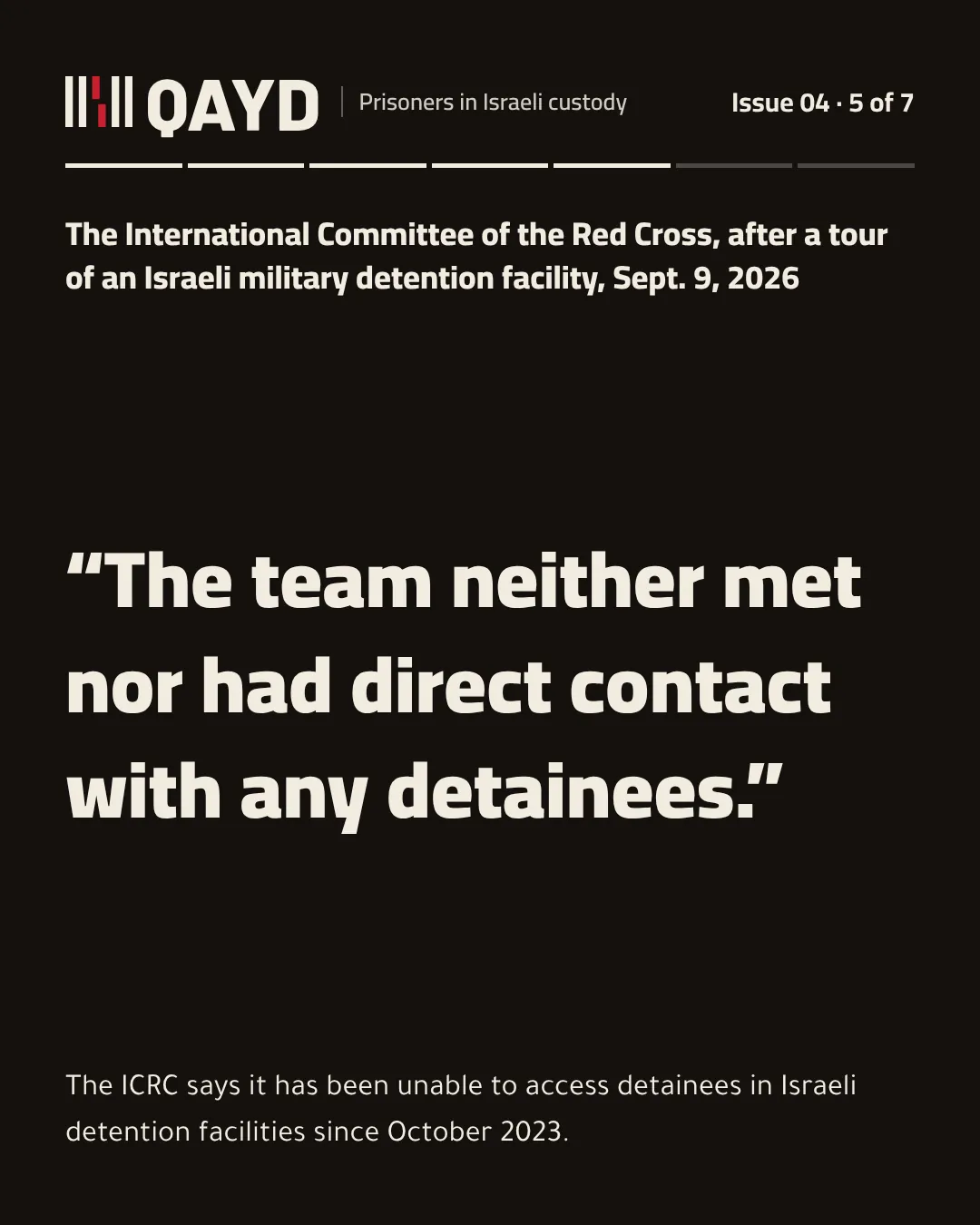
The International Committee of the Red Cross, after a tour of an Israeli military detention facility, Sept. 9, 2026
“The team neither met nor had direct contact with any detainees.”
The ICRC says it has been unable to access detainees in Israeli detention facilities since October 2023.
In detail
On Sept. 9, 2026, an ICRC team “held a technical meeting, assessment and tour of a military detention facility in Israel,” the committee said in a statement. The statement’s title says the team met the authorities at the facility “as part of efforts to reinstate access.”
We haven’t had access to prisoners or detainees in Israel since October 7.
The president of the International Committee of the Red Cross, to The National, Sept. 25, 2026
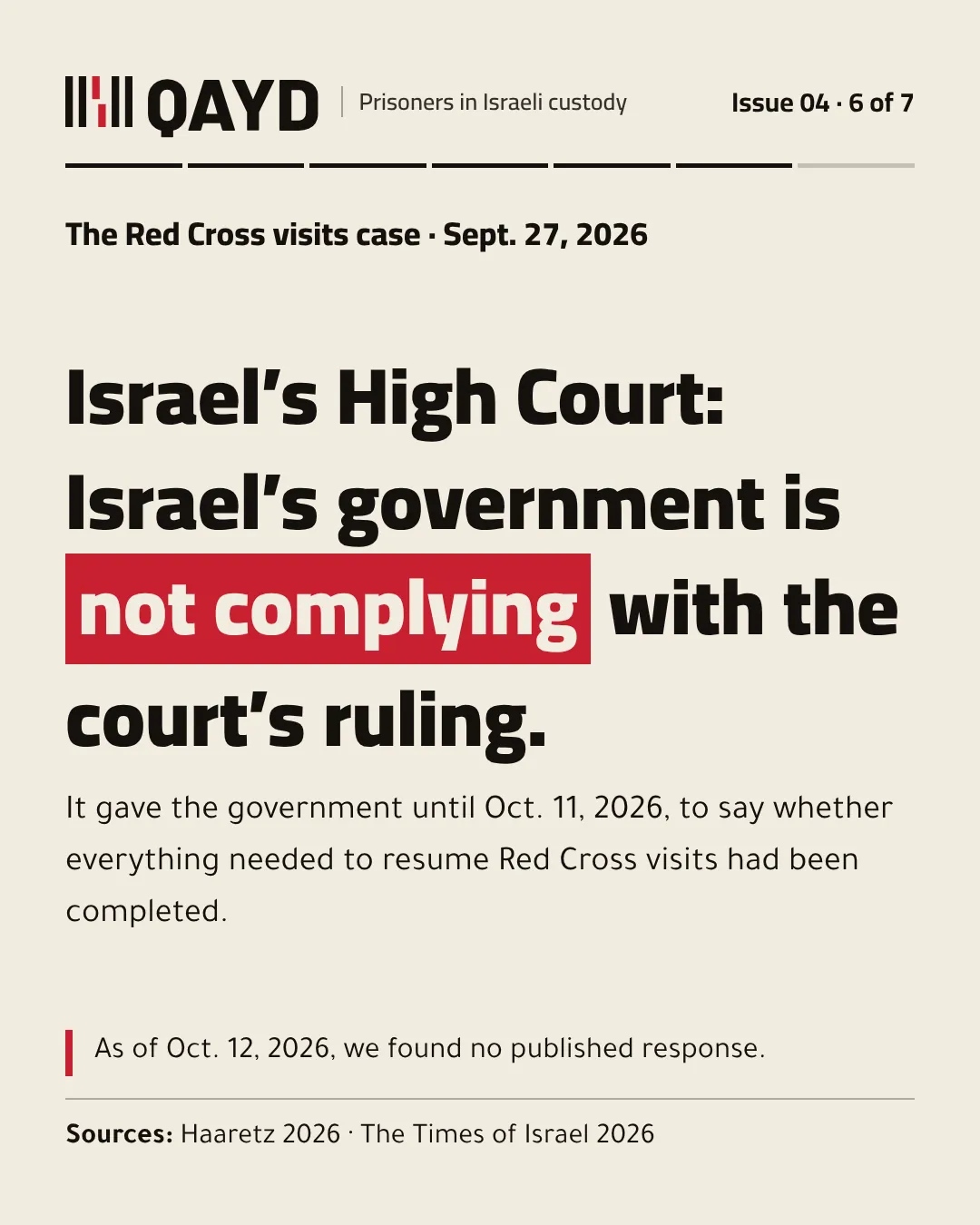
Israel’s High Court: Israel’s government is not complying with the court’s ruling.
It gave the government until Oct. 11, 2026, to say whether everything needed to resume Red Cross visits had been completed.
As of Oct. 12, 2026, we found no published response.
In detail
On Sept. 17, 2026, nearly four months after the ruling, four human rights groups led by the Association for Civil Rights in Israel asked Israel’s High Court to enforce it. They asked the court to order Prison Service Commissioner Kobi Yaakobi to resume the visits in line with international law, in the form they took before they were stopped on Oct. 7, 2023, Haaretz reported.
The operative meaning of the ruling is that the respondents [the state authorities named in the petition] are obligated to allow Red Cross visits to the detention facilities with due speed. More than three months have passed since the ruling.
Justices Yitzhak Amit, Noam Sohlberg and Daphne Barak-Erez, in Israel’s High Court decision of Sept. 27, 2026
On Sept. 27, Supreme Court President Yitzhak Amit, Deputy President Noam Sohlberg and Justice Daphne Barak-Erez found that the government was not complying with the ruling. Their decision answered the four groups’ request, which argued that the failure to comply was contempt of court. The justices told the government to clarify by Oct. 11 whether “all the necessary preparations have been completed,” in the words of The Times of Israel, and to update the court on any steps decided or already carried out.
The King–Crane Commissionreport 1919
To subject a people so minded to unlimited Jewish immigration, and to steady financial and social pressure to surrender the land, would be a gross violation of the principle just quoted, and of the peoples’ rights, though it kept within the forms of law.