Walid Ahmad, 17, from Silwad, died in Israel’s Megiddo prison in March 2025. The Israeli judge who closed the investigation into his death wrote that he was “apparently starved.” Since October 2023, 92 Palestinian prisoners whose identities have been made public have died in Israeli custody. More detainees died at Sde Teiman, a facility run by the army, than anywhere else. The army opened 57 investigations into detainee deaths, and by July 2026 none had led to an indictment.
This part reflects information available before publication on Oct. 12, 2026.
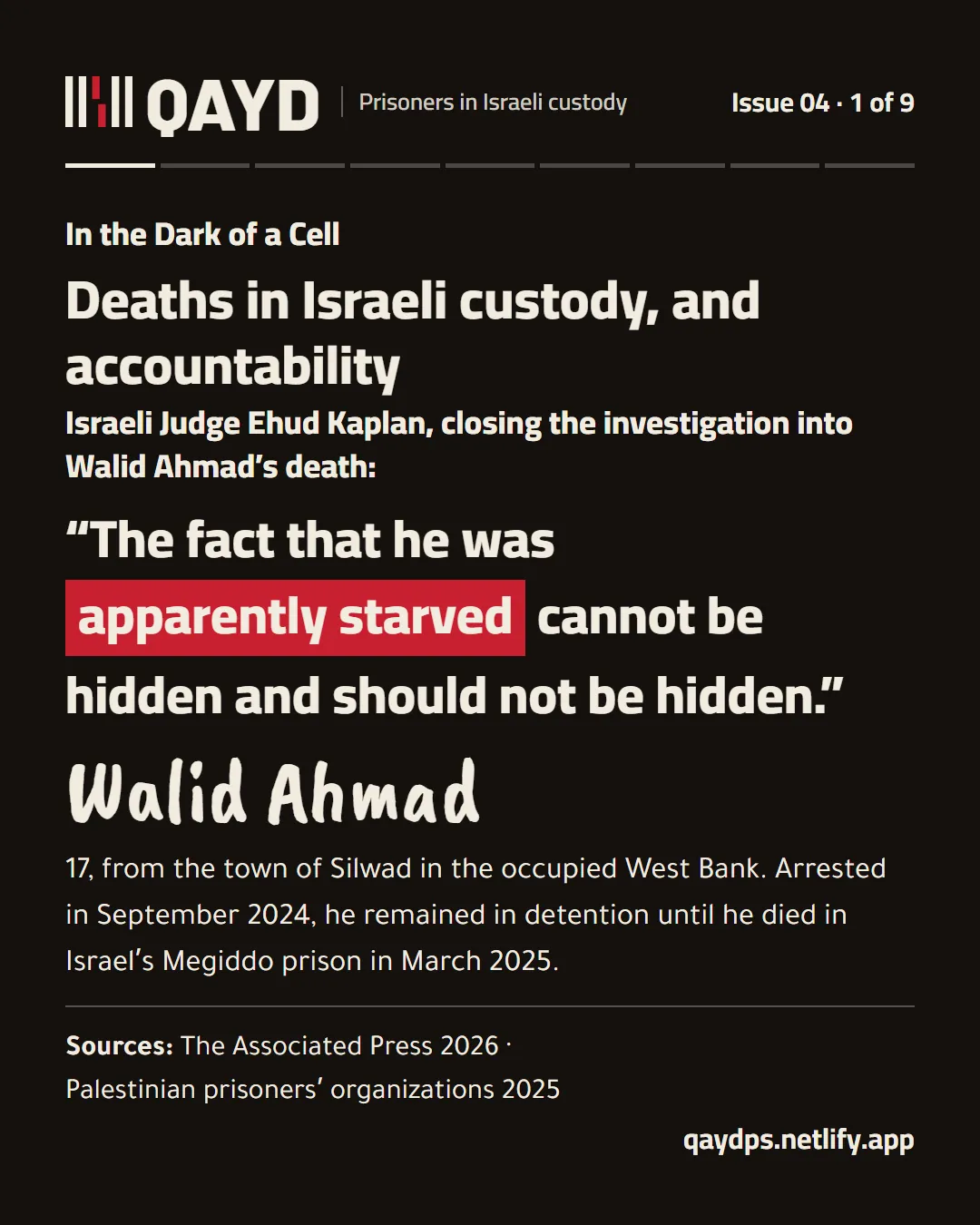
Israeli Judge Ehud Kaplan, closing the investigation into Walid Ahmad’s death
“The fact that he was apparently starved cannot be hidden and should not be hidden.”
Walid Ahmad, 17, from the town of Silwad in the occupied West Bank. Arrested in September 2024, he remained in detention until he died in Israel’s Megiddo prison in March 2025.
In detail
Haaretz shared the decision with The Associated Press, which published that line from it on March 25, 2026. Apart from that line, the AP reported, “the rest of the decision remains sealed.”
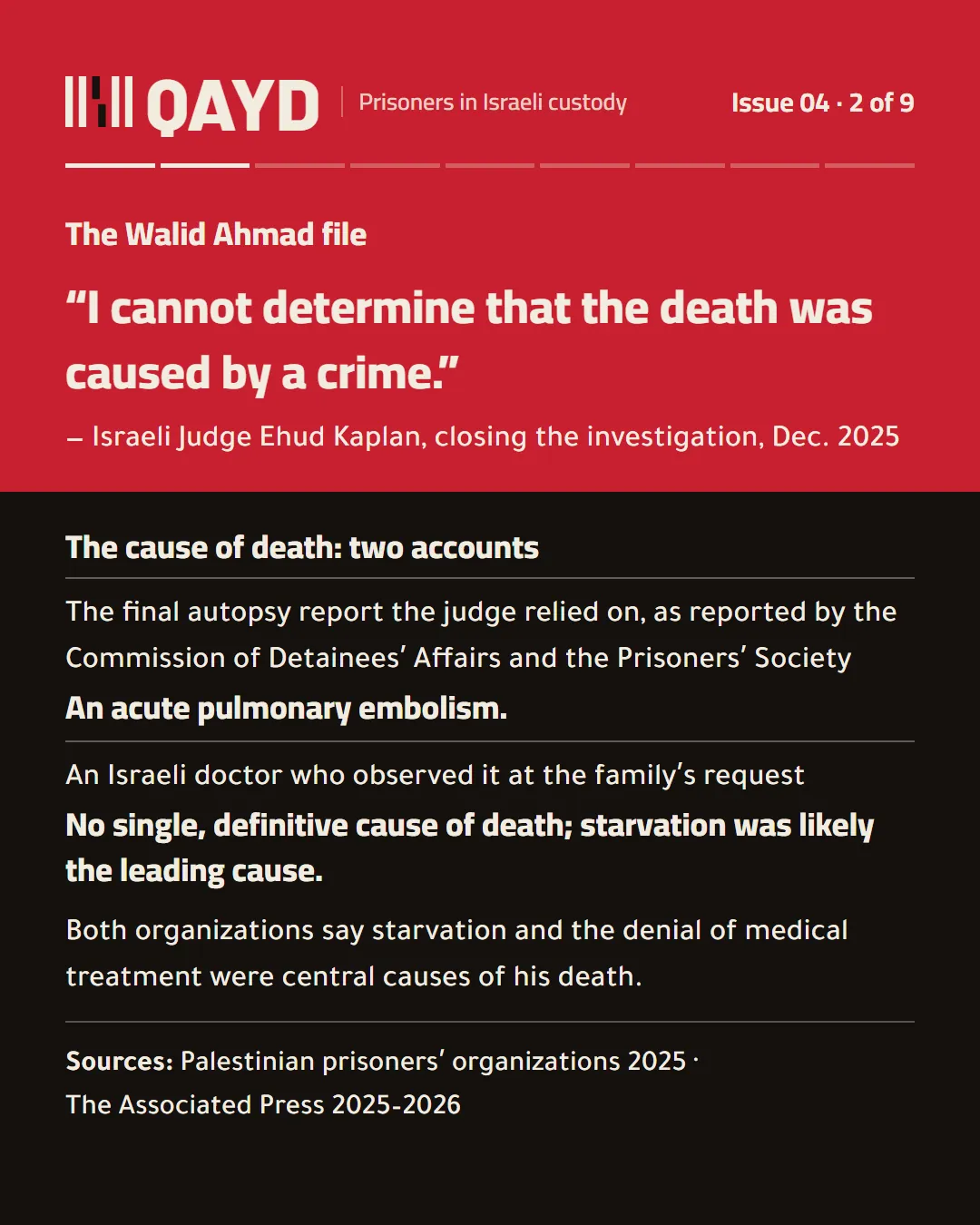
“I cannot determine that the death was caused by a crime.”
Israeli Judge Ehud Kaplan, closing the investigation, December 2025
The cause of death: two accounts.
The final autopsy report the judge relied on, as reported by the Commission of Detainees’ Affairs and the Prisoners’ Society: an acute pulmonary embolism.
An Israeli doctor who observed it at the family’s request: no single, definitive cause of death; starvation was likely the leading cause.
Both organizations say starvation and the denial of medical treatment were central causes of his death.
In detail
The full passage is longer: “But I cannot determine based on the findings of the expert report that there is a causal connection between his poor physical condition and his death, and therefore I cannot determine that the death was caused by a crime.” He went on: “Given this state of affairs, the investigation into his death is exhausted.”
The two organizations set out the chain of causes given in the final report: an acute pulmonary embolism caused by a blood clot, and a clot that resulted, “according to the occupation’s account,” from a “prolonged deterioration in health.” The decision rested on that report, they say, without addressing the effect of starvation and the deliberate denial of treatment. That effect, in their account, was confirmed by the initial medical report, prepared with a doctor from Physicians for Human Rights–Israel, and by the report of the Abu Kabir forensic institute.
The doctor in the second account is Daniel Solomon, a gastrointestinal surgeon. An Israeli civil court allowed him to observe the autopsy at the request of Walid’s family. In April 2025, the AP published his report, which it had obtained from the family: it did not conclude a cause of death, but said Walid was in a state of extreme weight loss and muscle wasting. In March 2026, the AP reported that Solomon wrote Walid “suffered from extreme malnutrition and also showed signs of inflammation of the colon and scabies,” and that he “likely suffered from colitis.”
The Israel Prison Service and the Israeli police did not respond to the AP’s requests for comment.
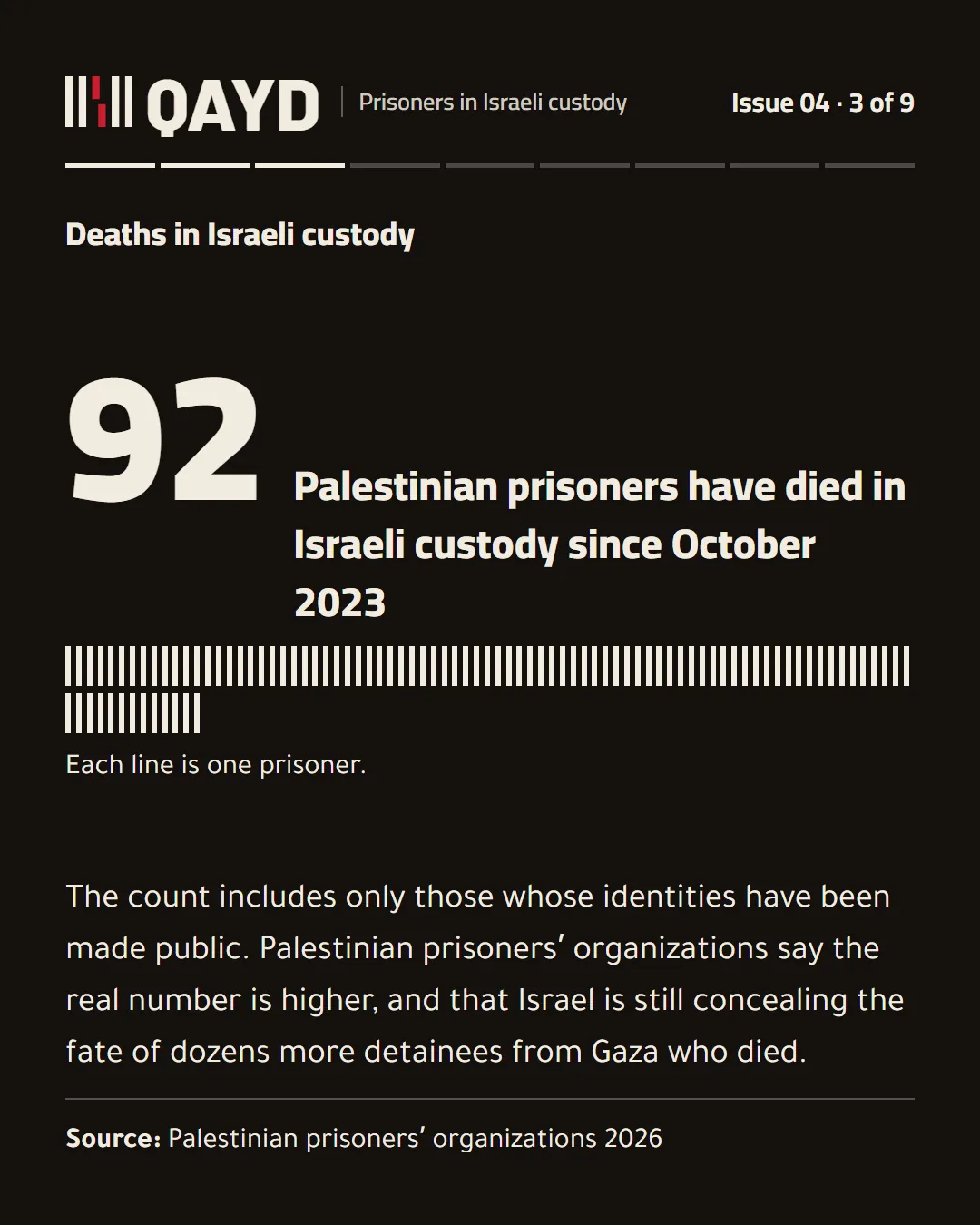
Palestinian prisoners have died in Israeli custody since October 2023.
The count includes only those whose identities have been made public. Palestinian prisoners’ organizations say the real number is higher, and that Israel is still concealing the fate of dozens more detainees from Gaza who died.
In detail
Of the 92, 53 were detainees from Gaza, the Palestinian Prisoners’ Society said in September 2026.
Dozens of martyred detainees from occupied Gaza remain subject to enforced disappearance.
Before the war, from 1967 to October 2023, 237 Palestinians died in Israeli custody, according to Amani Sarahneh of the Palestinian Prisoners’ Society, quoted by +972 Magazine in November 2025. The prisoners’ organizations, in their paper of Oct. 6, 2026, put the total since 1967 at 329. The two figures agree: 237 before the war plus 92 since add up to 329.
The same paper warns: “The figures presented here reflect only the minimum documented total.”
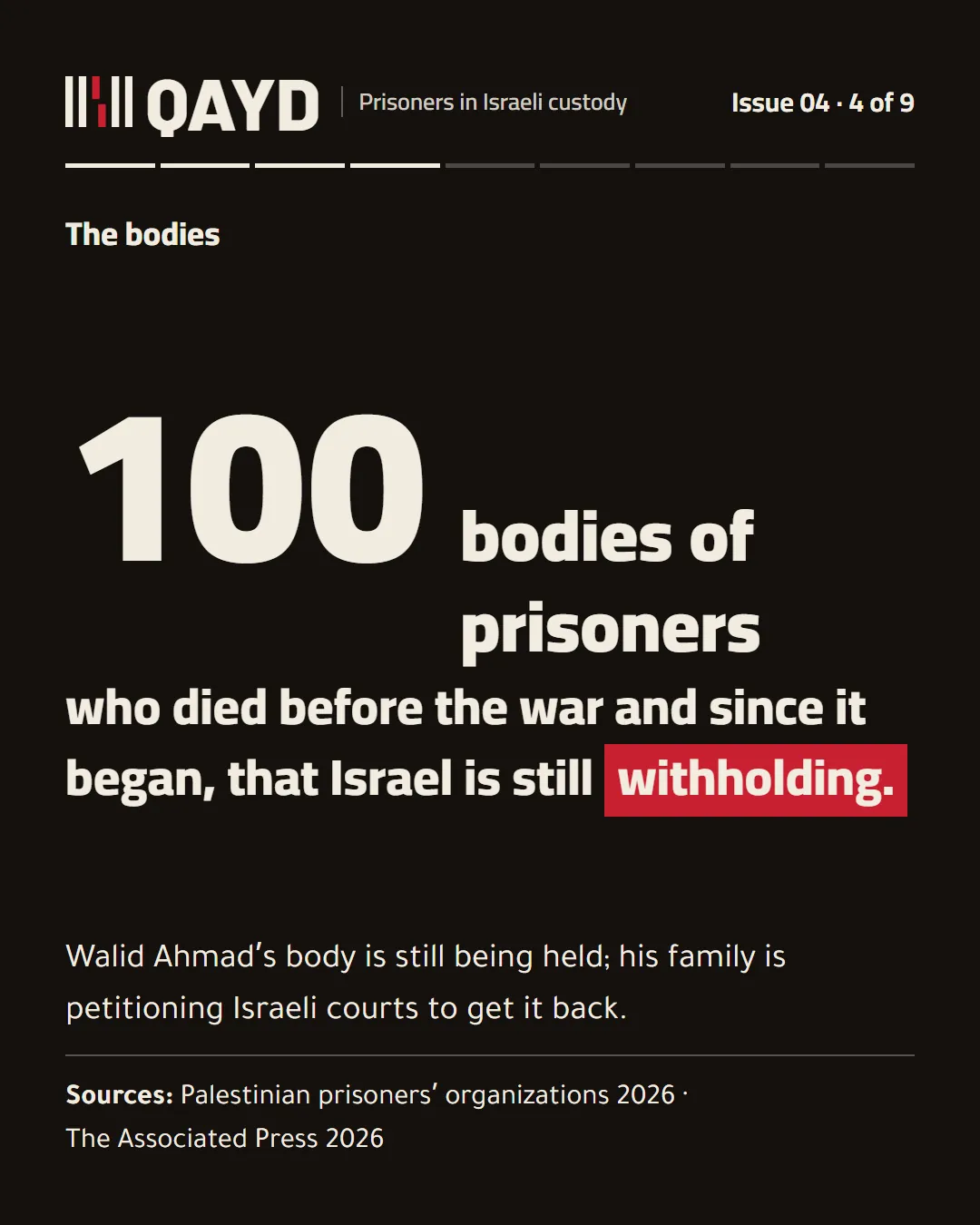
bodies of prisoners who died before the war and since it began, that Israel is still withholding.
Walid Ahmad’s body is still being held; his family is petitioning Israeli courts to get it back.
In detail
Of the 100 bodies, 89 are of prisoners who died after the war began, the Palestinian Prisoners’ Society said in September 2026. The other 11 are of prisoners who died before it.
The occupation continues to withhold the bodies of 100 Palestinian prisoners who were martyred in detention, both before and after the genocide.
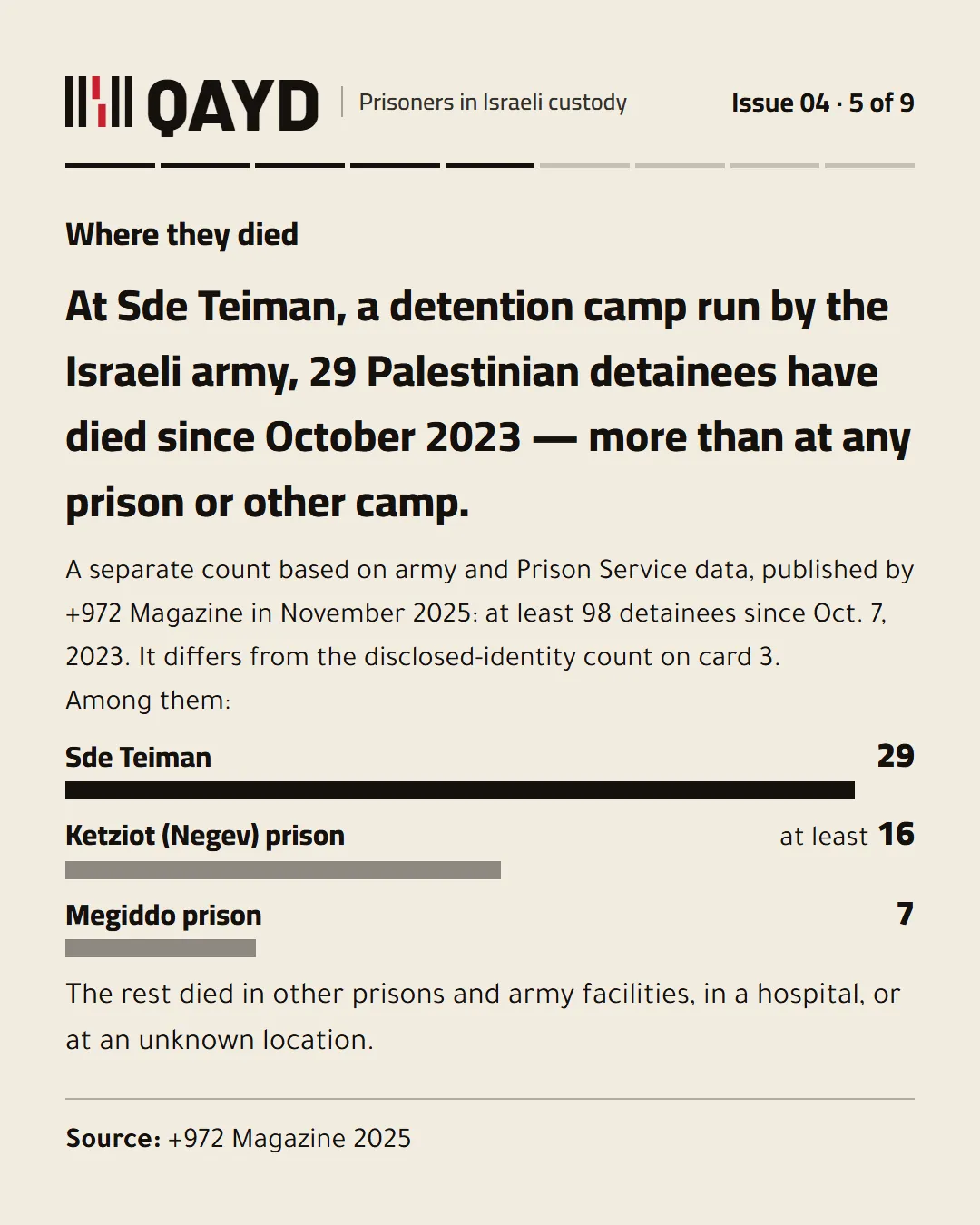
At Sde Teiman, a detention camp run by the Israeli army, 29 Palestinian detainees have died since October 2023 — more than at any prison or other camp.
A separate count based on army and Prison Service data, published by +972 Magazine in November 2025: at least 98 detainees since Oct. 7, 2023. It differs from the disclosed-identity count of 92. Among them: Sde Teiman, 29; Ketziot (Negev) prison, at least 16; Megiddo prison, 7.
The rest died in other prisons and army facilities, in a hospital, or at an unknown location.
In detail
The full breakdown comes from data gathered by Physicians for Human Rights–Israel. In Israel Prison Service prisons: al-Naqab (Ketziot), at least 16; Megiddo, 7; Nitzan and the Prison Service’s medical center together, at least 6; Ofer, at least 5; Nafha and Ramon together, 4; al-Jalama (Kishon), at least 3; Ashkelon (Shikma), 3; Eshel, at least 1. In army facilities: Sde Teiman, 29; Ofer Camp, at least 2; Anatot Camp, at least 1; other military facilities in southern Israel, at least 7. Five died at Soroka Hospital after being transferred from army facilities, and for eight the place of death is unknown. These figures add up to 97, not 98.
The two counts, 92 and 98, differ in source and definition. The 92 are the prisoners whose identities have been made public. Of the 98, 94 come from data that Physicians for Human Rights–Israel obtained from the army and the Prison Service, including at least 68 detainees from Gaza who died through the end of August 2025. At least four more died after that, according to +972.
In September 2024, the Israeli rights group HaMoked wrote that, as far as it knew, more than 1,000 detainees had been held at Sde Teiman in pen-like structures, without beds. On Sept. 18, 2024, ruling on a petition about the camp, Israel’s High Court held that Israel must run it in accordance with the law.
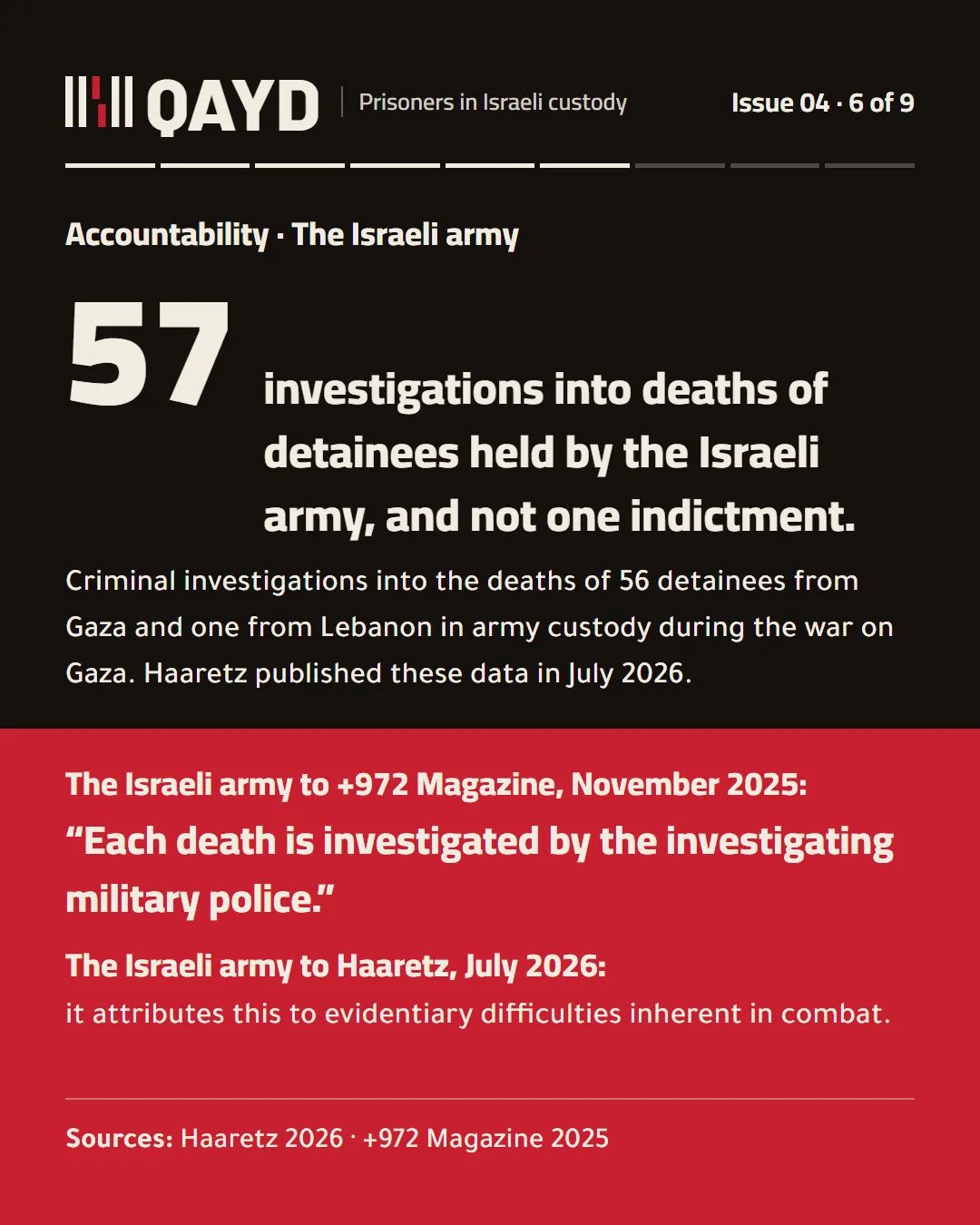
investigations into deaths of detainees held by the Israeli army, and not one indictment.
Criminal investigations into the deaths of 56 detainees from Gaza and one from Lebanon in army custody during the war on Gaza. Haaretz published these data in July 2026.
In detail
Haaretz journalist Bar Peleg reported the figures on July 17, 2026. The paper gives no cutoff date for the data. None of the investigations had led to an indictment by the day the report came out.
The Sde Teiman case covered in Part 7 of this issue is not one of these investigations: it concerns the abuse of a detainee, not a death.
The Israeli army told +972 Magazine in November 2025 that “each death is investigated by the investigating military police,” and pointed to “detainees who arrived injured or in a pre-existing complex medical condition.” To Haaretz, in July 2026, the army said it acts in accordance with international law, and attributed the absence of indictments to evidentiary difficulties inherent in combat.
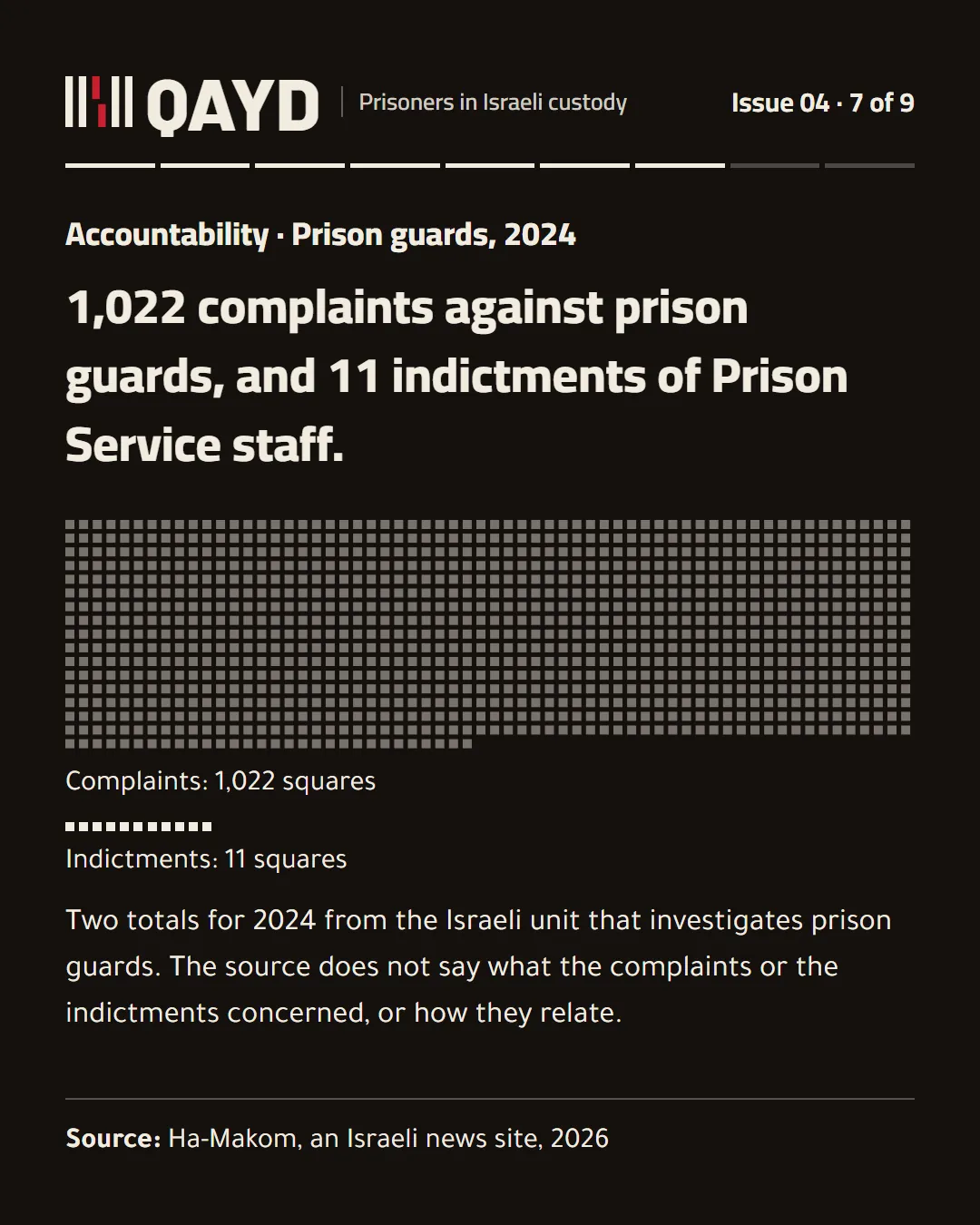
complaints against prison guards, and 11 indictments of Prison Service staff.
Two totals for 2024 from the Israeli unit that investigates prison guards. The source does not say what the complaints or the indictments concerned, or how they relate.
In detail
In 2025, according to the same source, the unit received 772 complaints, and five indictments were filed against Israel Prison Service staff.
The unit is the National Unit for the Investigation of Prison Guards, known by its Hebrew acronym, Yahas. It sits within Lahav 433, the Israel Police’s major-crimes unit, according to the Israeli news site Ha-Makom and a statement from Israel’s State Attorney’s Office. Ha-Makom published the figures on Sept. 2, 2026.
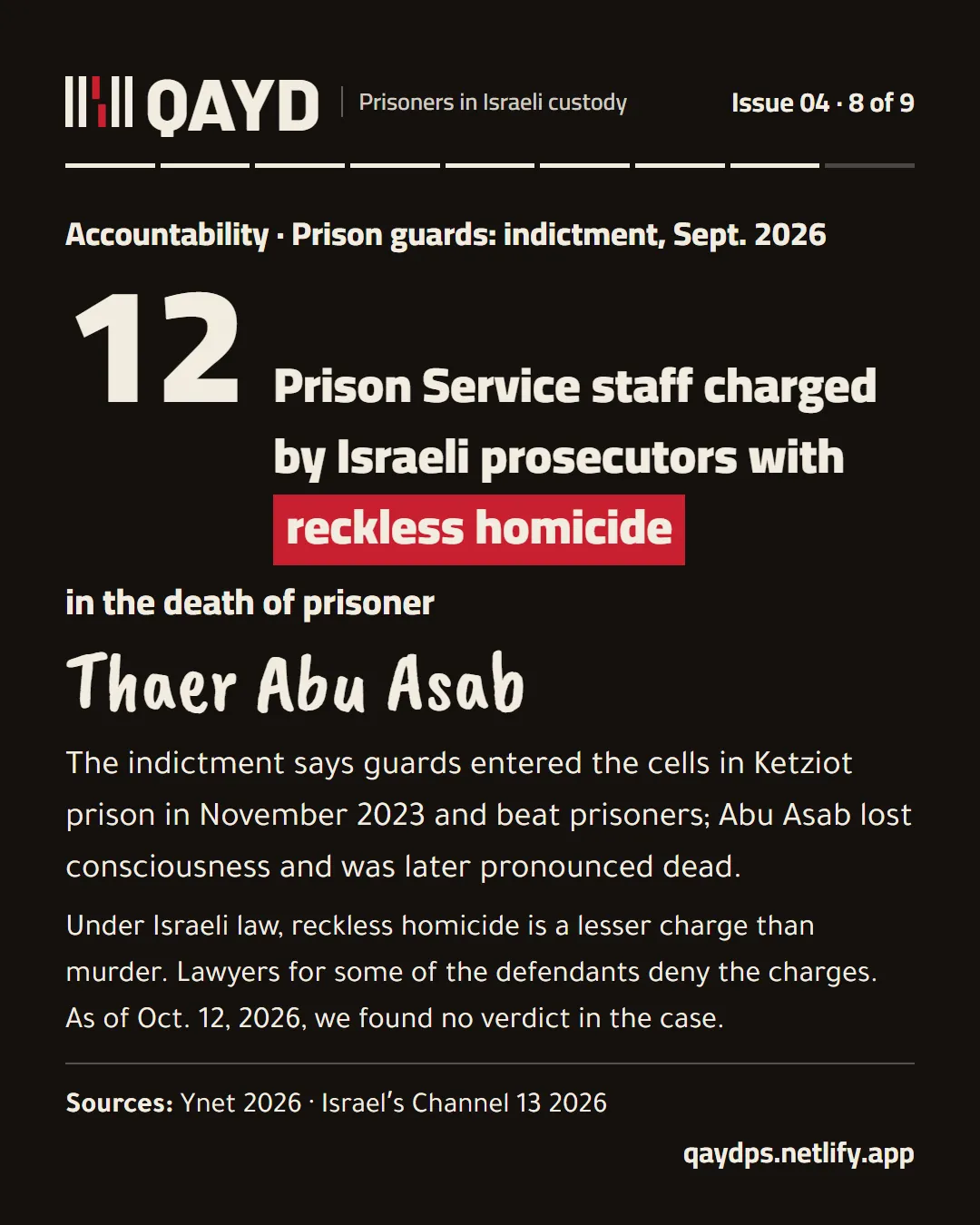
Accountability · Prison guards: indictment, September 2026
12
Prison Service staff charged by Israeli prosecutors with reckless homicide in the death of prisoner Thaer Abu Asab.
The indictment says guards entered the cells in Ketziot prison in November 2023 and beat prisoners; Abu Asab lost consciousness and was later pronounced dead.
Under Israeli law, reckless homicide is a lesser charge than murder. Lawyers for some of the defendants deny the charges. As of Oct. 12, 2026, we found no verdict in the case.
In detail
The Southern District Prosecutor’s Office filed the indictment with the Beersheba District Court on Sept. 1, 2026. According to the indictment, the incidents took place in Naqab prison on Nov. 18, 2023: the shift commander ordered the guards into the cells, where together they beat prisoners with punches, kicks and batons.
The indictment also carries two further charges, according to the Israeli news site Mako: aggravated grievous bodily harm, and aggravated actual bodily harm.
Efraim Damari, a lawyer for some of the defendants: “My clients categorically reject what is attributed to them, deny the facts of the indictment and maintain their innocence.” Samer Ali, also a lawyer for some of the defendants: “The facts stated in the indictment are inaccurate and contain a great deal of distortion.” (Israel’s Channel 13, Sept. 23, 2026)
Yitzhak EpsteinA Hidden Question 1907
[…] But one trifling matter we have forgotten: that in our beloved land there is an entire people that has clung to it for hundreds of years and has never thought of leaving it.