“Zaid” was 15 when he was arrested, and he spent most of his detention in Israel’s Megiddo prison, where, he says, one plate of rice came for 10 prisoners. In September 2026, Israeli prisons held more than 350 Palestinian children, nearly double the prewar number. A 2024 Israeli law lets judges sentence children as young as 12 to prison for murder or attempted murder defined as terrorism, and solitary confinement of children rose from one case in 2022 to 199 in 2024. In Damon prison, women prisoners get one hour a day outside their cells; in the clinic at Ramla prison, prisoners with chronic illnesses were held permanently.
This part reflects information available before publication on Oct. 10, 2026.
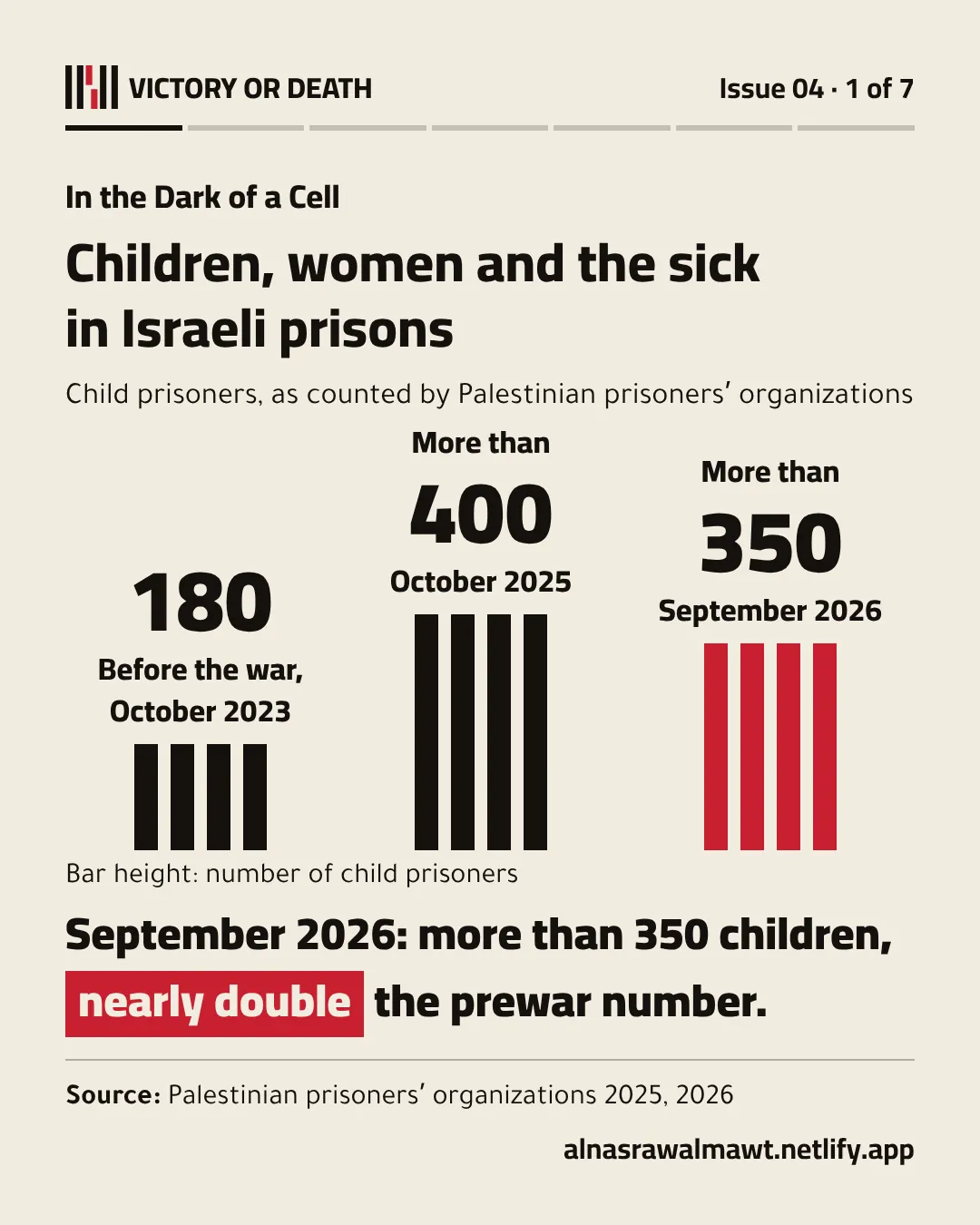
Children, women and the sick in Israeli prisons — child prisoners, as counted by Palestinian prisoners’ organizations
More than 350
September 2026: more than 350 children, nearly double the prewar number.
180 before the war, October 2023 · more than 400 in October 2025 · more than 350 in September 2026.
In detail
All three figures come from joint statements by the Palestinian prisoners’ organizations. On Oct. 8, 2025, they said Israeli prisons had held around 5,250 prisoners before the war, 180 of them children, and that “the number of child prisoners is more than 400, held in Ofer and Megiddo prisons.” On Sept. 16, 2026, they put the number at more than 350, in the same two prisons.
At a news conference in al-Bireh on Oct. 6, 2026, the organizations gave the figure as 350, without the “more than.” Arrests of children in the occupied West Bank, they said, had passed 2,000 “since the start of the genocide.” On Oct. 10, 2026, the Palestinian Prisoners’ Society counted “no fewer than 350” children, held in Ofer, Megiddo and Damon prisons.
The Israel Prison Service keeps its own count. At the end of June 2026, it was holding 376 Palestinians under 18 on “security grounds,” according to the Israeli rights group B’Tselem, as cited by +972 Magazine. “Security” is the Prison Service’s own classification.
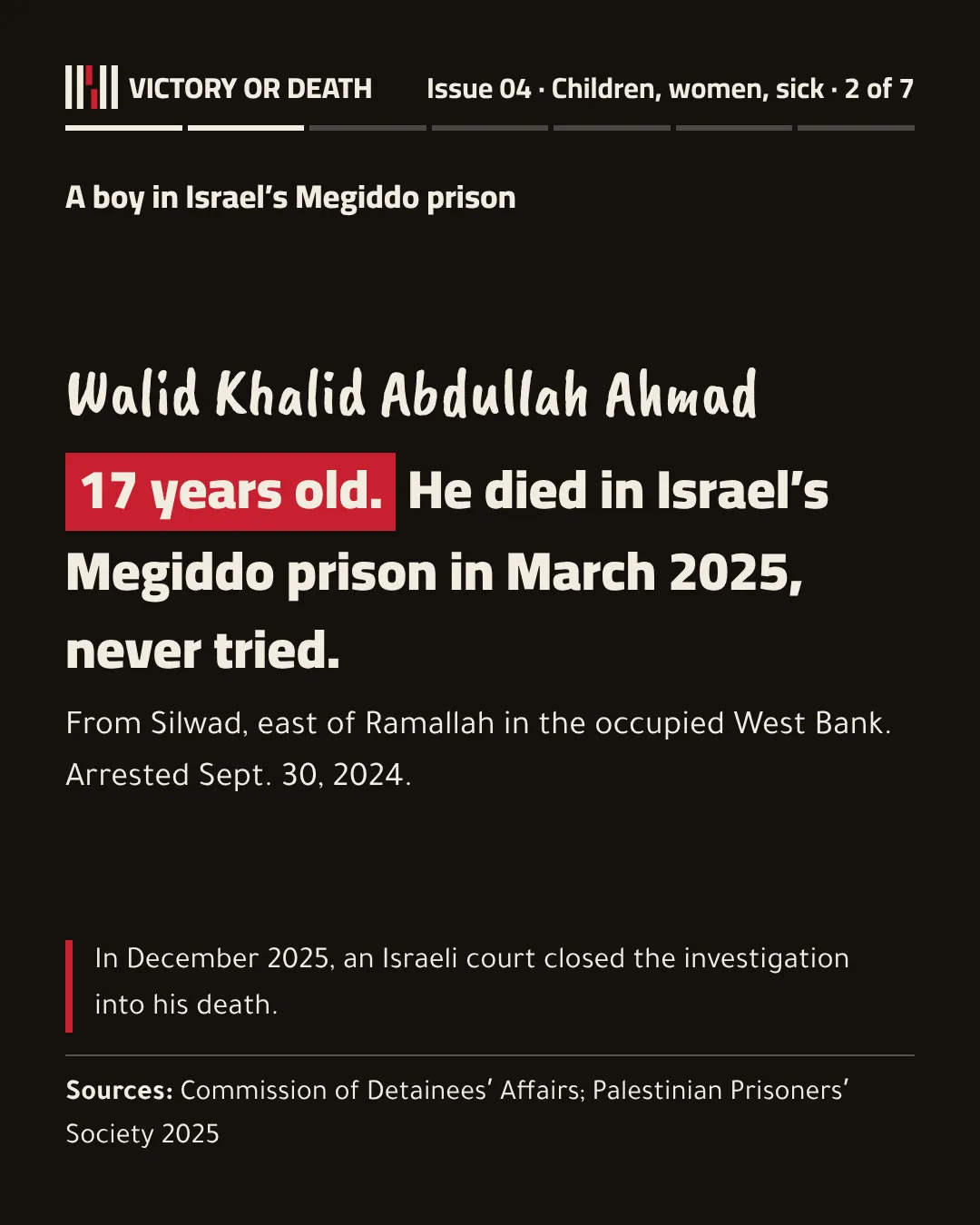
17 years old. He died in Israel’s Megiddo prison in March 2025, never tried.
From Silwad, east of Ramallah in the occupied West Bank. Arrested Sept. 30, 2024.
In December 2025, an Israeli court closed the investigation into his death.
In detail
Shortly after midnight on March 24, 2025, the Palestinian General Authority of Civil Affairs informed the Commission of Detainees’ Affairs and the Palestinian Prisoners’ Society of his death. He had been held since Sept. 30, 2024, and had never been sentenced. The two groups said that day that they had not been able to confirm how he died.
+972 Magazine wrote on Sept. 30, 2026, that “to date, he is the only Palestinian minor known to have died in Israeli custody.” Abdel Nasser Farawneh, who heads the studies and documentation unit at the Commission of Detainees’ Affairs, said on April 5, 2026, that “the list of martyrs of the prisoners’ movement has not been without children,” and that Walid was the latest to join them. Part 8 of this issue covers the investigation into his death and the autopsy.
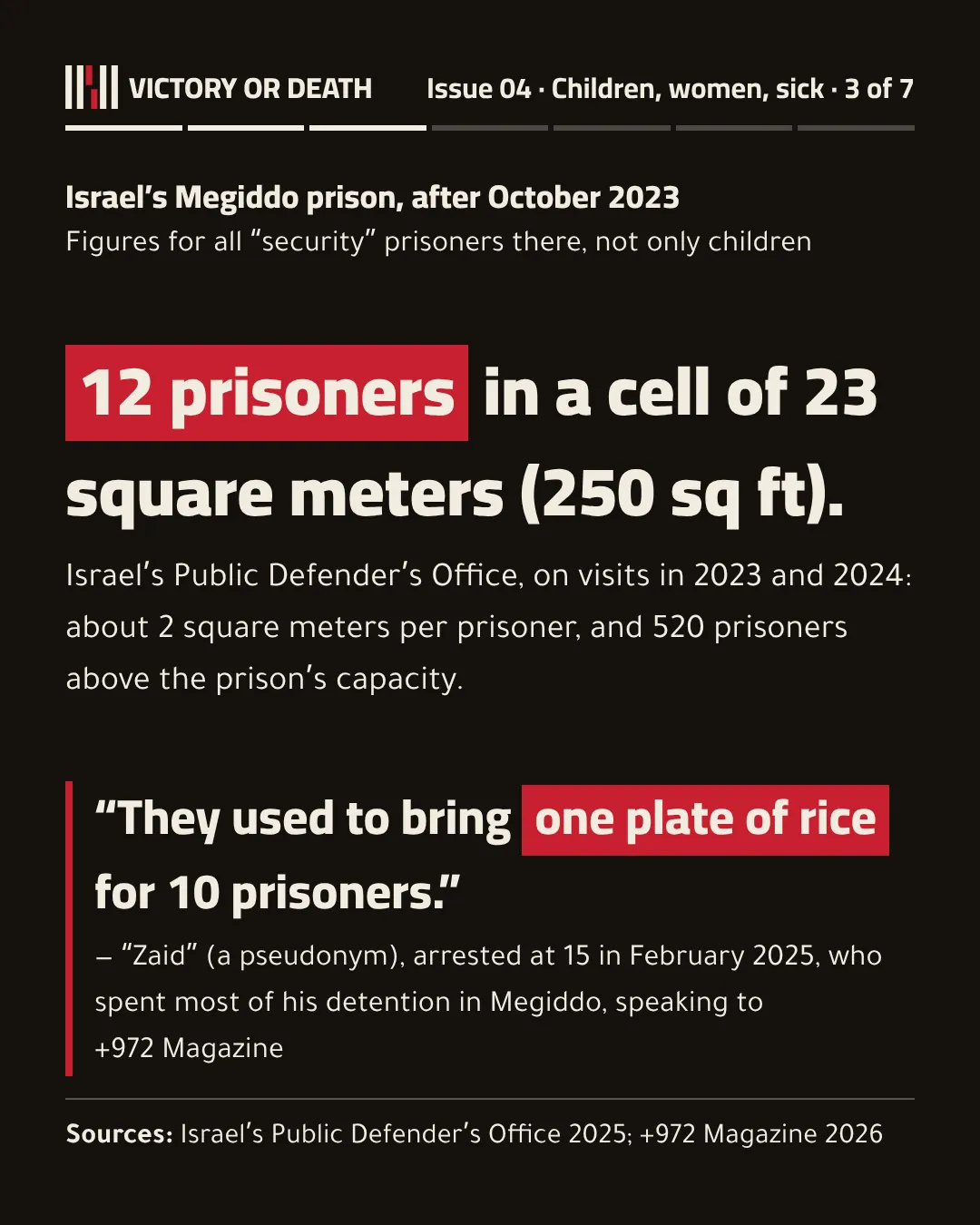
Israel’s Megiddo prison, after October 2023 — figures for all “security” prisoners there, not only children
12
prisoners in a cell of 23 square meters (250 sq ft).
Israel’s Public Defender’s Office, on visits in 2023 and 2024: about 2 square meters per prisoner, and 520 prisoners above the prison’s capacity.
“They used to bring one plate of rice for 10 prisoners.” — “Zaid” (a pseudonym), arrested at 15 in February 2025, who spent most of his detention in Megiddo, speaking to +972 Magazine
In detail
Israel’s Public Defender’s Office is a state body that inspects prisons. Its 17th report on detention conditions covers 2023 and 2024, and the Hebrew news site Ha-Makom published its contents on Dec. 5, 2025. Visits to Gilboa, Ramon, Megiddo and al-Naqab (Ketziot) prisons, and to the “security” wings at Ayalon, Shata, Eshel and the Russian Compound (al-Moscobiyeh), produced “a harsh and uniform picture,” in Ha-Makom’s description of the report.
The Megiddo figures appear in the report’s section on “security” prisoners since the war. Ha-Makom’s text does not give the date of the Megiddo visit. The report also found “drastic weight loss and signs of malnutrition,” The Times of Israel wrote.
“Zaid” is the name +972 Magazine gave the boy to protect him. “At 15, Zaid was separated from his parents, beaten, and starved,” it wrote.
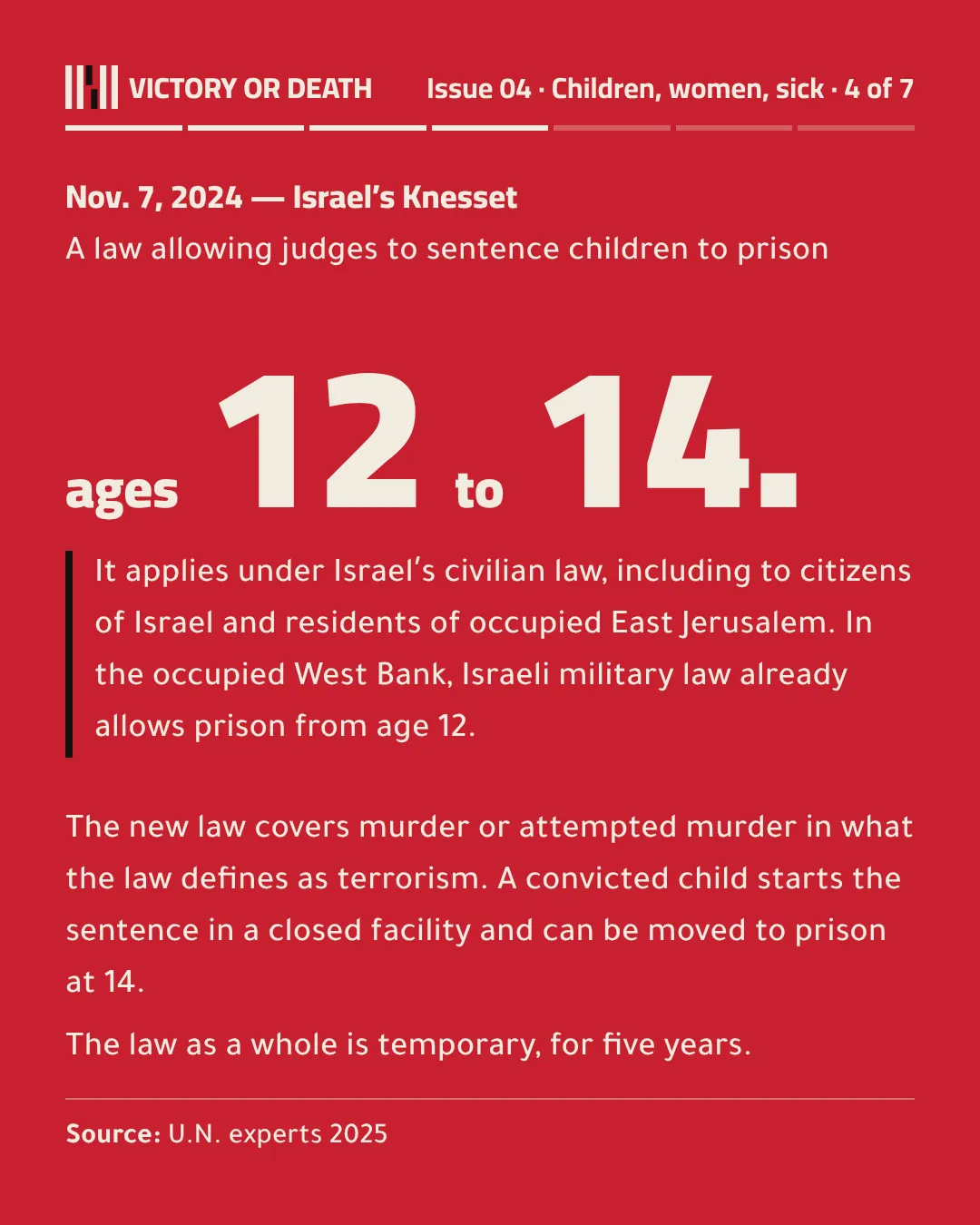
A law allowing judges to sentence children to prison: ages 12 to 14.
It applies under Israel’s civilian law, including to citizens of Israel and residents of occupied East Jerusalem. In the occupied West Bank, Israeli military law already allows prison from age 12.
The new law covers murder or attempted murder in what the law defines as terrorism. A convicted child starts the sentence in a closed facility and can be moved to prison at 14.
The law as a whole is temporary, for five years.
In detail
The Knesset passed the law 55-33 in a vote overnight on Nov. 6–7, 2024, The Times of Israel reported. U.N. experts, in a formal communication to Israel dated May 1, 2025, refer to it as Amendment No. 25 to Israel’s Youth Law.
Under the law, the U.N. experts wrote, “minors as young as 12 years old may be placed in a secure facility and can then be transferred to adult prison upon turning 14 years old.” A separate provision, temporary for three years only, lets the court move a child from the closed facility to prison for up to 10 days if it believes the child poses a threat to others. “In the event of repeated instances, the court can keep the minor in prison for a duration determined by the judge.”
The Times of Israel wrote that “an identical law that was passed in 2016 following a series of attacks carried out by teenagers and other minors expired in 2020.” The paper also lists manslaughter among the crimes the law covers. Manslaughter appears neither in the U.N. experts’ communication nor in the account of Adalah, the legal rights center that followed the law.
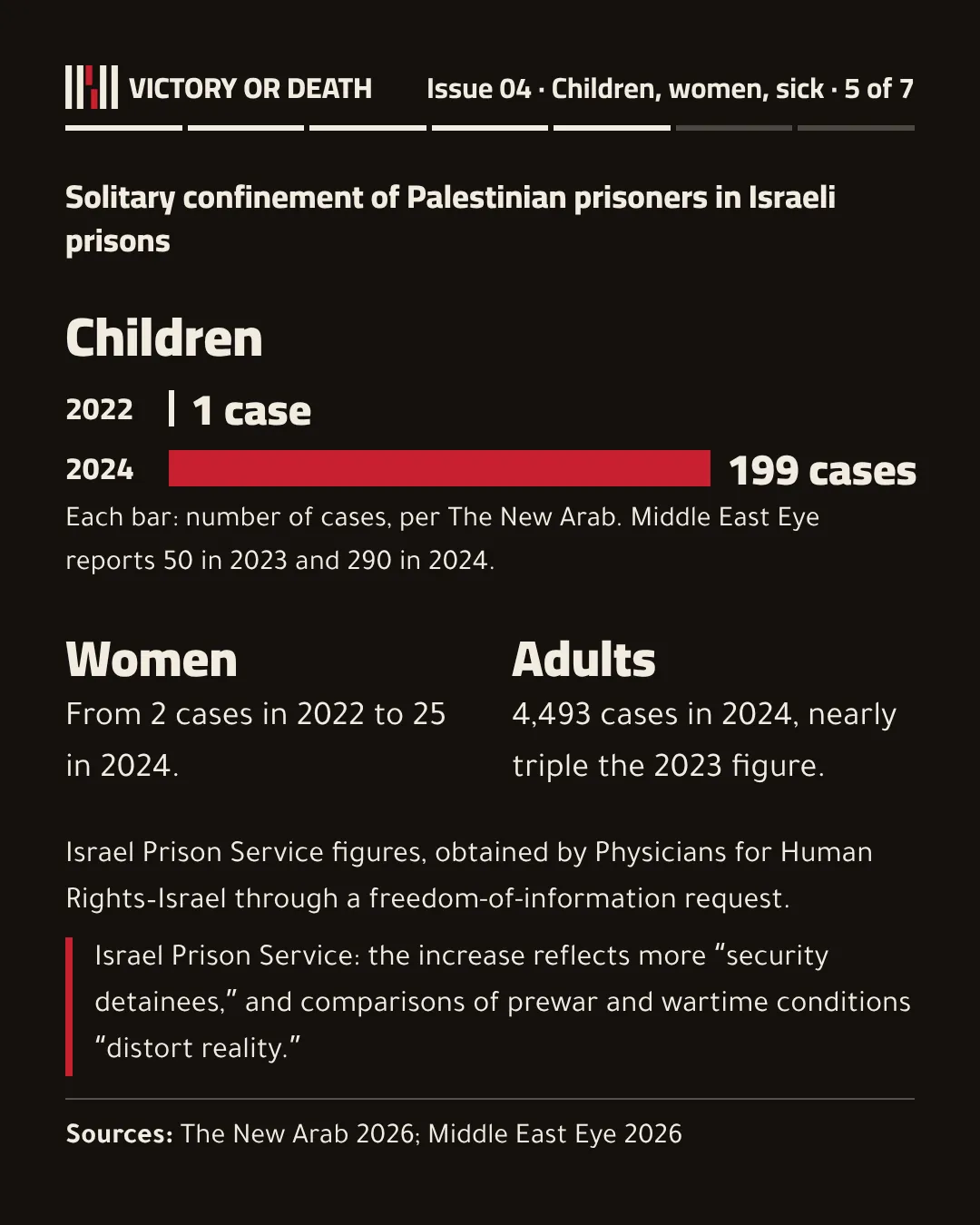
Solitary confinement of Palestinian prisoners in Israeli prisons
199
Children: 1 case in 2022, 199 cases in 2024.
The children’s figures are from The New Arab. Middle East Eye reports 50 in 2023 and 290 in 2024.
Women: from 2 cases in 2022 to 25 in 2024.
Adults: 4,493 cases in 2024, nearly triple the 2023 figure.
Israel Prison Service figures, obtained by Physicians for Human Rights–Israel through a freedom-of-information request.
Israel Prison Service: the increase reflects more “security detainees,” and comparisons of prewar and wartime conditions “distort reality.”
In detail
Haaretz published the figures first, on May 14, 2026, in a report by Nir Hasson. Its subheadline says punitive isolation of minors rose “from 1 case in 2022 to 199 in 2024.” The same day, Middle East Eye reported on the same data that “the number of minors transferred to solitary confinement rose from one in 2022 to 50 in 2023, before spiking significantly to 290 in 2024.” On May 15, The New Arab gave 199. None of the three explained the gap.
In the wording of Haaretz and The New Arab, the figures count cases, not people. Haaretz described the expansion as targeting Palestinian inmates; Middle East Eye wrote that “most cases involve Palestinians.” Both outlets give the same figures for women, from two to 25, and for adults, 4,493 in 2024.
We could not find the original Physicians for Human Rights–Israel report with these figures on the group’s website (as of Oct. 10, 2026).
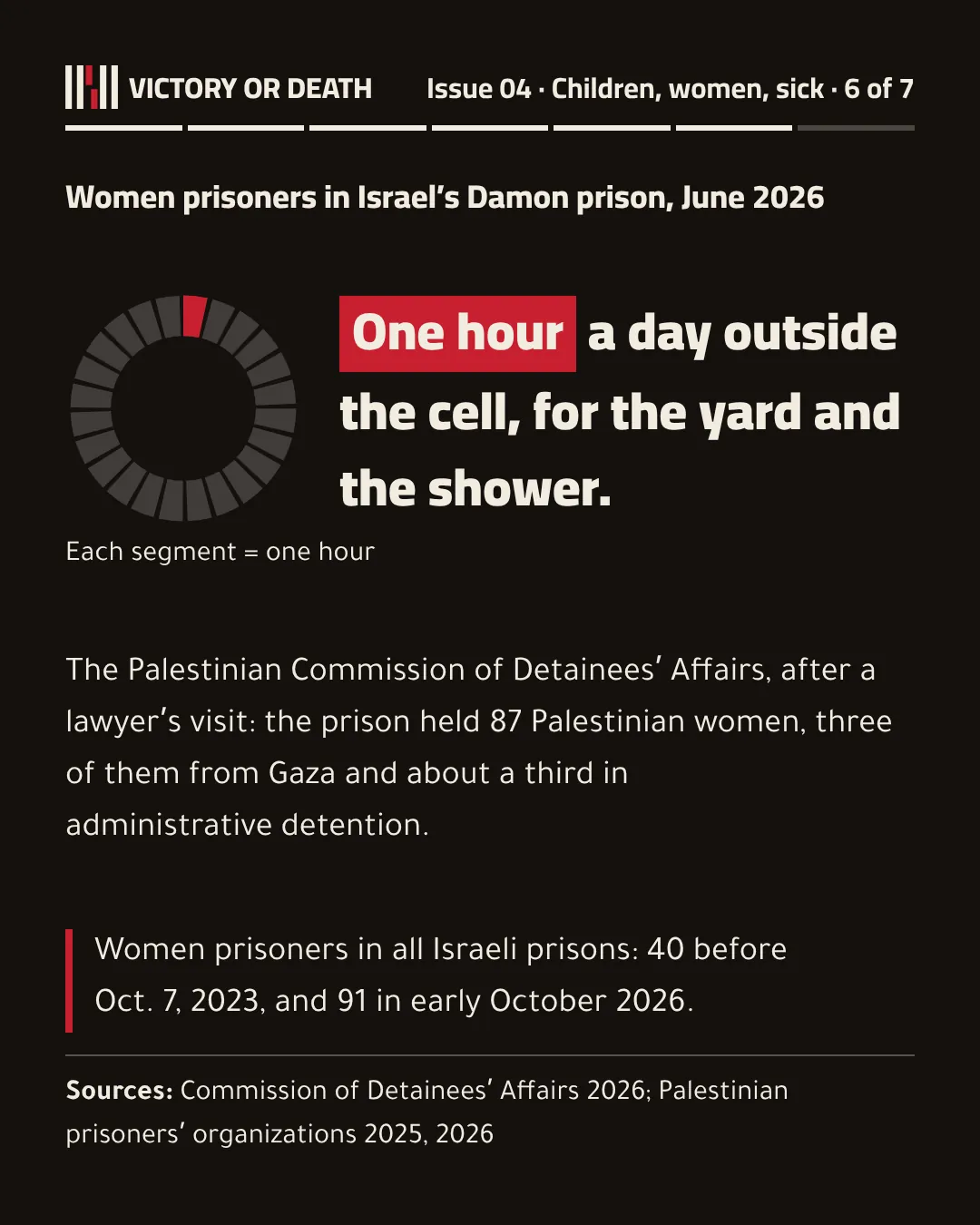
Women prisoners in Israel’s Damon prison, June 2026
One hour a day outside the cell, for the yard and the shower.
The Palestinian Commission of Detainees’ Affairs, after a lawyer’s visit: the prison held 87 Palestinian women, three of them from Gaza and about a third in administrative detention.
Women prisoners in all Israeli prisons: 40 before Oct. 7, 2023, and 91 in early October 2026.
In detail
The Commission of Detainees’ Affairs issued its statement on June 23, 2026, after its lawyer visited the prison. In WAFA’s English report, “the women are allowed only one hour per day outside their cells for recreation and showering.” The Arabic statement calls that hour al-fora, the prisoners’ word for their time out in the yard.
The number of women prisoners across all prisons shifts from week to week in the prisoners’ organizations’ figures: 90 in early September 2026, then 88 on Sept. 20, 21 of them in administrative detention, then 91 in early October. The statement of Sept. 20 said 35 of the women prisoners were mothers.
On Oct. 7, 2026, the prisoners’ rights group Addameer said Bushra al-Tawil, one of the women held in Damon, had been moved to an isolation section in Beersheba “after 46 days of continuous isolation” that began in Damon.
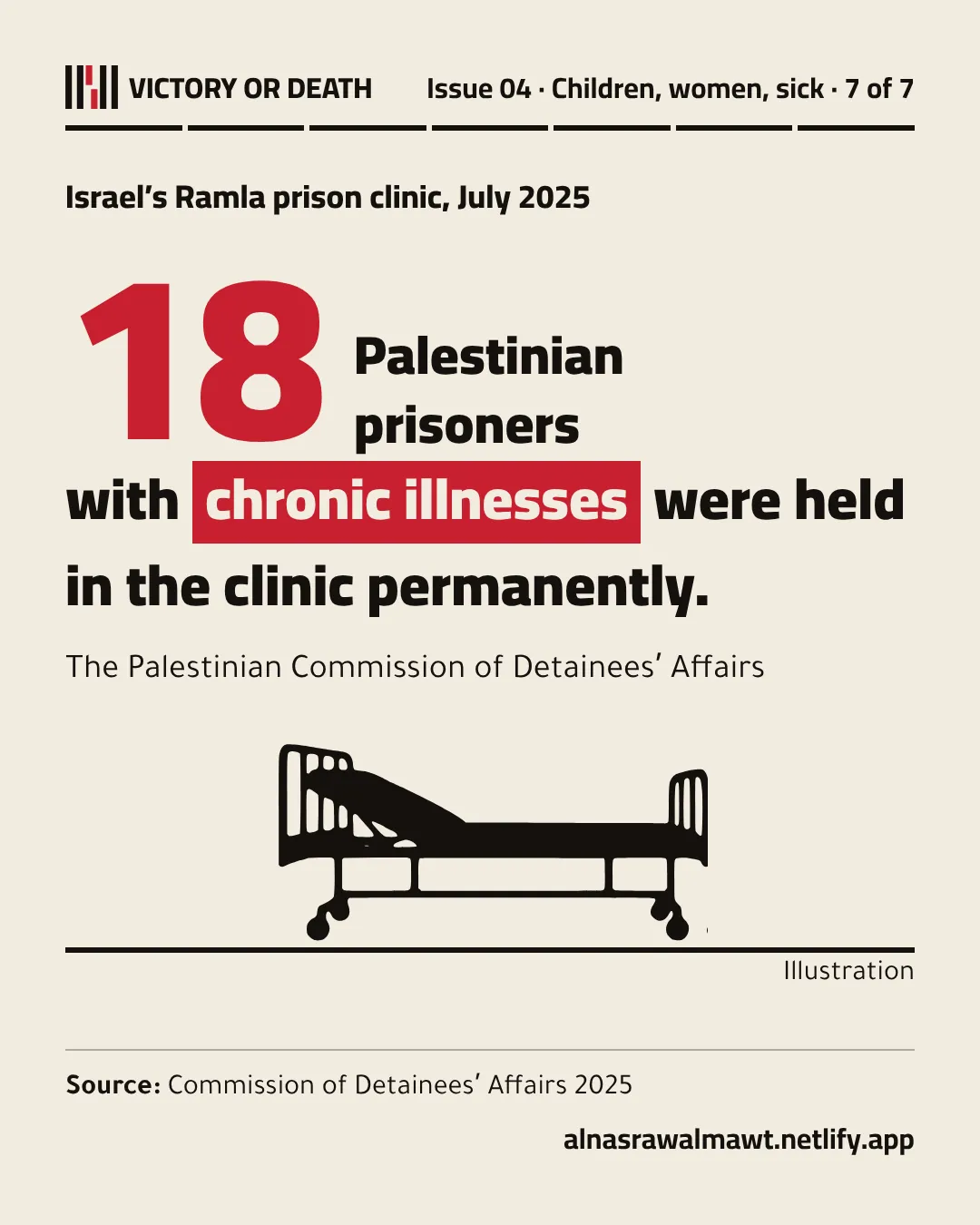
Palestinian prisoners with chronic illnesses were held in the clinic permanently.
The Palestinian Commission of Detainees’ Affairs
In detail
The figure comes from a statement by the Commission of Detainees’ Affairs on July 21, 2025. WAFA’s English report put it this way: “18 prisoners with chronic illnesses are held permanently in the Ramleh clinic.” The Al-Quds newspaper carried the same statement in Hebrew without the word “chronic”: 18 sick prisoners are hospitalized permanently in the prison clinic.
In the Al-Quds version, the statement describes a lack of intensive medical follow-up. It says the prison administration drags its feet in moving sick and wounded prisoners to civilian hospitals, and sends them back to the clinic before their necessary treatment is complete.
We found no report later than July 2025 with an updated count of patients in the clinic (as of Oct. 10, 2026).
Ibn Hamdisfrom a poem of longing for Sicily
If I was driven out of a paradise, I tell its stories.