Ibrahim Fuda saw an Israeli judge over Skype for three minutes; then his detention was extended until the end of the war, as an “unlawful combatant.” Israel holds 1,419 people under that law as of October 2026, and a detainee can wait weeks before seeing a judge or a lawyer. Another Israeli law now requires most hearings for “security” prisoners to be held by video. Since May 2026, death by hanging has been the default punishment, in The Times of Israel’s words, for residents of the occupied West Bank convicted by Israeli military courts of “deadly terrorist acts.” A separate law has set up a special military court for those accused over the “October 7 attack.”
This part reflects information available before publication on Oct. 11, 2026.
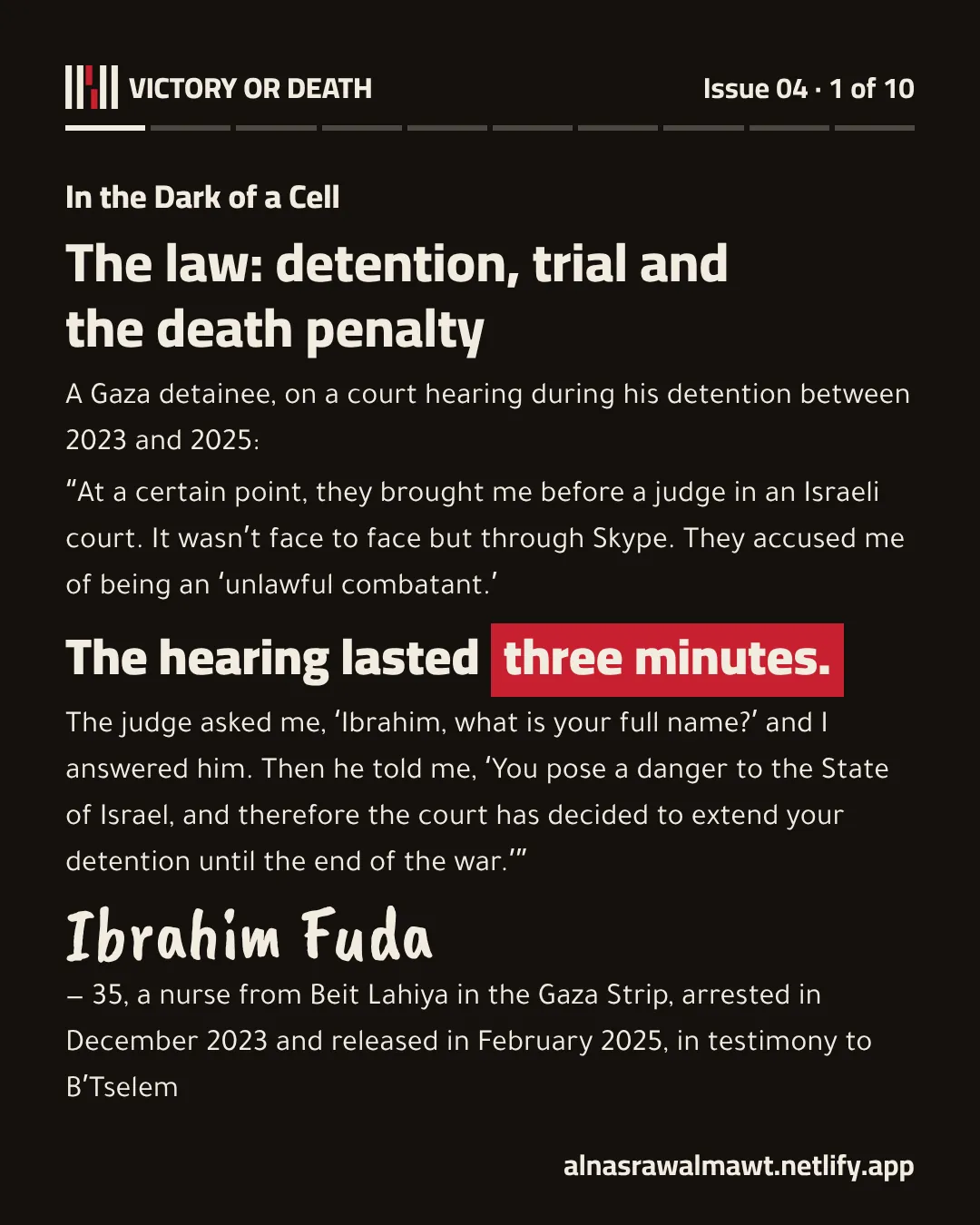
The law: detention, trial and the death penalty — a Gaza detainee, on a court hearing during his detention between 2023 and 2025
3 minutes
“The hearing lasted three minutes.”
Ibrahim Fuda, 35, a nurse from Beit Lahiya in the Gaza Strip, arrested in December 2023 and released in February 2025, in testimony to B’Tselem
“At a certain point, they brought me before a judge in an Israeli court. It wasn’t face to face but through Skype. They accused me of being an ‘unlawful combatant.’ The hearing lasted three minutes. The judge asked me, ‘Ibrahim, what is your full name?’ and I answered him. Then he told me, ‘You pose a danger to the State of Israel, and therefore the court has decided to extend your detention until the end of the war.’”
In detail
“I worked as a technical nurse in the operating room at al-Awda Hospital,” Ibrahim Fuda told B’Tselem. On Feb. 14, 2025, a Red Cross delegation arrived at the prison, and he was released that same month.
I met once with a lawyer from a human rights organization who came to the prison and asked me about my condition.
Ibrahim Fuda, in testimony to B’Tselem
“Before I was arrested, I weighed 87 kilograms,” he said. “During my detention I lost 25 kilograms.”
B’Tselem, an Israeli rights group, took his testimony through its field researcher Muhammad Sabah on Oct. 9, 2025. It appeared in January 2026 in the group’s report “Living Hell,” among new testimonies from 21 released Palestinian prisoners.
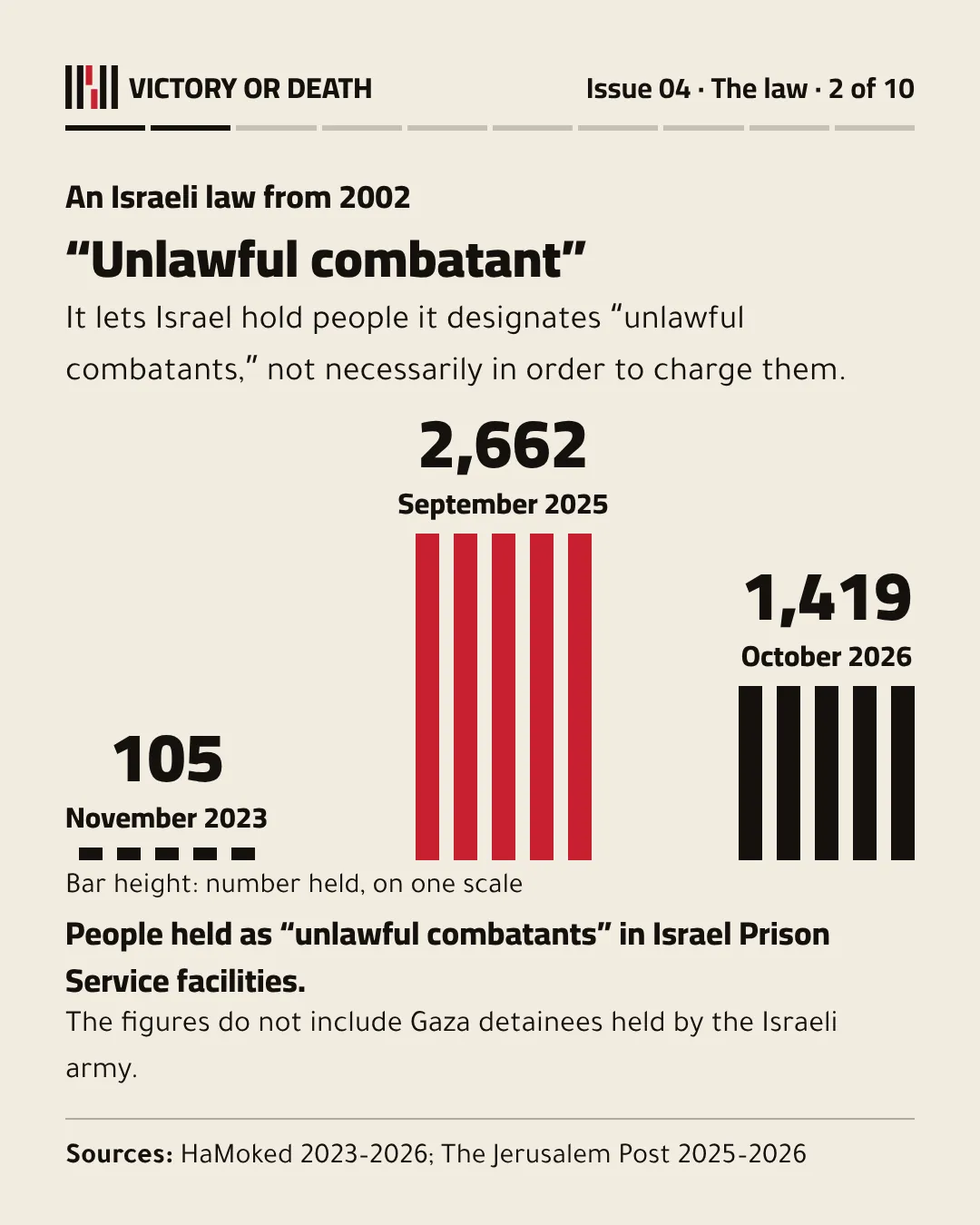
It lets Israel hold people it designates “unlawful combatants,” not necessarily in order to charge them.
People held as “unlawful combatants” in Israel Prison Service facilities: 105 in November 2023. The number rose to 2,662 in September 2025, then fell to 1,419 in October 2026. The figures do not include Gaza detainees held by the Israeli army.
In detail
Since November 2023, the Israel Prison Service figures published by HaMoked, an Israeli rights group, have included Palestinians from the Gaza Strip held under Israel’s Incarceration of Unlawful Combatants Law of 2002.
In November 2023, according to government data reported by HaMoked, Israel held 2,313 sentenced prisoners, 2,321 people held pending trial or sentencing and 2,070 administrative detainees, as well as 105 people from Gaza held as “unlawful combatants.” By September 2025, it held 11,040 Palestinian “security” prisoners, “the most Israel has ever held,” HaMoked said. Of those, 3,577 were in administrative detention and 2,662 were held as “unlawful combatants.” “Security” is the Israel Prison Service’s own classification.
As of October 2026, HaMoked says, Israel holds 9,265 “security” inmates in prisons inside Israel: 1,509 sentenced prisoners, 3,236 held pending trial or sentencing, 3,101 administrative detainees “held without trial,” and 1,419 people held as “unlawful combatants.” At the end of December 2025, the Hebrew news site Ha-Makom put the number held under the law at 1,287.
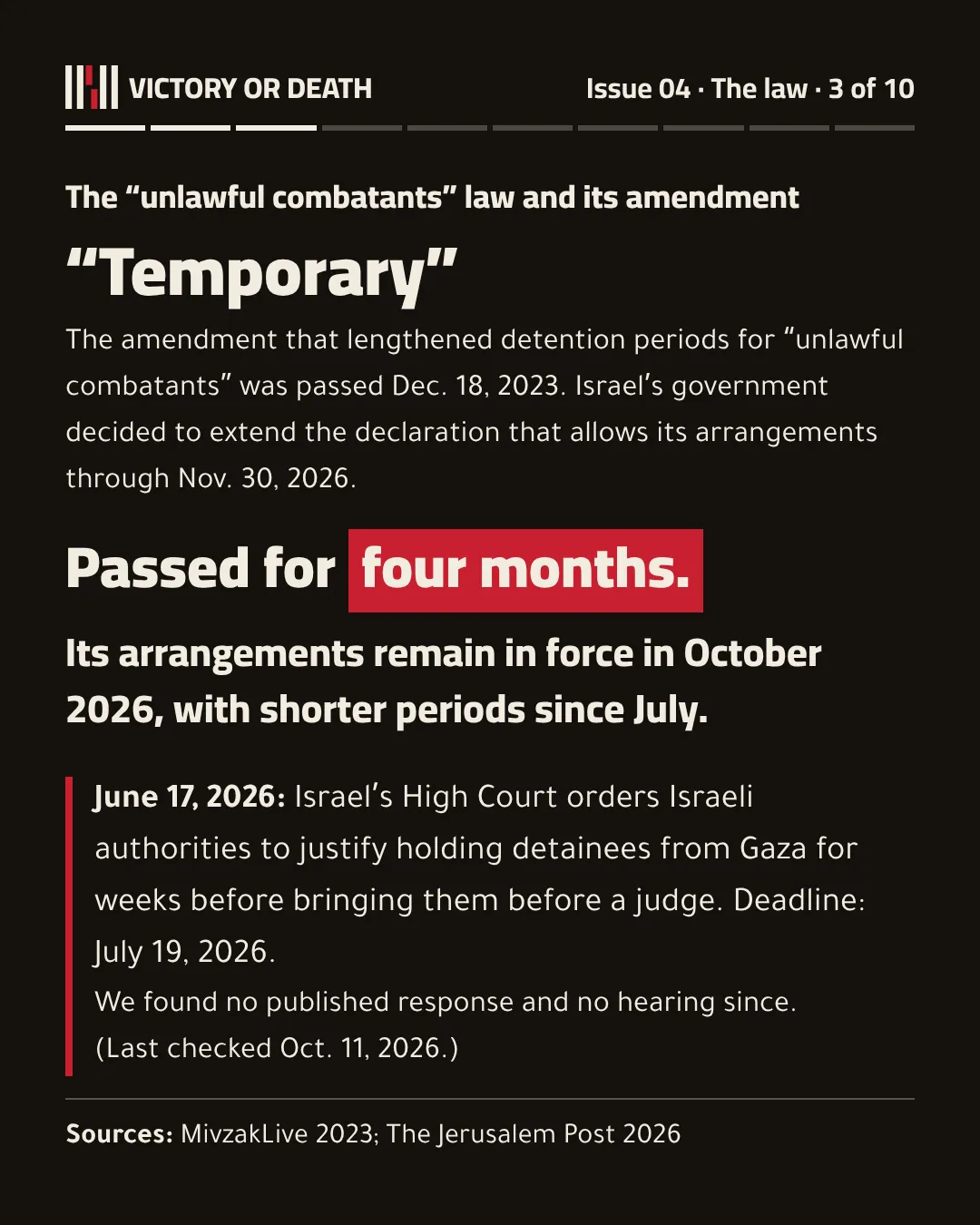
The amendment that lengthened detention periods for “unlawful combatants” was passed Dec. 18, 2023. Israel’s government decided to extend the declaration that allows its arrangements through Nov. 30, 2026.
Its arrangements remain in force in October 2026, with shorter periods since July.
June 17, 2026: Israel’s High Court orders Israeli authorities to justify holding detainees from Gaza for weeks before bringing them before a judge. Deadline: July 19, 2026. We found no published response and no hearing since (as of Oct. 11, 2026).
In detail
Nine Knesset members voted for the amendment on Dec. 18, 2023, with none against and no abstentions, and it was set as a temporary order for four months, the Hebrew news site MivzakLive reported. It has been extended ever since. In January 2026, The Jerusalem Post said the measures had “since been extended six times,” most recently on Dec. 25, 2025, through March 31, 2026. In March 2026, Ha-Makom wrote that the temporary order had been “changed and extended four times” and was now facing a fifth extension. Neither source explains the difference in the count.
In early October 2026, Israel’s government extended by two months the declaration that triggers the special arrangements, from Sept. 30 to Nov. 30, saying “conditions on the ground still justify extending the declaration,” The Jerusalem Post reported. If the declaration expires, the paper wrote, “existing decisions preventing detainees from meeting with lawyers would expire immediately.” It added: “Thousands of unlawful combatants remain in detention, including detainees for whom permanent detention orders have not yet been issued.”
The conditional order of June 17, 2026, was issued by Supreme Court President Yitzhak Amit and Justices Daphne Barak-Erez and Ruth Ronnen. The Public Committee Against Torture in Israel wrote that it requires the state “to justify provisions delaying judicial review of the detention of thousands of Palestinians from Gaza.”
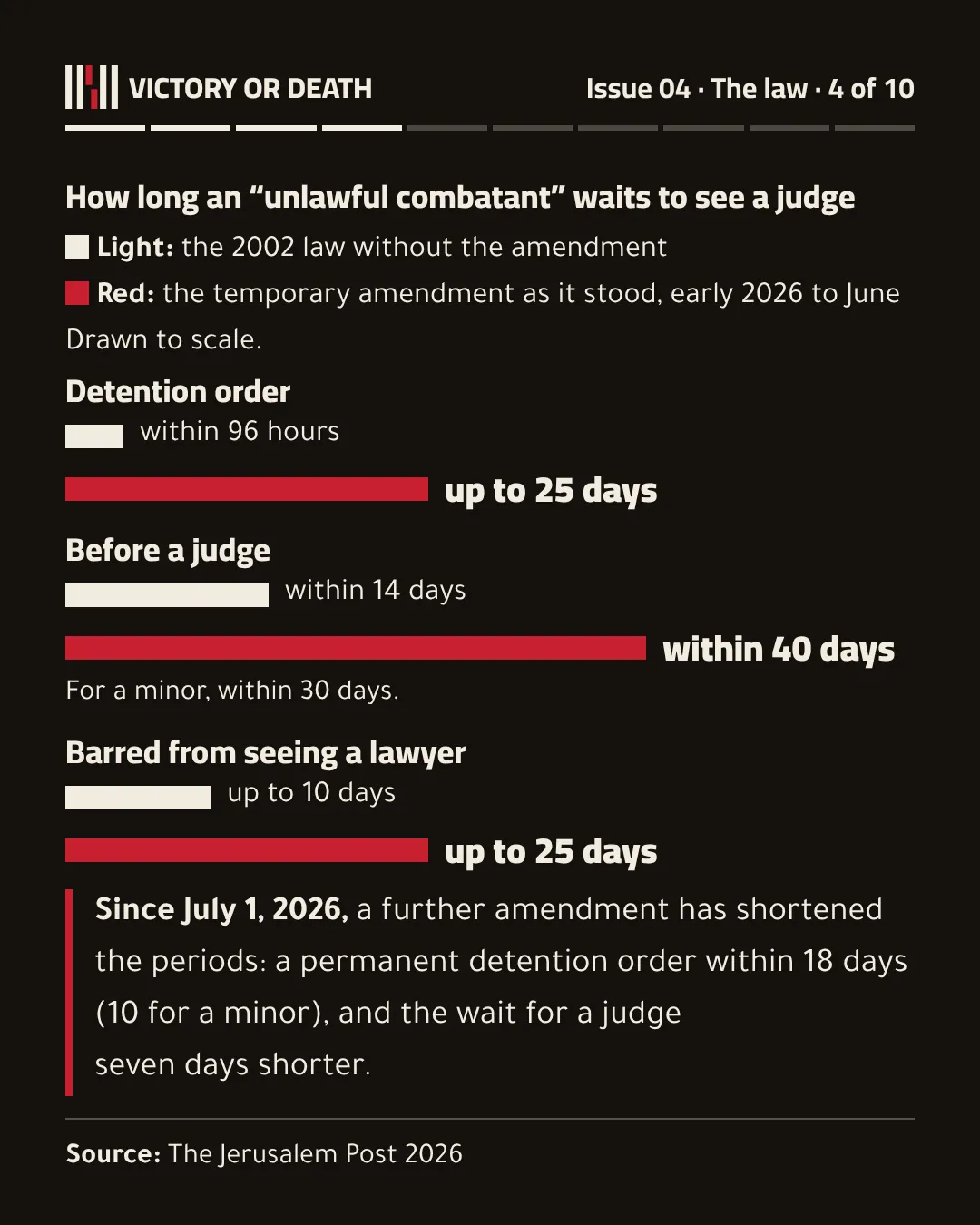
How long an “unlawful combatant” waits to see a judge
40 days
Before a judge: within 14 days under the 2002 law, within 40 days under the temporary amendment, and within 30 days for a minor.
Detention order: within 96 hours under the 2002 law without the amendment, against up to 25 days under the temporary amendment as it stood from early 2026 to June. Before a judge: within 14 days, against within 40 days; for a minor, within 30 days. Barred from seeing a lawyer: up to 10 days, against up to 25 days.
Since July 1, 2026, a further amendment has shortened the periods: a permanent detention order within 18 days (10 for a minor), and the wait for a judge seven days shorter.
In detail
Before the Sixth Amendment, the temporary periods were longer. The amendment “slightly reduced some timeframes — shortening temporary detention warrants from 30 days to 25, requiring initial judicial review within 40 days instead of 45, and limiting the prevention of meetings with lawyers to 25 days rather than 45,” The Jerusalem Post reported. The draft of the Sixth Amendment, on the Israeli government’s agenda for Dec. 11, 2025, was to run until March 31, 2026. In June 2026, the Post still described the 40-day wait, and 30 days for a child, as “the current framework.”
On June 18, the paper wrote that a first draft of a later amendment would have shortened the wait for a judge, but that “the final version of the amendment left the existing timeframes in place.” On Oct. 2, 2026, it wrote of “the latest amendment to the temporary provision, which entered into effect on July 1”: a permanent detention order “must be signed within 18 days of detention, or within 10 days in the case of a minor.” “The periods before judicial review were shortened by seven days,” it added, and the longest a detainee can be kept from a lawyer was cut too, by an amount it did not give. The paper does not explain how the two reports fit together.
We found neither the text of the July 1 amendment nor the dates it was passed and expires (as of Oct. 11, 2026).
The Israeli state, according to The Jerusalem Post (June 18, 2026), said that “before the amendment was advanced for final approval, the security situation had worsened,” citing “the war with Iran and renewed intensive IDF ground maneuvering in Lebanon.” For that reason, the final version kept the existing periods.
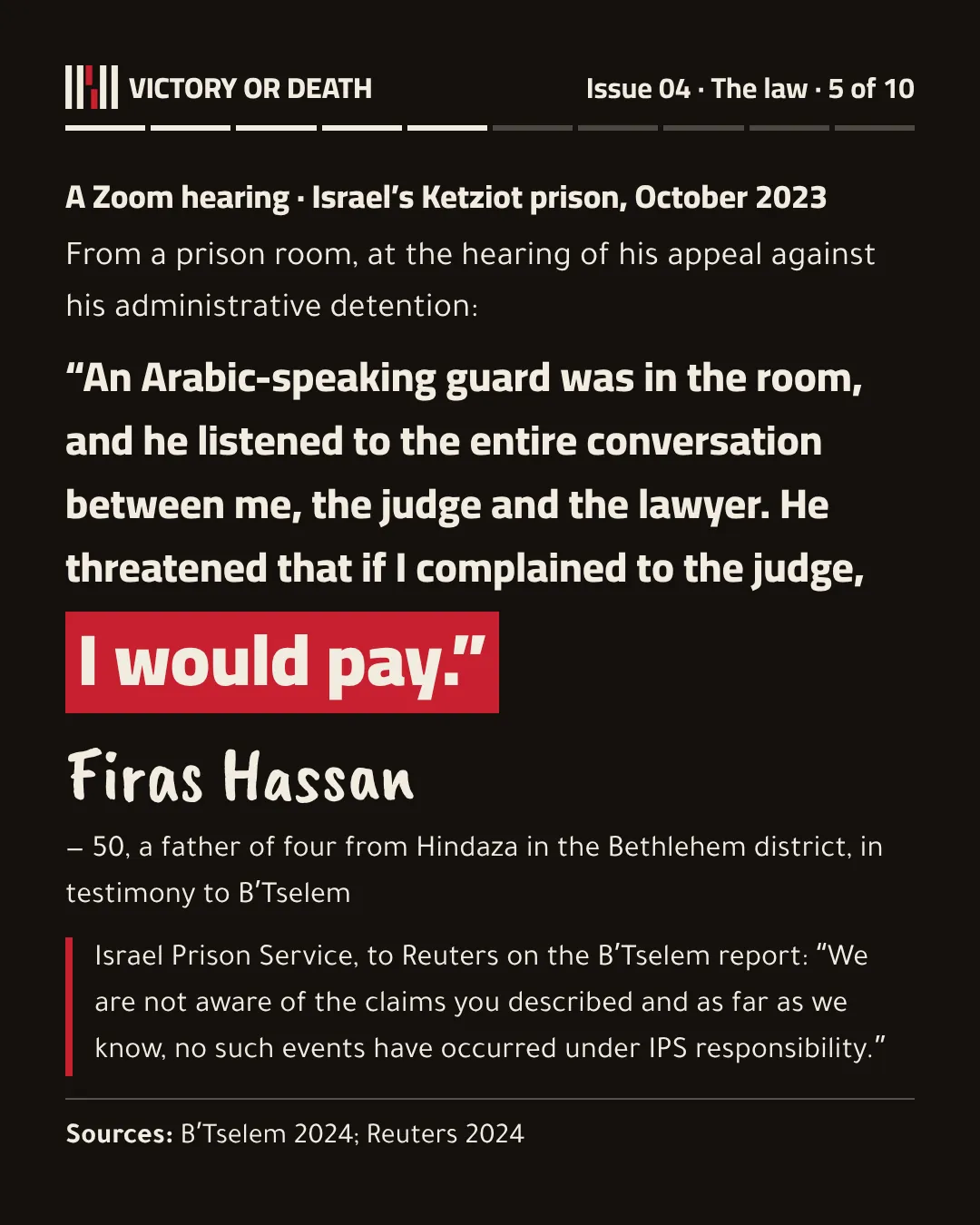
A Zoom hearing · Israel’s Ketziot prison, October 2023
“An Arabic-speaking guard was in the room, and he listened to the entire conversation between me, the judge and the lawyer. He threatened that if I complained to the judge, I would pay.”
Firas Hassan, 50, a father of four from Hindaza in the Bethlehem district, in testimony to B’Tselem
From a prison room, at the hearing of his appeal against his administrative detention.
Israel Prison Service, to Reuters on the B’Tselem report: “We are not aware of the claims you described and as far as we know, no such events have occurred under IPS responsibility.”
In detail
On Oct. 22, 2023, an Israeli court was due to hear Firas Hassan’s appeal against his administrative detention order.
That day, he told B’Tselem, the guards took the prisoners one at a time, to a room where they watched the court proceedings on Zoom.
B’Tselem field researcher Basel al-Adra took the testimony on April 24, 2024. It was published in August 2024 in B’Tselem’s report “Welcome to Hell.”
The Israel Prison Service also told Reuters that all prisoners had been treated according to the law, that their basic rights had been fully provided by professionally trained guards, and that detainees had the right to file complaints that would be fully examined and investigated (The Times of Israel, Aug. 6, 2024).
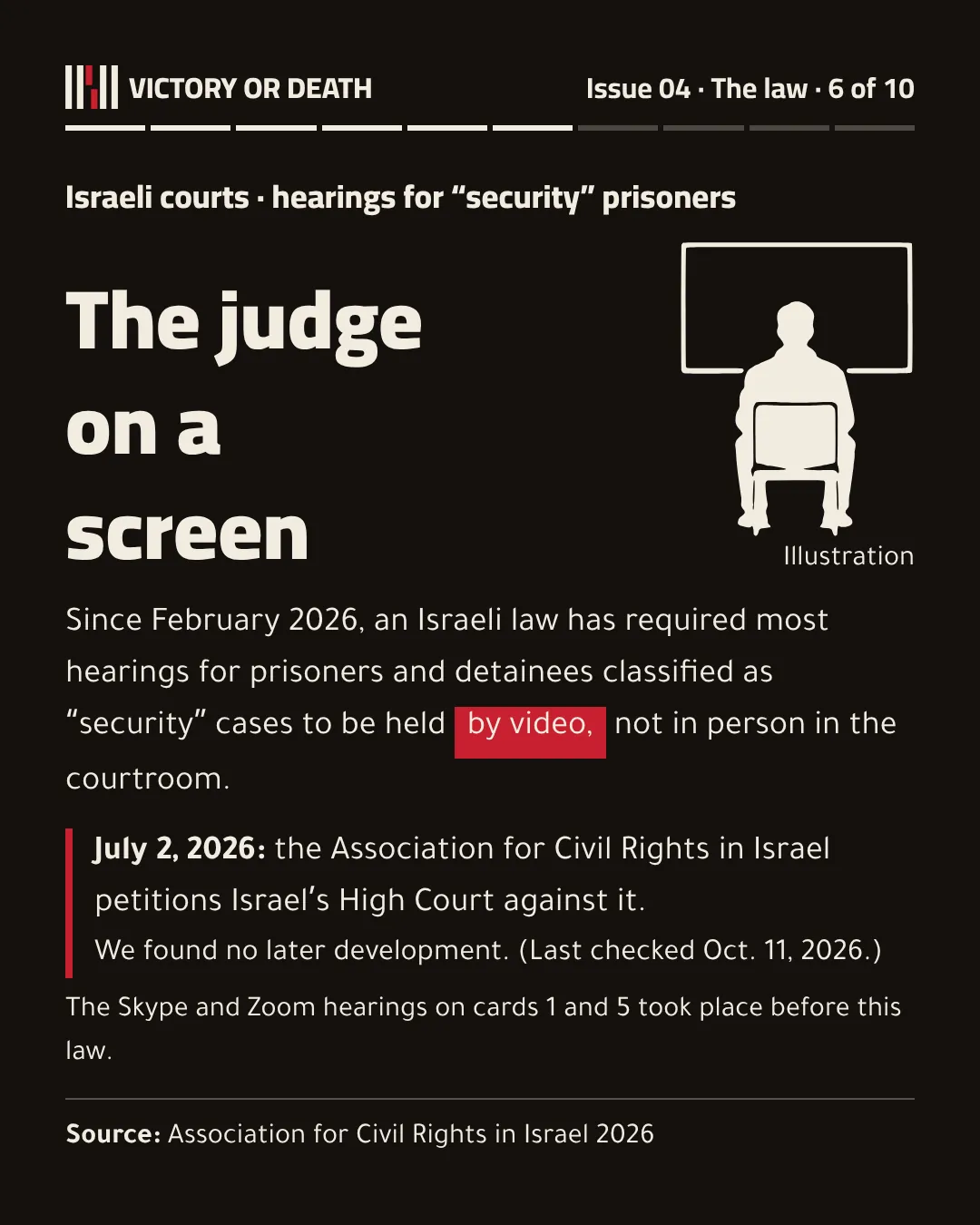
Israeli courts · hearings for “security” prisoners
The judge on a screen
Since February 2026, an Israeli law has required most hearings for prisoners and detainees classified as “security” cases to be held by video, not in person in the courtroom.
July 2, 2026: the Association for Civil Rights in Israel petitions Israel’s High Court against it. We found no later development (as of Oct. 11, 2026).
In detail
The law is called “Holding Hearings by Video Conference.” The association’s petition to Israel’s High Court, No. 5586-07-26, followed a letter it sent to the attorney general on March 23, 2026.
I had a remote court hearing over Zoom. My detention was extended until further notice under the classification of “unlawful combatant.”
Muhammad Khader, 36, a father of five from ‘Izbet Beit Hanoun in Gaza, in testimony to B’Tselem (Nov. 12, 2025)
Other B’Tselem testimonies describe hearings on Zoom in the first months of the war. Z.A., an administrative detainee from East Jerusalem, was arrested on Oct. 12, 2023, and moved to al-Naqab (Ketziot) prison. “Every time, they would take me at 8:00 A.M. to the room where I attended the hearing, which started at 2:00 P.M., via Zoom,” he said.
Muhammad Salah, 27, from Burqa, near Nablus, was held in Megiddo prison. “Throughout the entire period of detention, I didn’t meet with a lawyer,” he told B’Tselem. “I also didn’t see my parents or other family members, because they canceled visits altogether.”
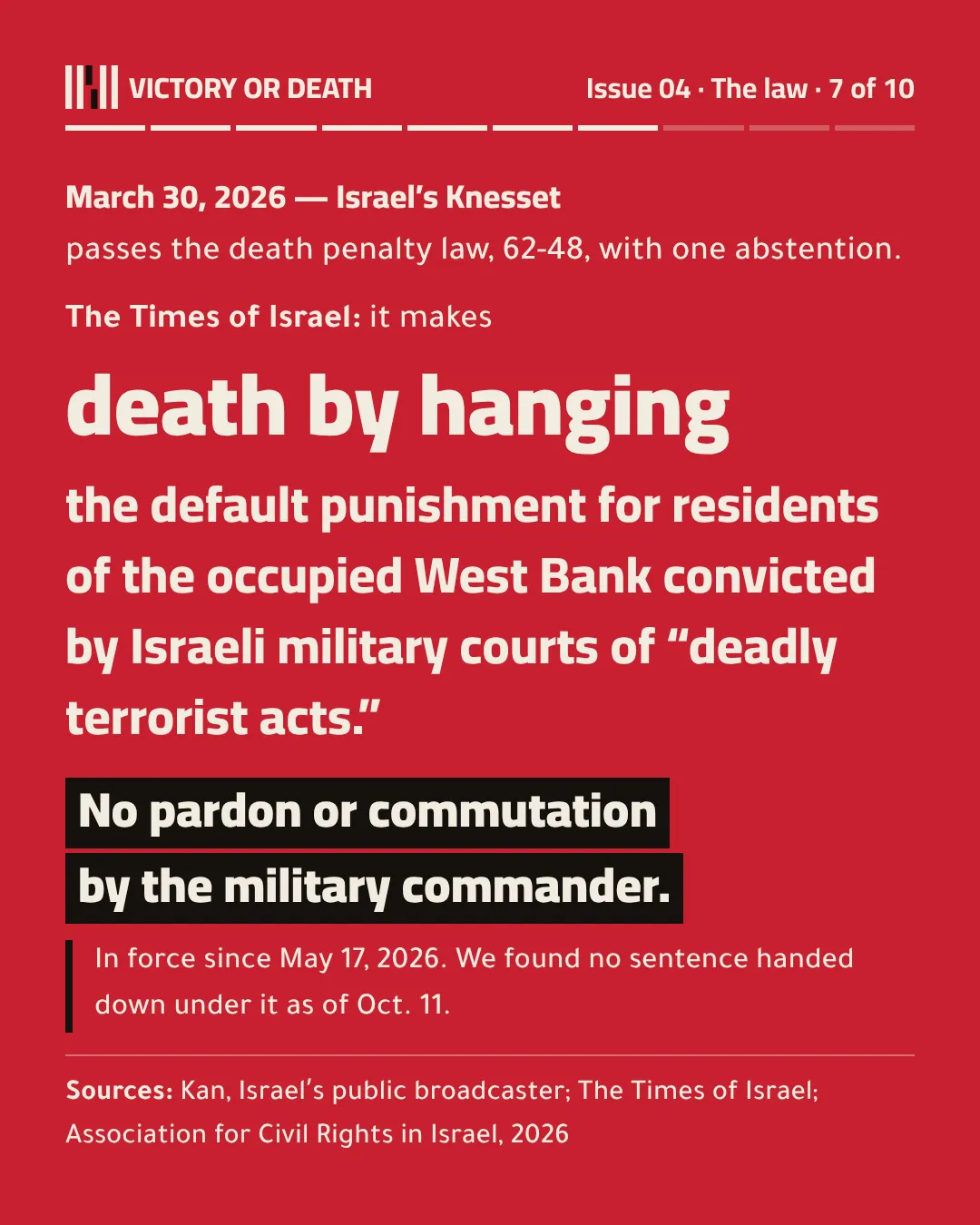
The Times of Israel: it makes death by hanging the default punishment for residents of the occupied West Bank convicted by Israeli military courts of “deadly terrorist acts.”
Passes the death penalty law, 62-48, with one abstention.
No pardon or commutation by the military commander.
In force since May 17, 2026. We found no sentence handed down under it as of Oct. 11.
In detail
“Deadly terrorist acts” is The Times of Israel’s phrase. On the day of the vote, the Association for Civil Rights in Israel published a Q&A on the law, then still a bill. Palestinians “convicted of terror-related murder in military courts in the territories would face a mandatory death sentence,” it said, and “The Military Commander would not have the authority to exercise discretion and offer pardons or commute sentences.”
The two sources disagree on the right of appeal. The Times of Israel wrote that the law passed “while eliminating any right of appeal.” The association wrote: “The defendant would have the right to appeal the death sentence.”
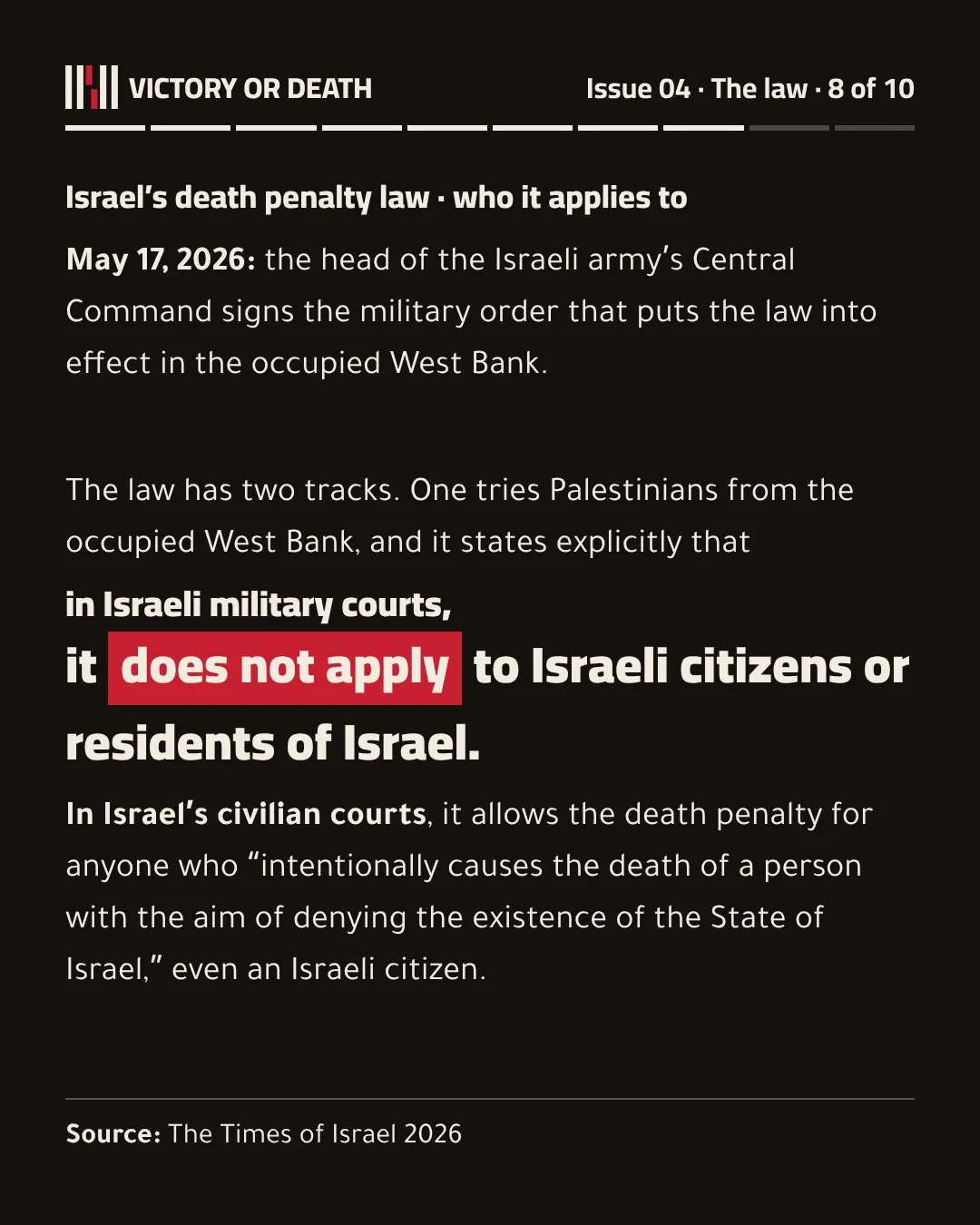
In Israeli military courts, it does not apply to Israeli citizens or residents of Israel.
May 17, 2026: the head of the Israeli army’s Central Command signs the military order that puts the law into effect in the occupied West Bank.
The law has two tracks. One tries Palestinians from the occupied West Bank, and it states explicitly that in Israeli military courts, it does not apply to Israeli citizens or residents of Israel.
In Israel’s civilian courts, it allows the death penalty for anyone who “intentionally causes the death of a person with the aim of denying the existence of the State of Israel,” even an Israeli citizen.
In detail
Maj. Gen. Avi Bluth, head of the Israeli army’s Central Command, signed the military order, and the law “came into effect Sunday night,” May 17, 2026, The Times of Israel reported. On the day the law passed, the paper noted that “only Palestinians are tried in military courts.”
The Association for Civil Rights in Israel explained the other track: “In Israeli courts, a person convicted of terror-related murder committed with the intent to eradicate the State of Israel would be sentenced to death or life imprisonment.” In the military track, then, death is a mandatory sentence; in the civilian track, it is one of two.
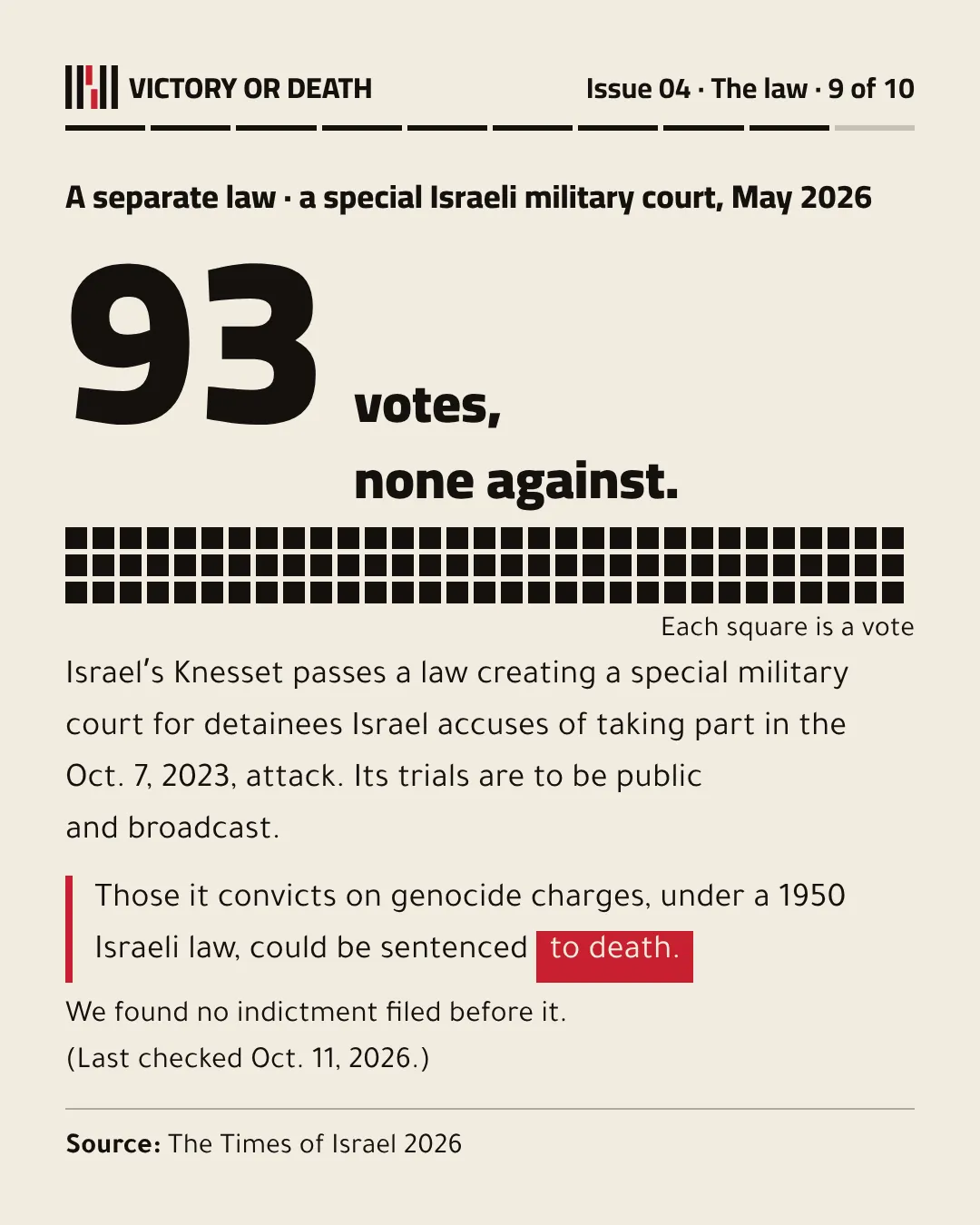
A separate law · a special Israeli military court, May 2026
93
votes, none against.
Israel’s Knesset passes a law creating a special military court for detainees Israel accuses of taking part in the “Oct. 7, 2023, attack.” Its trials are to be public and broadcast.
Those it convicts on genocide charges, under a 1950 Israeli law, could be sentenced to death.
We found no indictment filed before it (as of Oct. 11, 2026).
In detail
The vote took place on May 11, 2026, The Times of Israel reported. “The bill passed 93-0 in Israel’s 120-seat parliament,” Al Jazeera wrote. Trials “will be open to the public and broadcast on a website set up for that purpose,” The Times of Israel wrote. The genocide charges would be brought under Israel’s 1950 Law for the Prevention of Genocide.
On Oct. 7, 2026, The Times of Israel reported that the trial process faced delays, and that Simcha Rothman, a Knesset member, wanted the first indictments filed “in the first half of 2027.” The Algemeiner wrote on Oct. 8 that “there has yet to be a full criminal accounting of the events in a courtroom.”
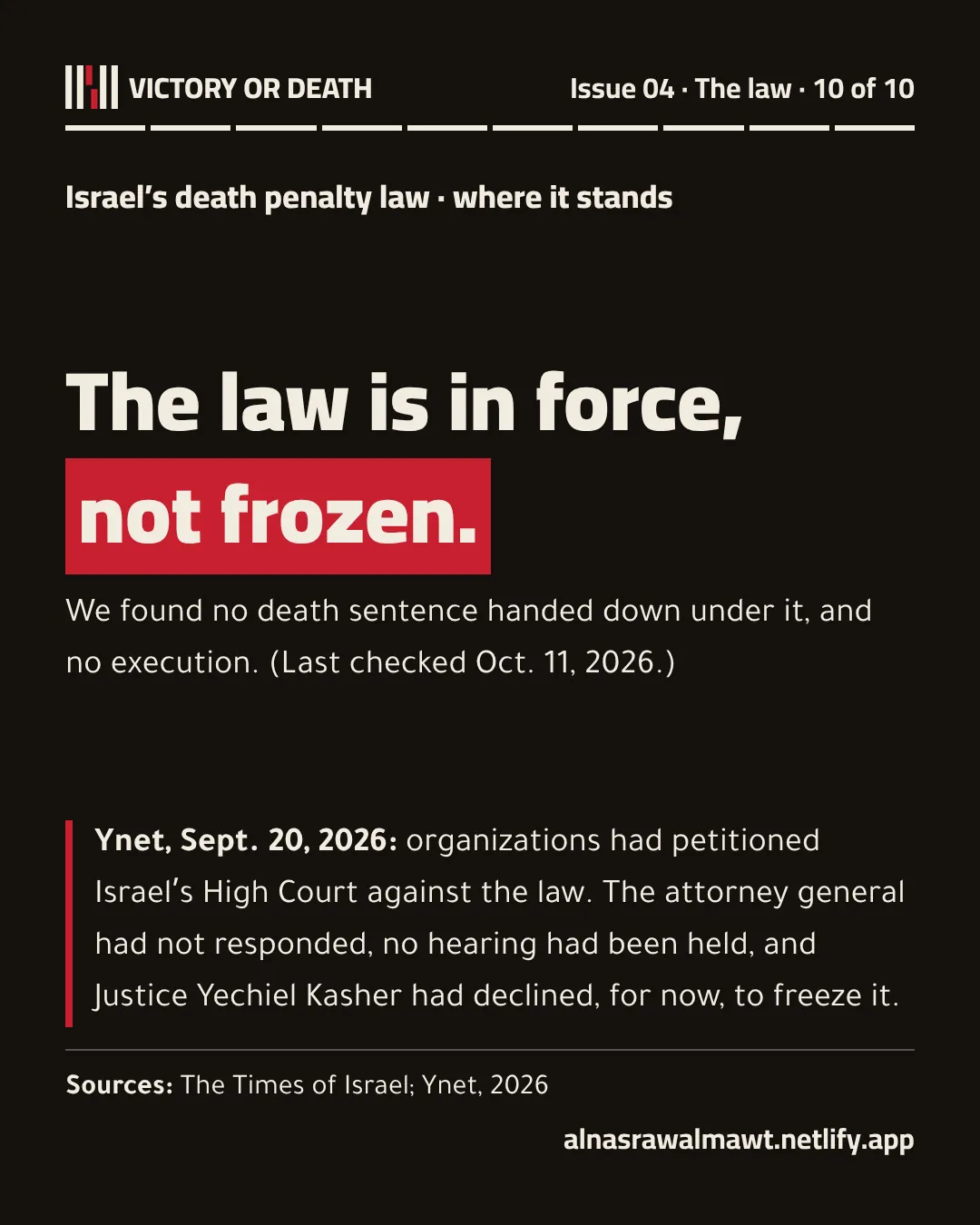
We found no death sentence handed down under it, and no execution (as of Oct. 11, 2026).
Ynet, Sept. 20, 2026: organizations had petitioned Israel’s High Court against the law. The attorney general had not responded, no hearing had been held, and Justice Yechiel Kasher had declined, for now, to freeze it.
In detail
On May 19, 2026, after the military order was signed, the Association for Civil Rights in Israel filed a request with Israel’s High Court. The court rejected it the next day “because there is currently no concrete case to which the order’s provisions would apply,” the association said.
On Aug. 20, 2026, National Security Minister Itamar Ben Gvir announced that ground had been broken on a gallows, The Times of Israel reported. “It is unclear, however, if the legislation will lead to automatic death penalty sentences,” the paper wrote. On Sept. 28, it wrote that “nobody has been executed under it yet, and some observers say it will not be used in practice.”
On May 24, 2026, the Israeli authorities undertook to inform Israel’s High Court “immediately” if a defendant is convicted of an offense that carries the death penalty, according to the Association for Civil Rights in Israel.
Jean-Jacques RousseauThe Social Contract 1762
Let us agree, then, that force does not make right, and that we are obliged to obey only legitimate powers.