Before the war, W.B., a prisoner from Qalqilya, saw his family once a month, on visits arranged by the Red Cross. From Oct. 7, 2023, family visits and phone calls were banned for Palestinian “security” prisoners, and Red Cross delegates were kept out of the prisons. Prisoners who came out describe complete isolation. Rights groups took the bans to Israel’s High Court, which ruled on the Red Cross visits in June 2026.
This part reflects information available before publication on Oct. 12, 2026.
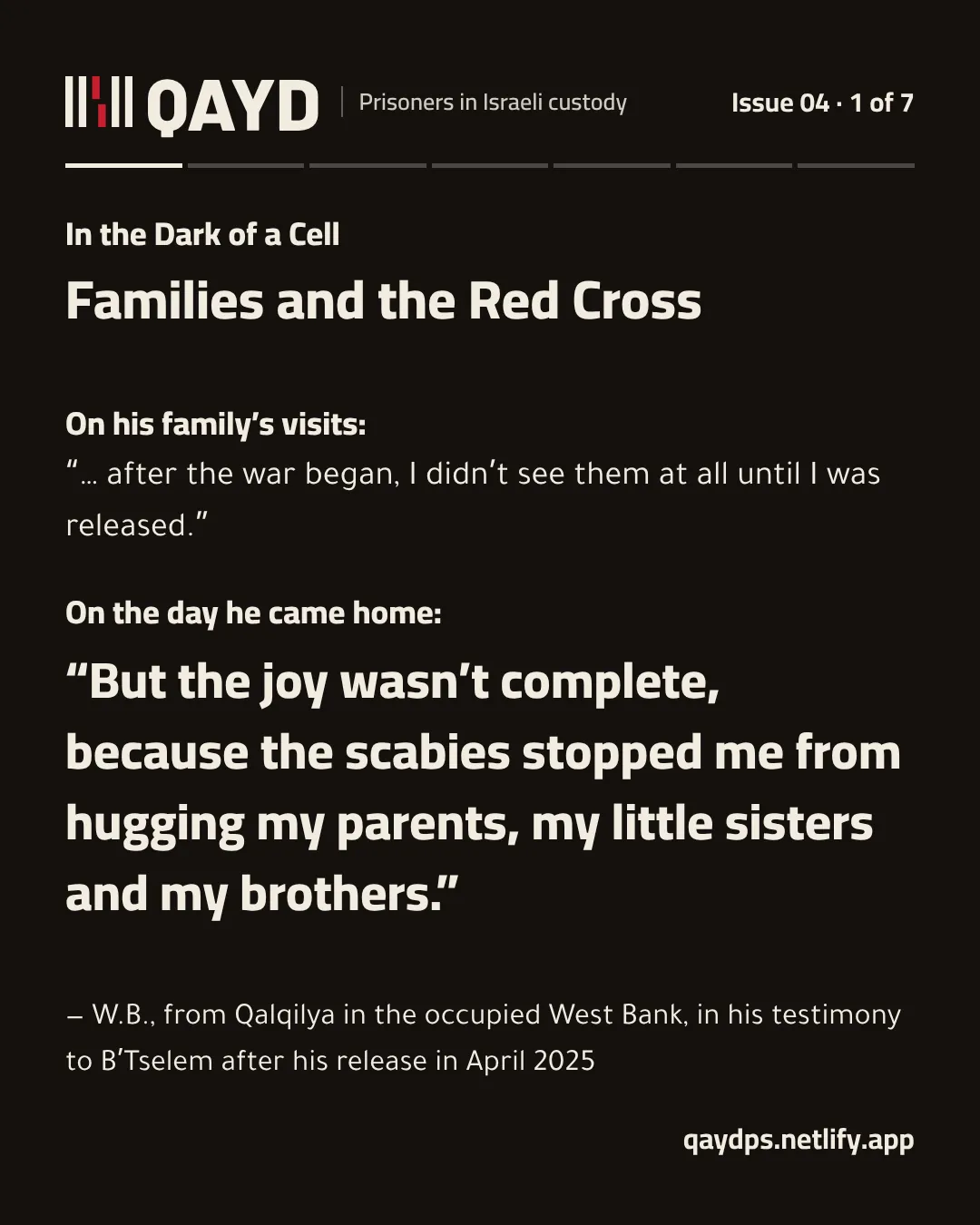
“But the joy wasn’t complete, because the scabies stopped me from hugging my parents, my little sisters and my brothers.”
W.B., from Qalqilya in the occupied West Bank, in his testimony to B’Tselem after his release in April 2025
On his family’s visits: “… after the war began, I didn’t see them at all until I was released.”
In detail
In his words, “Before 7 October 2023, my family paid me visits once a month arranged by the Red Cross.”
Visits were completely stopped for all prisoners, and all the conditions became much harsher and degrading.
W.B., in his testimony to B’Tselem
B’Tselem took his testimony on April 15, 2025, and published it in January 2026 in “Living Hell,” a report built on new testimonies from 21 released Palestinian prisoners.
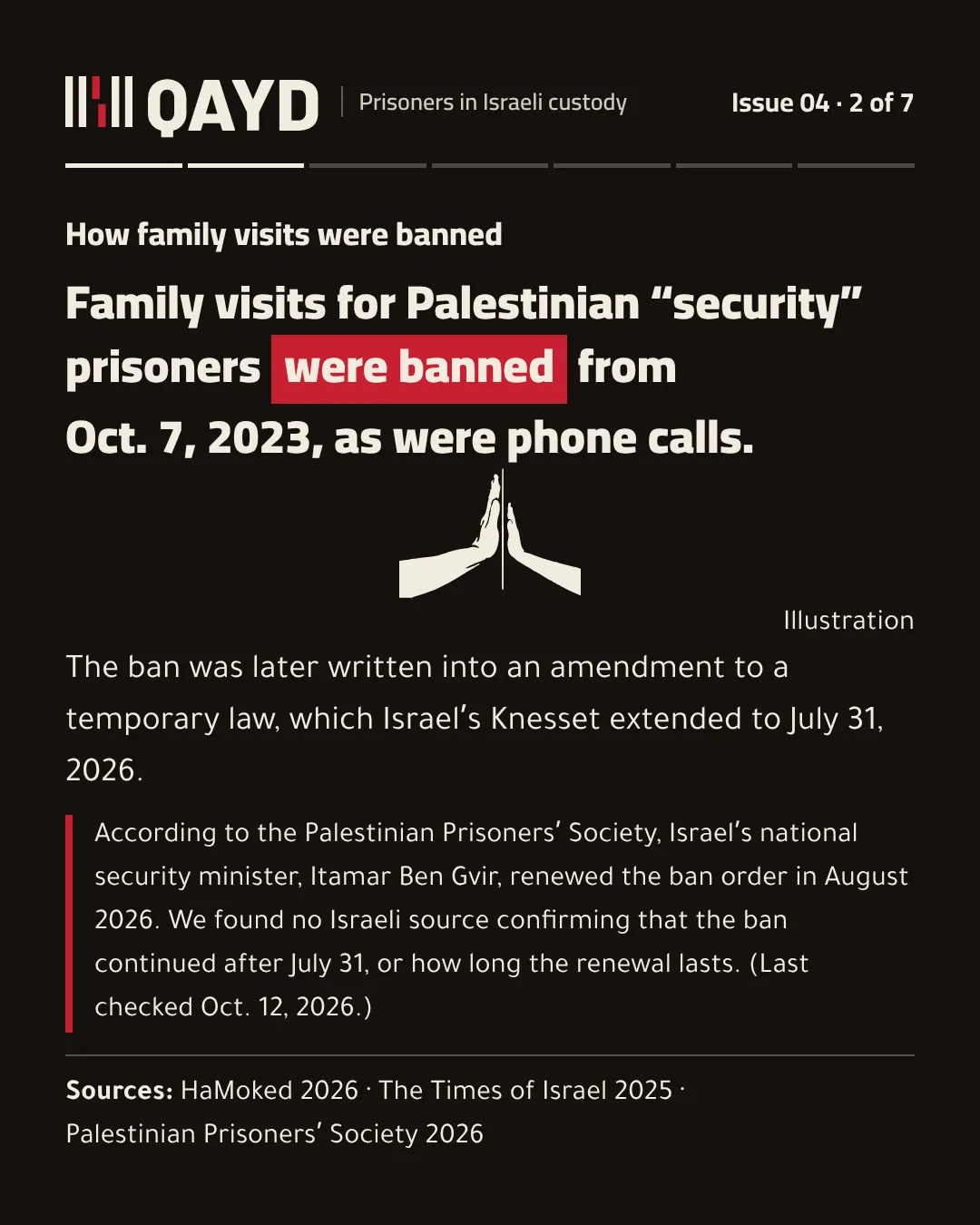
Family visits for Palestinian “security” prisoners were banned from Oct. 7, 2023, as were phone calls.
The ban was later written into an amendment to a temporary law, which Israel’s Knesset extended to July 31, 2026.
According to the Palestinian Prisoners’ Society, Israel’s national security minister, Itamar Ben Gvir, renewed the ban order in August 2026. We found no Israeli source confirming that the ban continued after July 31, or how long the renewal lasts (as of Oct. 12, 2026).
In detail
On Oct. 7, 2023, the Israel Prison Service declared an “incarceration emergency” with a blanket ban on family visits to “security” prisoners, according to the Israeli rights group HaMoked. The ban was “later codified in an amendment to a temporary order,” HaMoked says.
The order itself was signed by the Prison Service commissioner, Kobi Yaakobi, The Times of Israel reported in November 2025. “Since then, Palestinian inmates have been unable to contact their relatives through both phone calls and in-person visits,” the paper wrote.
When the Knesset approved the extension to July 31, 2026, 9,243 “security” prisoners were left completely cut off from their families, HaMoked says.
The Palestinian Prisoners’ Society issued its statement on the renewal of the ban order on Aug. 7, 2026.
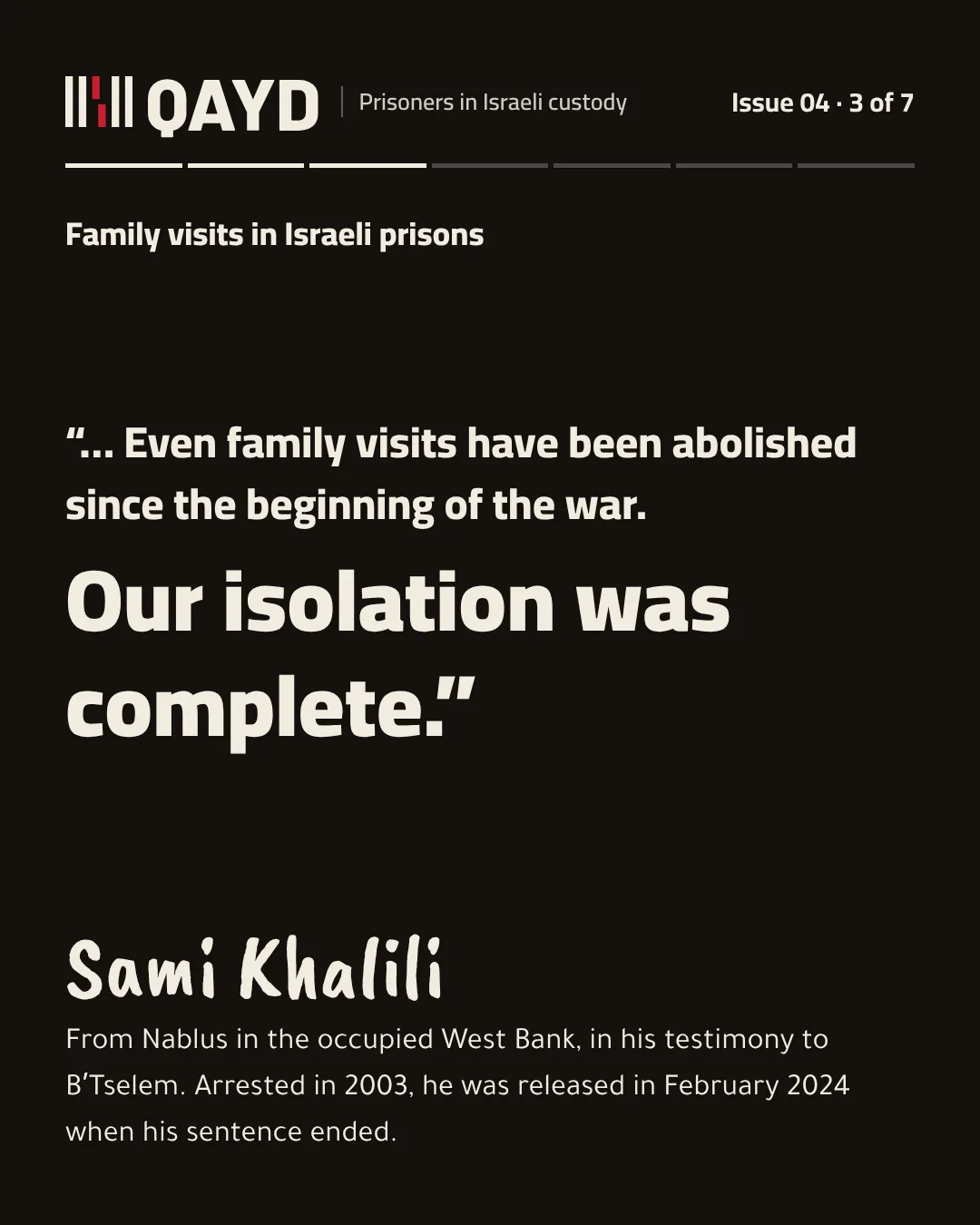
Sami Khalili, from Nablus in the occupied West Bank, in his testimony to B’Tselem
“… Even family visits have been abolished since the beginning of the war.”
Arrested in 2003, he was released in February 2024 when his sentence ended.
In detail
Sami Khalili says in his testimony that he was arrested on Feb. 10, 2003, and sentenced to 22 years in prison. His sentence ended on Feb. 8, 2024. He was 41 when B’Tselem took his testimony on March 29, 2024; the group published it in August 2024 in its report “Welcome to Hell.”
There were no family visits and there was no contact with anyone on the outside, not even the Red Cross. We were cut off from the news and the outside world.
Musa ’Aasi, from Beit Liqya, near Ramallah, in testimony to B’Tselem
Just before those words, he says: “This is the worst time in the history of Palestinians in Israeli prisons. The prisoners have no rights. They’ve been stripped of everything, and left completely vulnerable and isolated.”
The same report carries the testimony of Musa ’Aasi, 58, a married father of five from Beit Liqya, near Ramallah, on the same isolation. The only news that could reach the detainees, he says, came when a lawyer visited one of them.
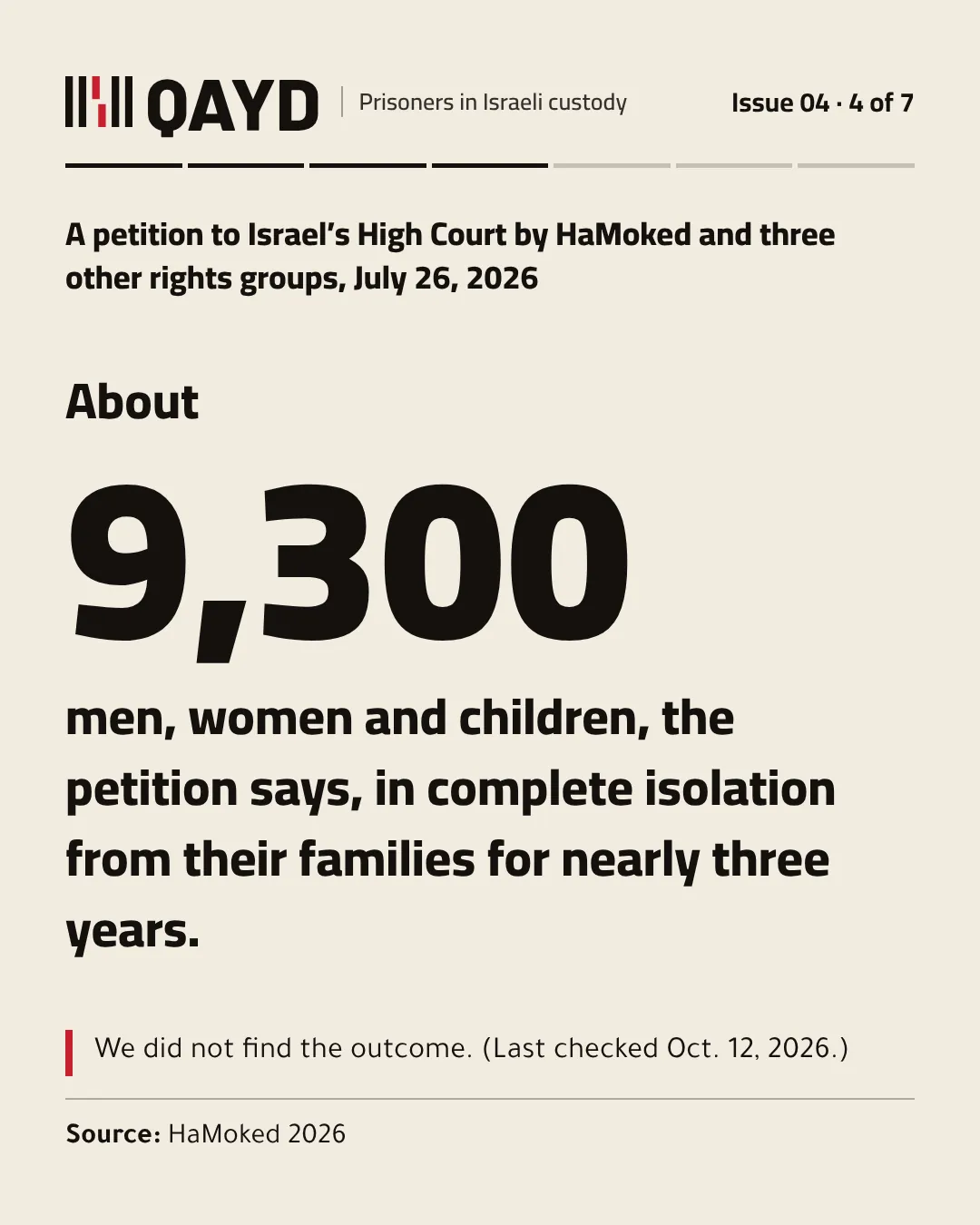
A petition to Israel’s High Court by HaMoked and three other rights groups, July 26, 2026
About 9,300
men, women and children, the petition says, in complete isolation from their families for nearly three years.
We did not find the outcome (as of Oct. 12, 2026).
In detail
It was not the first petition. On Nov. 25, 2025, Israel’s High Court rejected an earlier HaMoked petition against the family-visit ban, “holding that it failed to exhaust administrative remedies” with the Israel Prison Service, HaMoked says.
On July 26, 2026, ahead of the extension’s July 31 expiry, HaMoked and three other human rights organizations filed a second petition against the ban. Holding “approximately 9,300 men, women, and children in complete isolation from their families for nearly three years,” the petitioners argued, is an ongoing violation of their most basic rights.
The petition’s figure is approximate. It is slightly higher than the one HaMoked gave when the Knesset approved the extension, 9,243, and the two figures come from different dates.
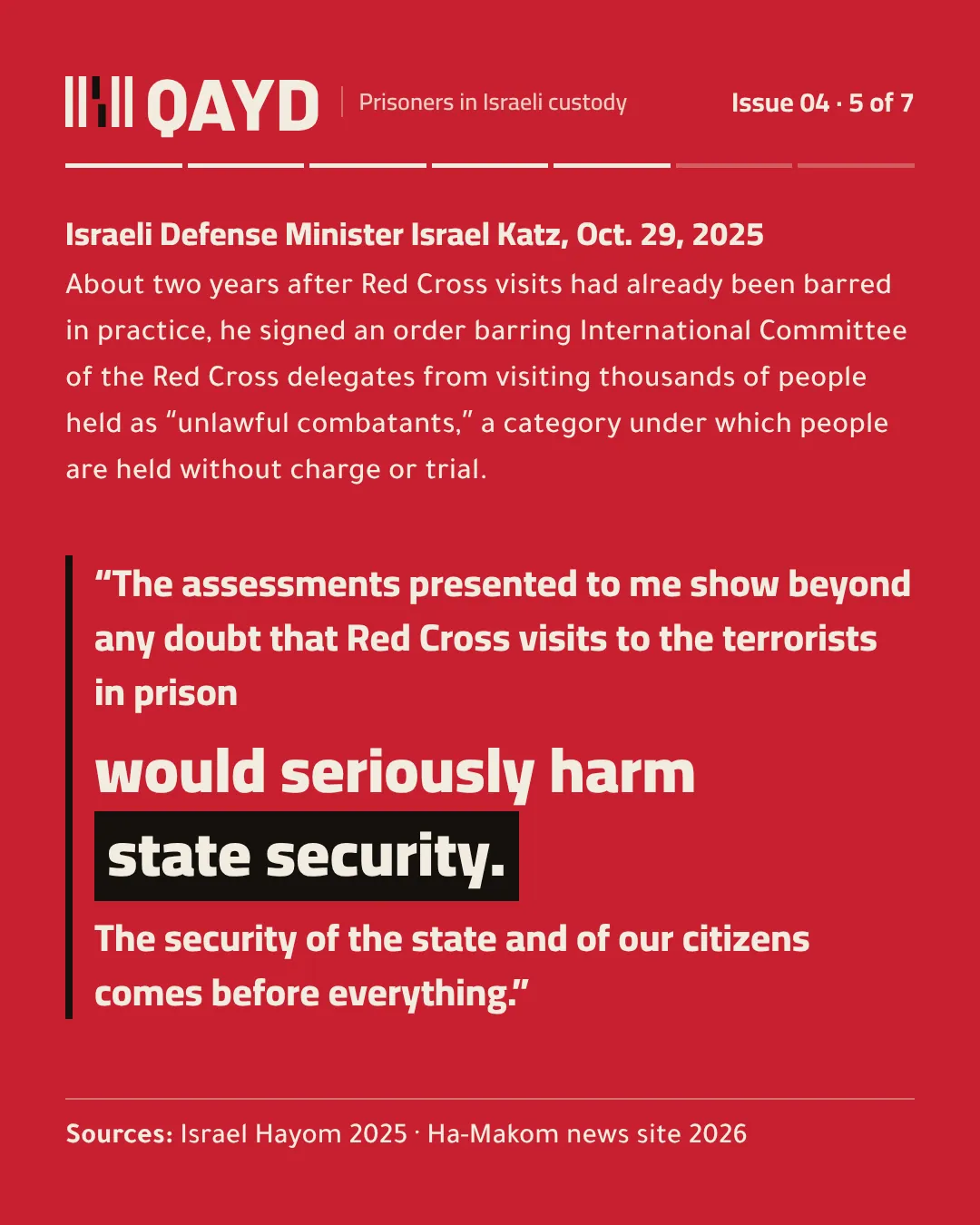
Israeli Defense Minister Israel Katz, Oct. 29, 2025
“The assessments presented to me show beyond any doubt that Red Cross visits to the terrorists in prison would seriously harm state security. The security of the state and of our citizens comes before everything.”
About two years after Red Cross visits had already been barred in practice, he signed an order barring International Committee of the Red Cross delegates from visiting thousands of people held as “unlawful combatants,” a category under which people are held without charge or trial.
In detail
“The ICRC has been unable to access detainees held in Israeli detention facilities since October 2023,” the International Committee of the Red Cross said in September 2026. Katz’s order was the first time he used his power to bar the visits, according to the Hebrew news site Ha-Makom.
Katz signed the order at midday, Ynet reported. It applies to everyone held under the “unlawful combatant” classification. According to the Israeli newspaper Israel Hayom, it covers thousands of detainees whose names appear on a classified list.
“Unlawful combatant” is a category in a 2002 Israeli law, Ha-Makom says.
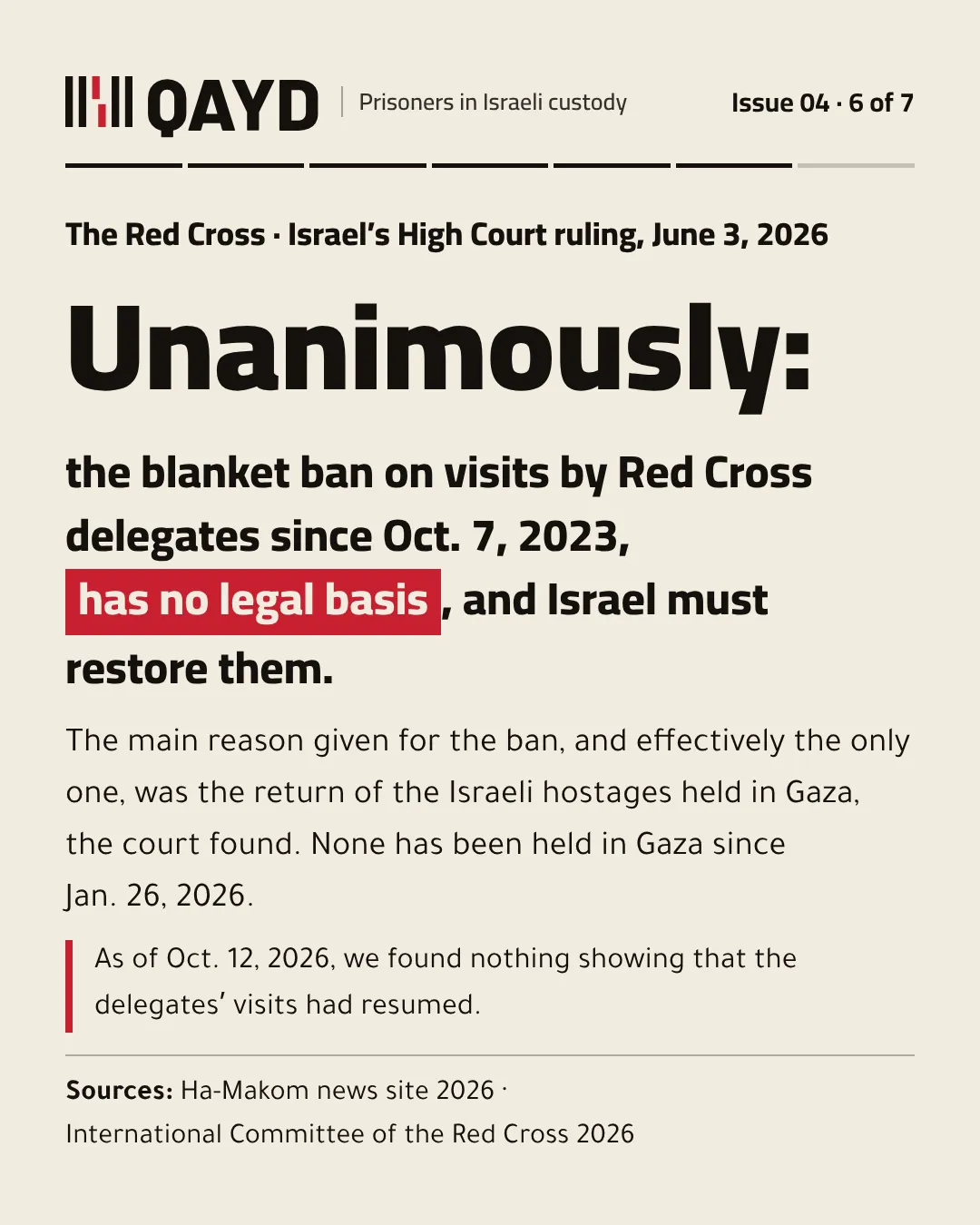
The Red Cross · Israel’s High Court ruling, June 3, 2026
Unanimously: the blanket ban on visits by Red Cross delegates since Oct. 7, 2023, has no legal basis, and Israel must restore them.
The main reason given for the ban, and effectively the only one, was the return of the Israeli hostages held in Gaza, the court found. None has been held in Gaza since Jan. 26, 2026.
As of Oct. 12, 2026, we found nothing showing that the delegates’ visits had resumed.
In detail
Four organizations filed the petition in February 2024: the Association for Civil Rights in Israel, Physicians for Human Rights–Israel, HaMoked: Center for the Defence of the Individual, and Gisha. Israel’s High Court issued a conditional order in August 2024, Ha-Makom reported.
On June 3, 2026, the conditional order was made absolute. The court unanimously accepted the petition and ordered Israel to restore the delegates’ visits to “security” prisoners and detainees, and to resume handing over information about them to the International Committee of the Red Cross. In Ha-Makom’s report on the ruling, the blanket ban had lasted more than two and a half years, with no time limit and no legal basis.
The justices added that the government had presented no legal basis for its policy, even though it had been given many opportunities to do so, Haaretz reported. What followed the ruling is told in Part 10.
HomerThe Odyssey Book 9
Nothing is sweeter than one’s homeland and one’s parents, even for one who lives far off in a rich house in a foreign land, away from his parents.