In Nafha prison, Samer Khawaireh was the one who handed out the food: a spoonful of labneh for breakfast, and jam measured by the lines on a plastic cup. Israel’s own inspectors found prisoners suffering from “extreme hunger,” and National Security Minister Itamar Ben Gvir said his policy was “the minimum of the minimum.” In September 2025, Israel’s High Court ruled that providing food is not a means of punishment. A year later, Haaretz wrote that “the deliberate starvation policy continues.”
This part reflects information available before publication on Oct. 10, 2026.
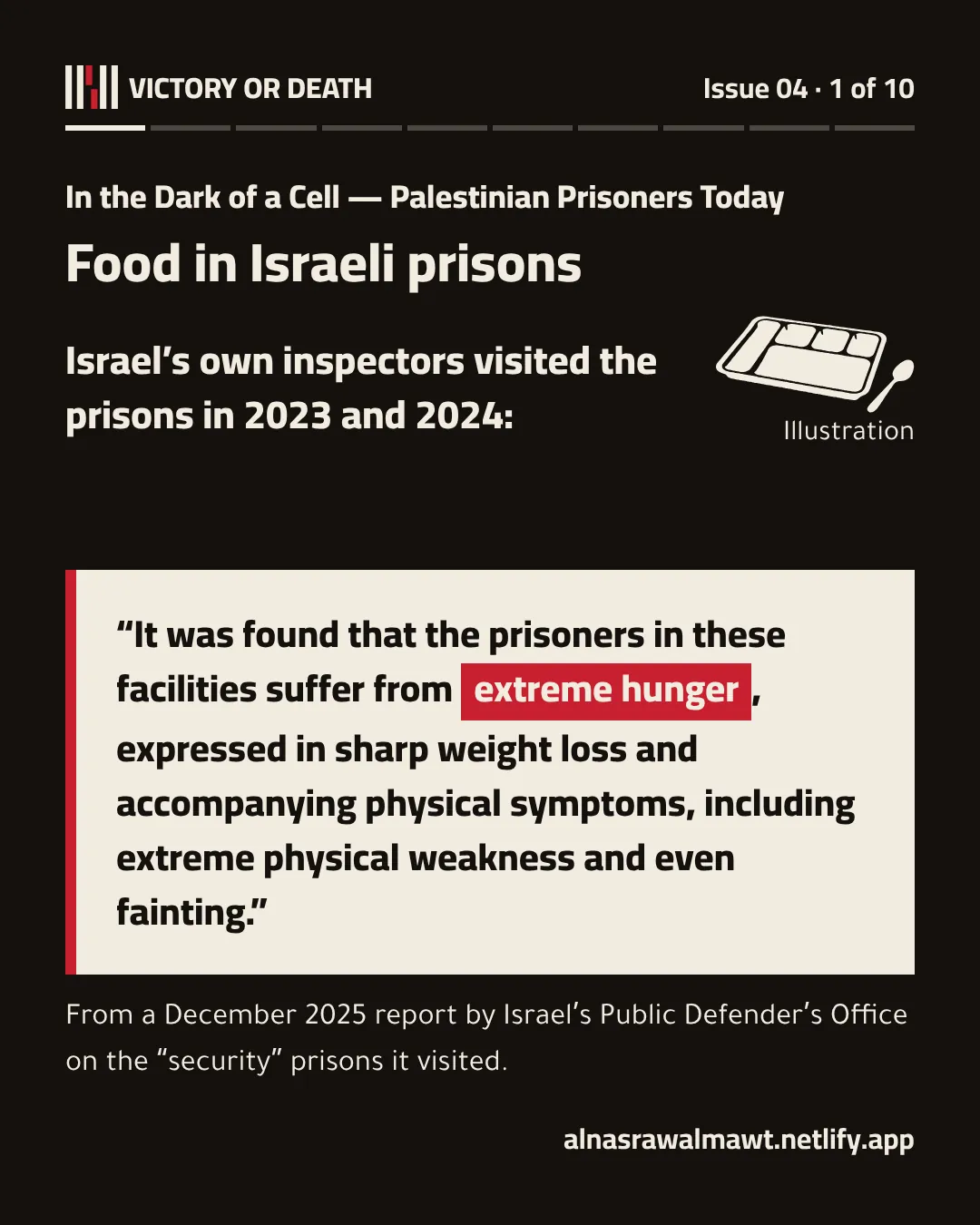
Israel’s own inspectors visited the prisons in 2023 and 2024:
“It was found that the prisoners in these facilities suffer from extreme hunger, expressed in sharp weight loss and accompanying physical symptoms, including extreme physical weakness and even fainting.”
From a December 2025 report by Israel’s Public Defender’s Office on the “security” prisons it visited.
In detail
The Public Defender’s Office is an Israeli state body that inspects prisons. Its report came out on Dec. 4, 2025, after reviews and site visits during 2023 and 2024. Conditions had reached “one of the harshest detention crises the state has known,” the report said.
“Security” is the Israel Prison Service’s own classification.
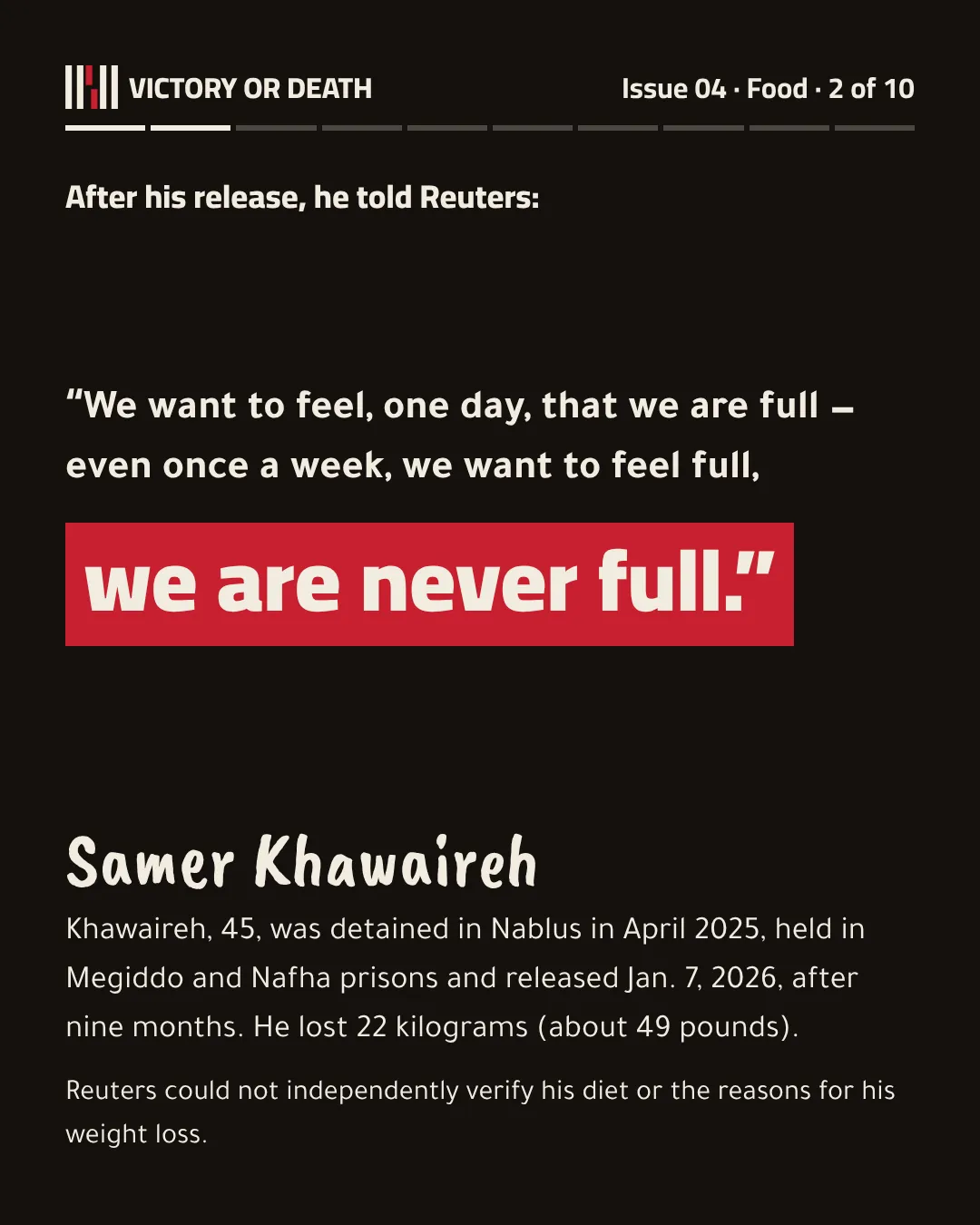
“We want to feel, one day, that we are full — even once a week, we want to feel full, we are never full.”
Samer Khawaireh
Khawaireh, 45, was detained in Nablus in April 2025, held in Megiddo and Nafha prisons and released Jan. 7, 2026, after nine months. He lost 22 kilograms (about 49 pounds).
Reuters could not independently verify his diet or the reasons for his weight loss.
In detail
When Khawaireh came home in January 2026, his 9-year-old son did not recognize him, Haaretz reported.
In Nafha I was the shawish, the one who hands out the food. Every day we got 10 slices of bread. Breakfast was a spoonful of labneh, and a spoonful or half a spoonful of jam. … I would count the jam by the lines on the plastic cup: one line, two, three.
Samer Khawaireh, to Haaretz
Khawaireh is a journalist from Nablus and the occupied West Bank correspondent for the Arabic news site Al-Araby Al-Jadeed. He was arrested at home in a nighttime raid and spent the nine months in administrative detention. Asked by Haaretz why he had been held without trial, Israel’s Shin Bet security service declined to respond, the paper reported on Oct. 8, 2026.
Reuters added that it could not independently verify “exactly how widespread such experience is” among prisoners.
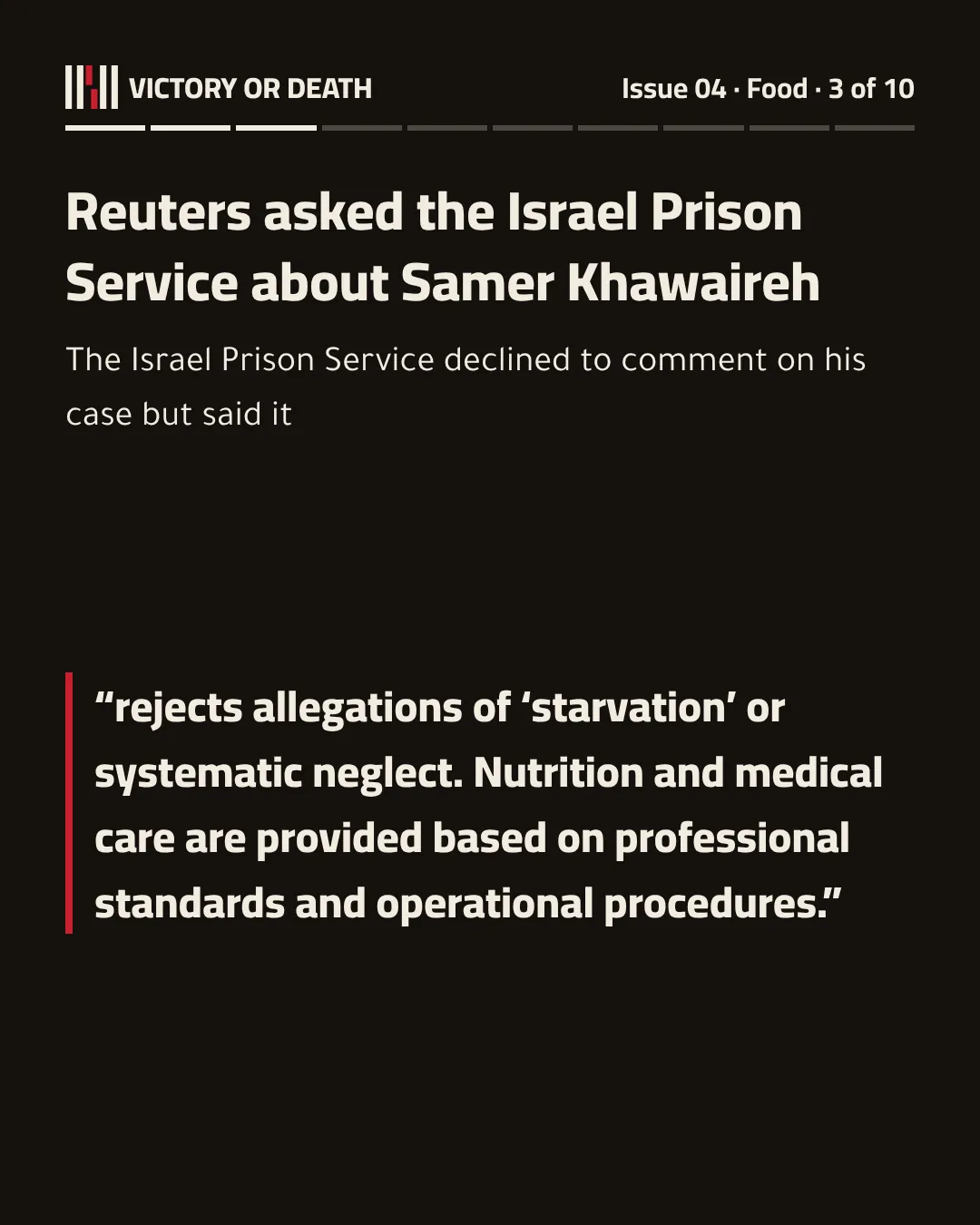
Reuters asked the Israel Prison Service about Samer Khawaireh
The Israel Prison Service declined to comment on his case but said it “rejects allegations of ‘starvation’ or systematic neglect. Nutrition and medical care are provided based on professional standards and operational procedures.”
In detail
The reply appeared in a Reuters report published on Feb. 11, 2026. Khawaireh’s story, Reuters wrote, came “five months after Israel’s Supreme Court ruled that its prisons were failing to provide enough food.”
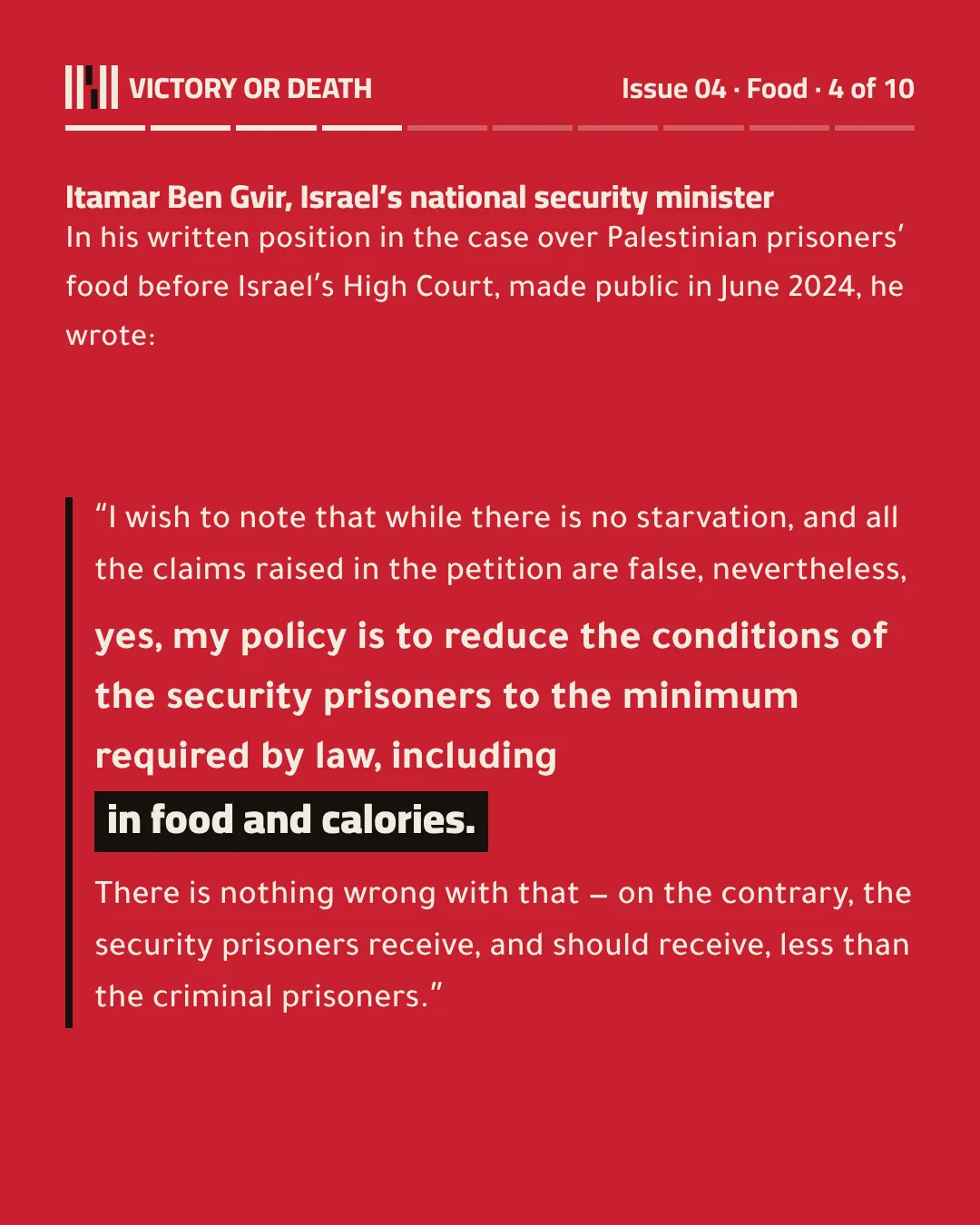
Itamar Ben Gvir, Israel’s national security minister. In his written position in the case over Palestinian prisoners’ food before Israel’s High Court, made public in June 2024, he wrote:
“I wish to note that while there is no starvation, and all the claims raised in the petition are false, nevertheless, yes, my policy is to reduce the conditions of the security prisoners to the minimum required by law, including in food and calories. There is nothing wrong with that — on the contrary, the security prisoners receive, and should receive, less than the criminal prisoners.”
In detail
The minister’s position came to light at a hearing on June 26, 2024. At that hearing, representatives of the Israeli government presented the attorney general’s position: the food given to “security” prisoners was sufficient, and it had been changed mainly for logistical and operational reasons. It was then claimed at the hearing that the State Attorney’s Office had left the minister’s position out of the government’s response to the High Court. The justices rebuked the prosecution, Maariv reported.
My policy is clear, and it is a shame the prosecution hid it: the terrorists will get minimum conditions and minimum food, and I will make sure this policy is carried out.
Itamar Ben Gvir, Israel’s national security minister, June 26, 2024
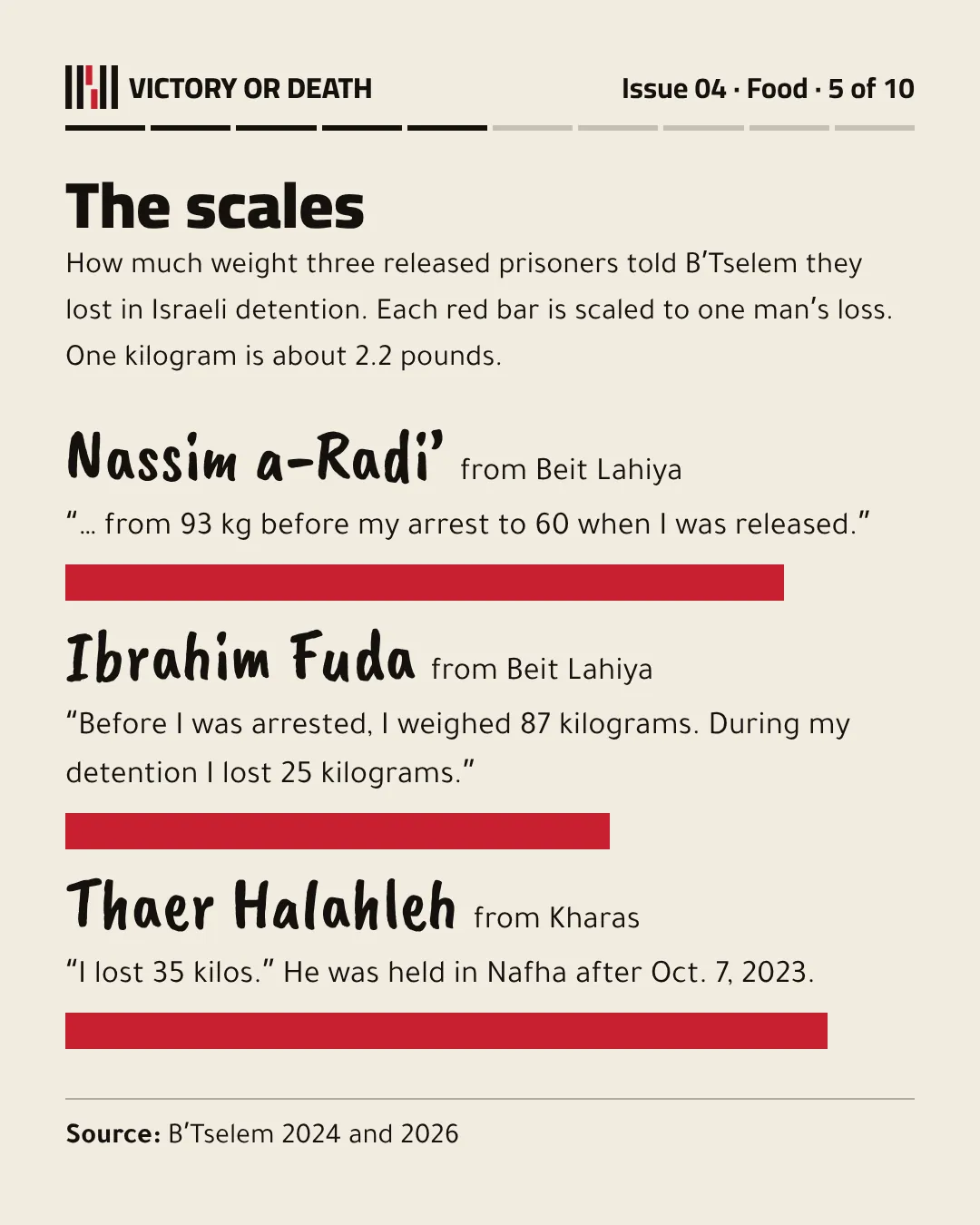
How much weight three released prisoners told B’Tselem they lost in Israeli detention.
Nassim a-Radi’, from Beit Lahiya: “… from 93 kg before my arrest to 60 when I was released.”
Ibrahim Fuda, from Beit Lahiya: “Before I was arrested, I weighed 87 kilograms. During my detention I lost 25 kilograms.”
Thaer Halahleh, from Kharas: “I lost 35 kilos.” He was held in Nafha after Oct. 7, 2023.
One kilogram is about 2.2 pounds.
In detail
Nassim a-Radi’, 34, a father of four from Beit Lahiya, was released after two years in prison. Ibrahim Fuda, 35, a father of two, is also from Beit Lahiya.
Thaer Halahleh, 45, a father of four from Kharas, near Hebron, was held in Nafha prison, in cell 3 on wing 4.
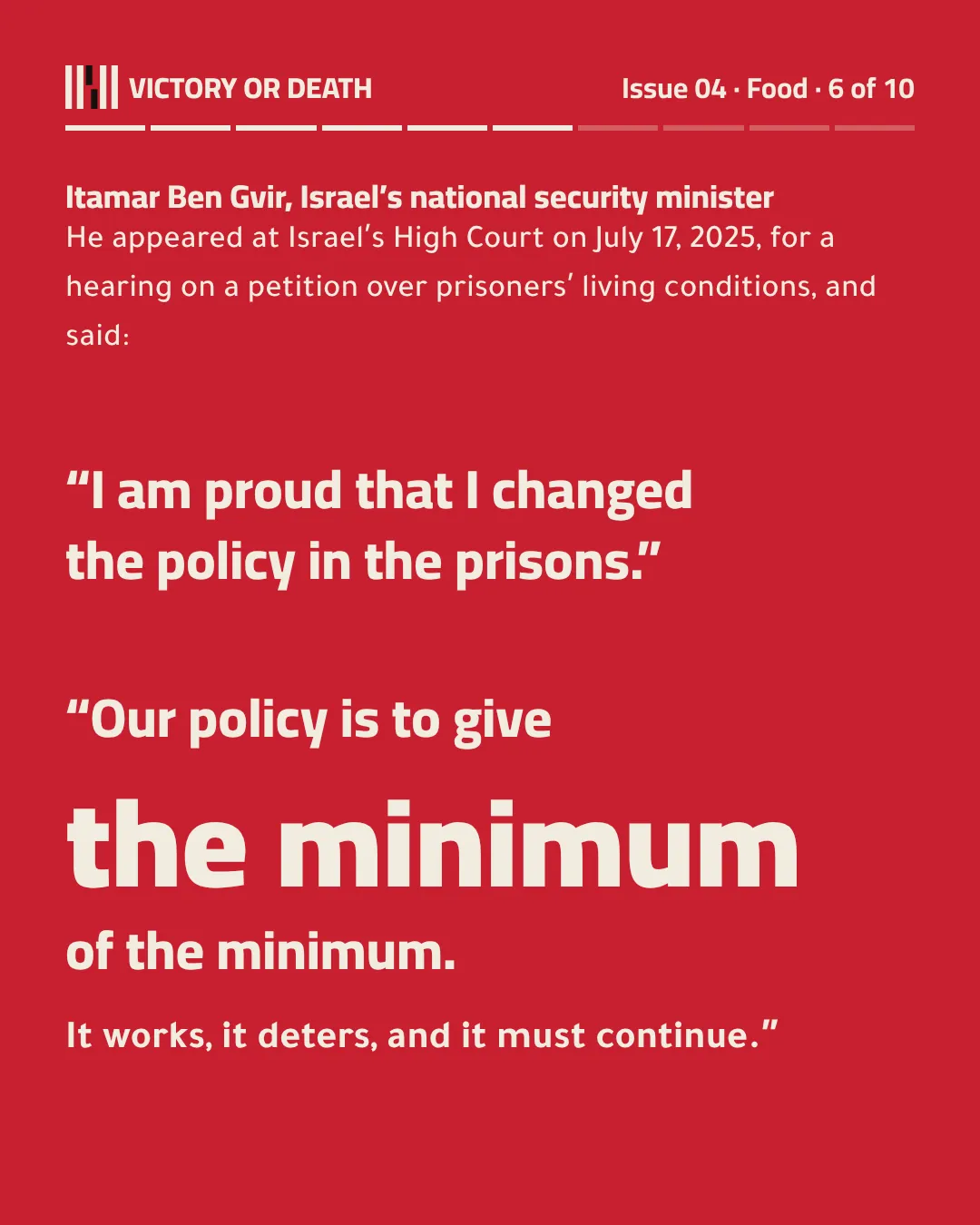
Itamar Ben Gvir, Israel’s national security minister. He appeared at Israel’s High Court on July 17, 2025, for a hearing on a petition over prisoners’ living conditions, and said:
“I am proud that I changed the policy in the prisons.” “Our policy is to give the minimum of the minimum. It works, it deters, and it must continue.”
In detail
Ben Gvir came to the court on July 17, 2025, for a hearing on a petition by the Association for Civil Rights in Israel over the living and detention conditions of prisoners. He said he was proud of changing the policy as the hearing opened, Israel Hayom reported.
… In the past they went in thin and came out fat …
Itamar Ben Gvir, Israel’s national security minister, July 17, 2025
Israel Hayom described an uproar in the courtroom, with Ben Gvir present. About seven weeks later, on Sept. 7, 2025, Israel’s High Court ruled in the food case.
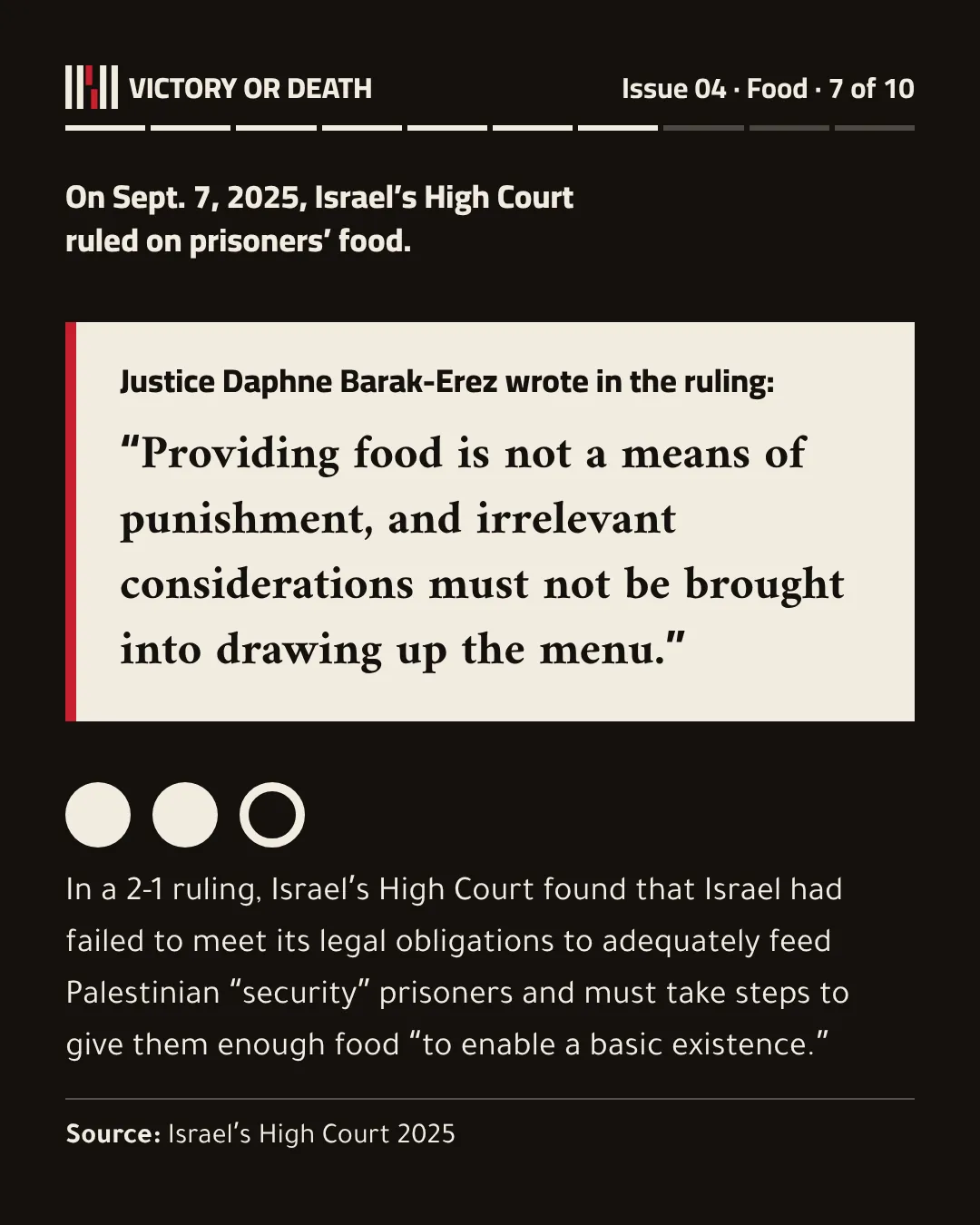
On Sept. 7, 2025, Israel’s High Court ruled on prisoners’ food.
“Providing food is not a means of punishment, and irrelevant considerations must not be brought into drawing up the menu.”
Justice Daphne Barak-Erez, in the ruling
In a 2-1 ruling, Israel’s High Court found that Israel had failed to meet its legal obligations to adequately feed Palestinian “security” prisoners and must take steps to give them enough food “to enable a basic existence.”
In detail
The ruling came on Sept. 7, 2025. Justice David Mintz dissented.
About three months later, Haaretz summed up what the ruling requires: that the Israeli government supply “security” prisoners with food “in a quantity suited to maintaining their health.”
On Oct. 8, 2026, Haaretz wrote that the justices of Israel’s High Court had twice ruled against the starvation policy, “after many delays, and while dragging their feet,” and that in September 2025 they had ordered the state “to see to proper nutrition for the prisoners.”
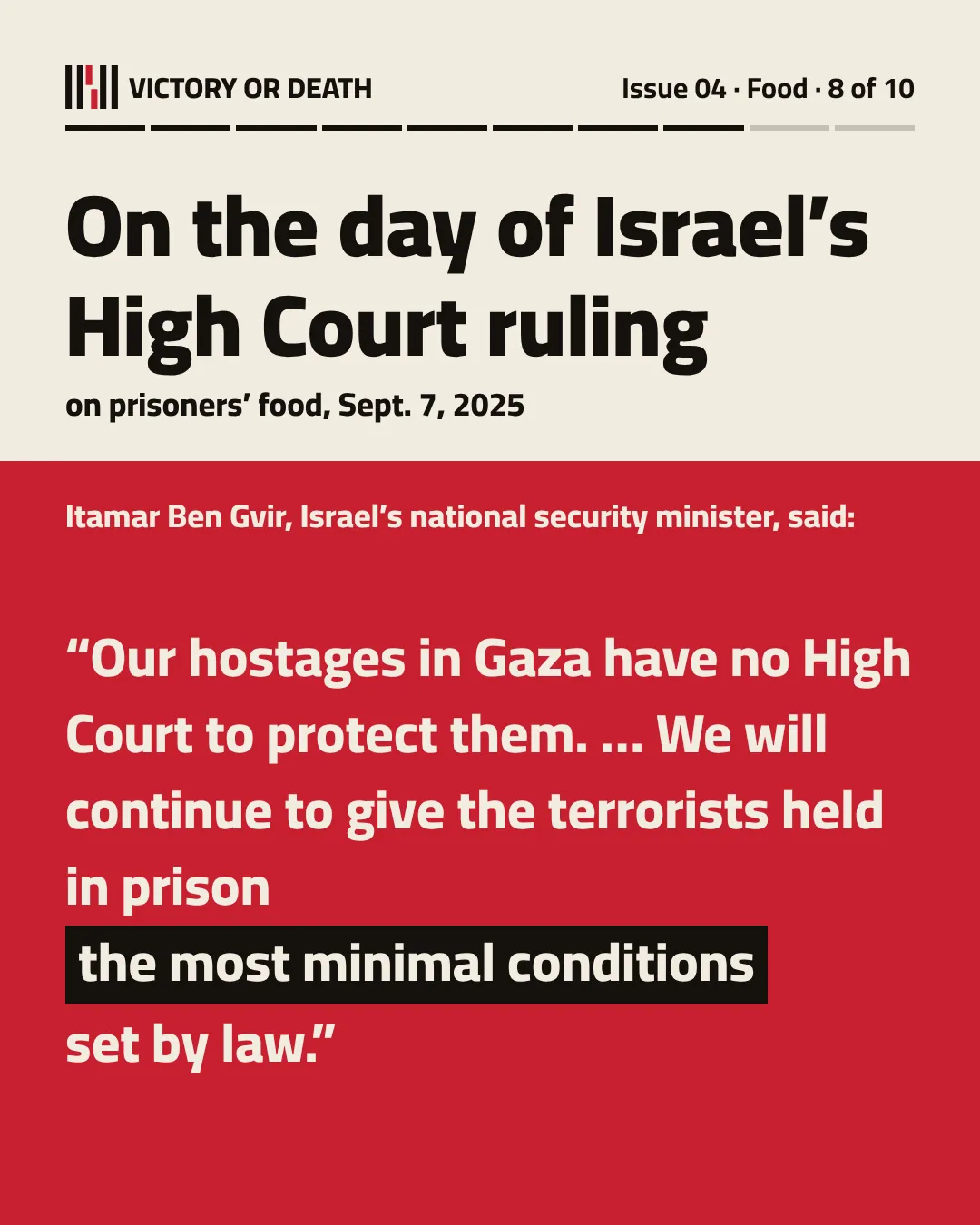
On the day of Israel’s High Court ruling on prisoners’ food, Sept. 7, 2025
“Our hostages in Gaza have no High Court to protect them. … We will continue to give the terrorists held in prison the most minimal conditions set by law.”
Itamar Ben Gvir, Israel’s national security minister
In detail
The minister responded on the same day the ruling came out. As of September 2026, Haaretz reported, only 16% of the “security” prisoners held in Israel had been charged and convicted in court.
More than a year after the ruling, on Oct. 8, 2026, Haaretz opened its investigation with these words: “For three years now, Israel’s prisons for Palestinian inmates have operated as torture camps.” Hunger, severe violence, scabies and brutal living conditions are part of daily life for thousands of prisoners, the paper wrote. None of it happens in the dark, it said: this is declared policy, at the center of Ben Gvir’s election campaign.
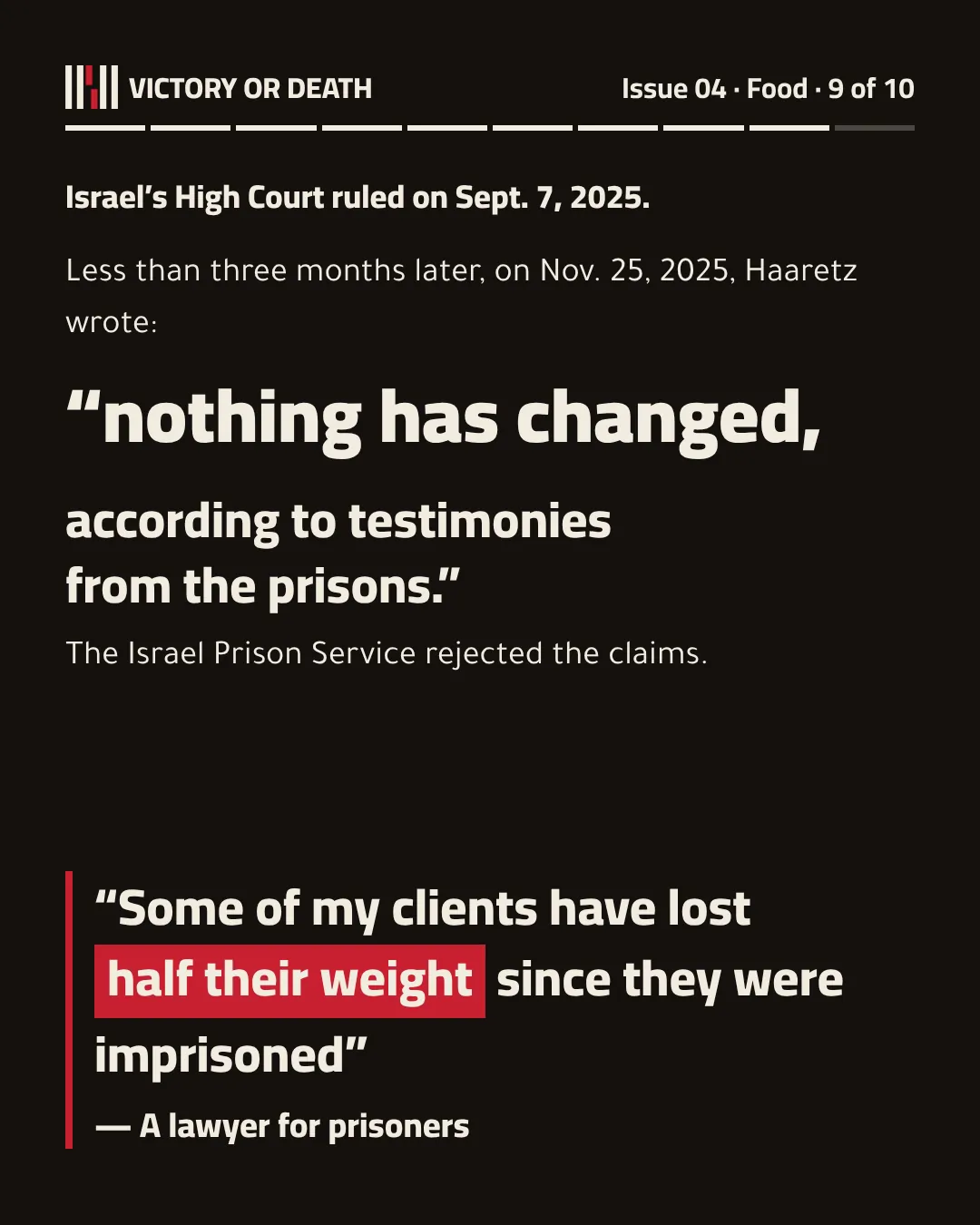
Israel’s High Court ruled on Sept. 7, 2025. Less than three months later, on Nov. 25, 2025, Haaretz wrote:
“nothing has changed, according to testimonies from the prisons.”
The Israel Prison Service rejected the claims.
“Some of my clients have lost half their weight since they were imprisoned” — a lawyer for prisoners
In detail
Haaretz based its report on a motion that the Association for Civil Rights in Israel and the Israeli rights group Gisha filed with Israel’s High Court early that week, drawing on visits to the prisons. The two groups said the Israel Prison Service was not carrying out the ruling. In affidavits attached to the motion, prisoners said nothing had changed in how food was handed out, and some said the amount had even gone down. The groups asked the court to fine or jail the Prison Service commissioner, Kobi Yaakobi.
On March 28, 2026, Haaretz reported that Israel’s High Court had told the Israeli government that the Israel Prison Service must provide enough food to all “security” prisoners, not only to those who are underweight.
On April 23, 2026, the Israeli news site Arutz Sheva reported the court’s decision on the two groups’ contempt motion. The court found they had not laid a “sufficient basis to prove a systemic violation” of the ruling. The justices stressed that the duty to provide enough food applies to all “security” prisoners, and that individual prisoners’ claims of food shortages are to be heard in personal petitions. Extra food is allowed “when the need for it arises.”
On Oct. 8, 2026, Haaretz wrote that contempt motions had been filed in both cases, over food and over Red Cross visits, and that in neither case did the rulings appear to have changed anything in how the Israel Prison Service operates.
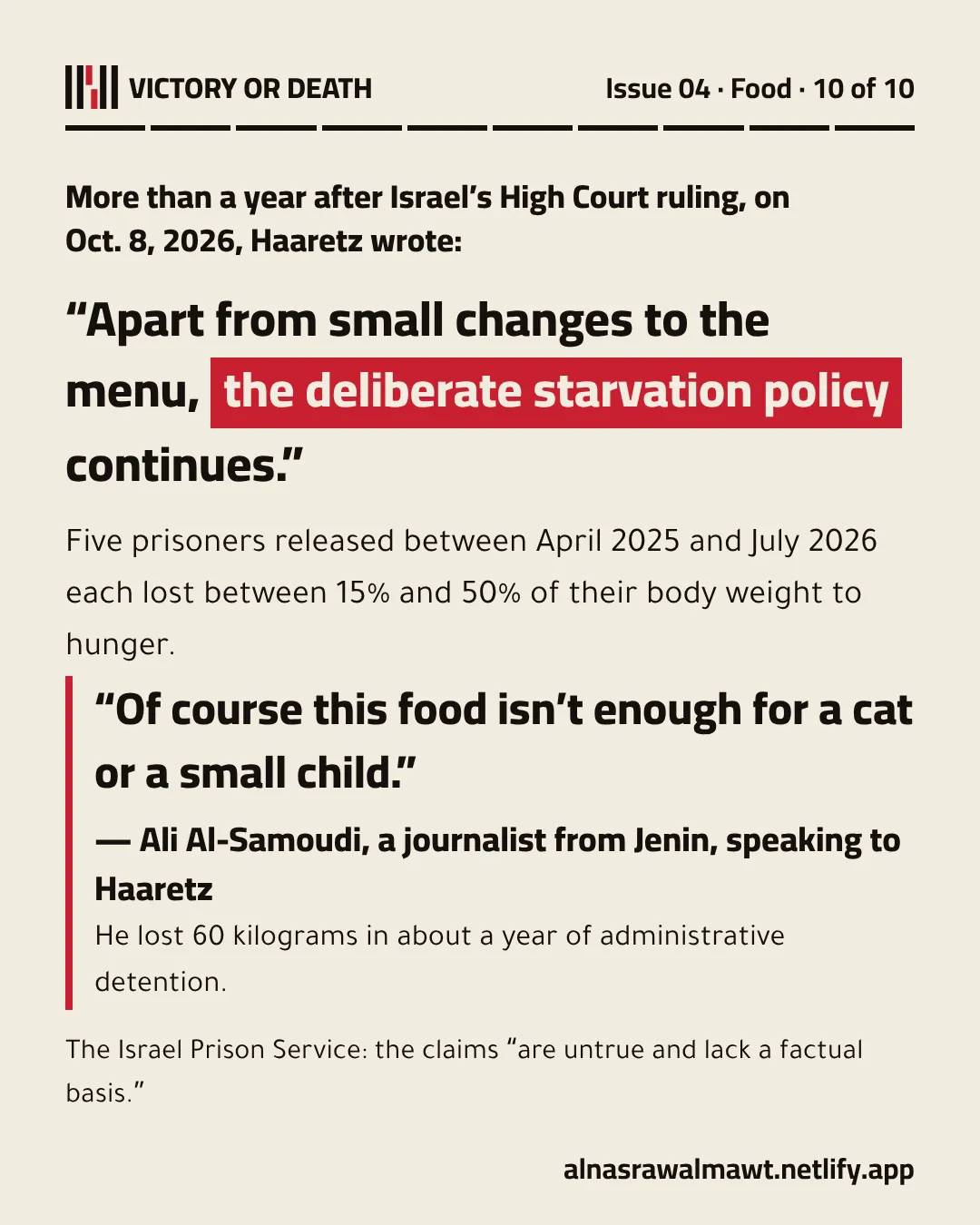
More than a year after Israel’s High Court ruling, on Oct. 8, 2026, Haaretz wrote:
“Apart from small changes to the menu, the deliberate starvation policy continues.”
Five prisoners released between April 2025 and July 2026 each lost between 15% and 50% of their body weight to hunger.
“Of course this food isn’t enough for a cat or a small child.” — Ali Al-Samoudi, a journalist from Jenin, speaking to Haaretz. He lost 60 kilograms in about a year of administrative detention.
The Israel Prison Service: the claims “are untrue and lack a factual basis.”
In detail
The five came out of Megiddo, Nafha, al-Naqab (Ketziot), Ofer and Damon prisons, and all of them live in the occupied West Bank. Ali Al-Samoudi went into prison weighing 120 kilograms, with diabetes and high blood pressure. He came out with 10 illnesses.
It is meant only so that we can stand and sit for the count. That leads to illnesses like mine: I would faint and wake up lying on the floor.
Ali Al-Samoudi, a journalist from Jenin, to Haaretz
In his account to Haaretz, there was no salt, no sugar and no coffee in the prison food.
Hiba Allawi, a mother of five from al-Dhahiriya, spent five and a half months in Damon prison and came out in July 2026 having lost 36 kilograms. Rabee Abu Naim, from the village of al-Mughayyir near Ramallah, described how most prisoners saved up food for what they called “the day of fullness,” “so that one day a week we would feel full.”
The Israel Prison Service told Haaretz the claims “are untrue, lack a factual basis and are part of a smear campaign against the State of Israel and its lawful institutions around the world.” It said it “operates in accordance with the law and under constant judicial review.”
Arthur BalfourMemorandum respecting Syria, Palestine and Mesopotamia 1919
For in Palestine we do not propose even to go through the form of consulting the wishes of the present inhabitants of the country, though the American Commission has been going through the forms of asking what they are.