Prisoners looked for the sun through a hole in the shower-room wall, and a whole day’s food could be counted in spoonfuls. Three times a day they knelt for the count, then slept on mattresses on the floor. This is a prisoner’s day in an Israeli prison, as those who lived it describe it and as state inspectors found it. Most of the testimonies cover the first months after October 2023; the figures run to September 2026.
This part reflects information available before publication on Oct. 9, 2026.
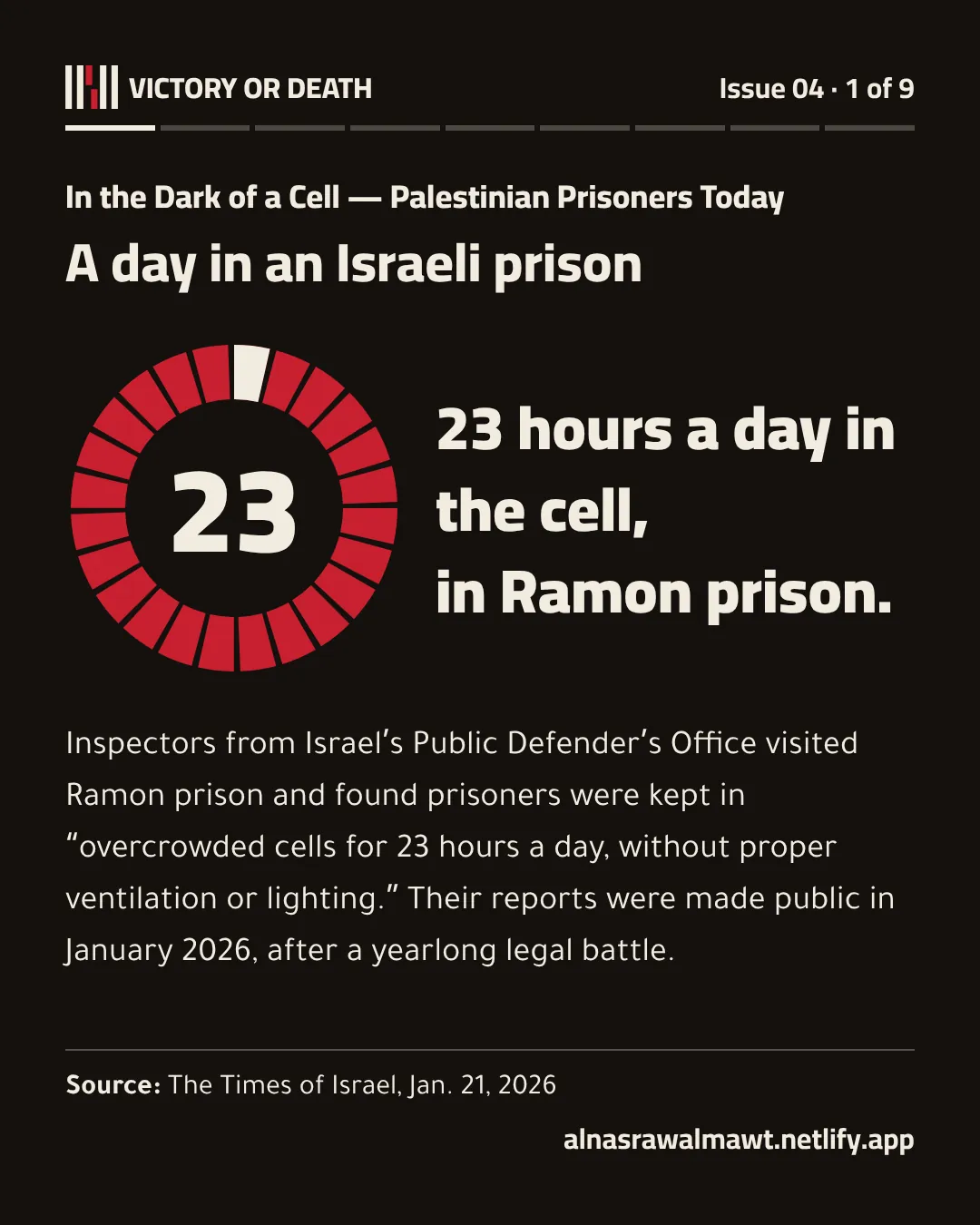
Inspectors from Israel’s Public Defender’s Office visited Ramon prison and found prisoners were kept in “overcrowded cells for 23 hours a day, without proper ventilation or lighting.” Their reports were made public in January 2026, after a yearlong legal battle.
In detail
The inspectors also found prisoners held “without enough food or hygiene products, with reduced access to medical treatment.” Their reports came out only after a yearlong legal battle by the Association for Civil Rights in Israel.
Besides Ramon, the Public Defender’s Office visited Gilboa, Megiddo and al-Naqab (Ketziot) prisons, and the “security” wings at Ayalon, Shata, Eshel and the Russian Compound (al-Moscobiyeh). The visits produced “a harsh and uniform picture,” in the words of Ha-Makom, the Hebrew news site that reported on the findings.
Since August 2024, the Israel Prison Service has been merging Nafha and Ramon into a single prison called Ganot, about 15 kilometers north of the town of Mitzpe Ramon, according to the prison’s official page. It has 17 “security” wings and two isolation wings.
The commanders of Megiddo and Ramon prisons denied that violence against prisoners was prevalent and said sufficient hygiene and cleaning products were provided (The Times of Israel, Jan. 21, 2026).
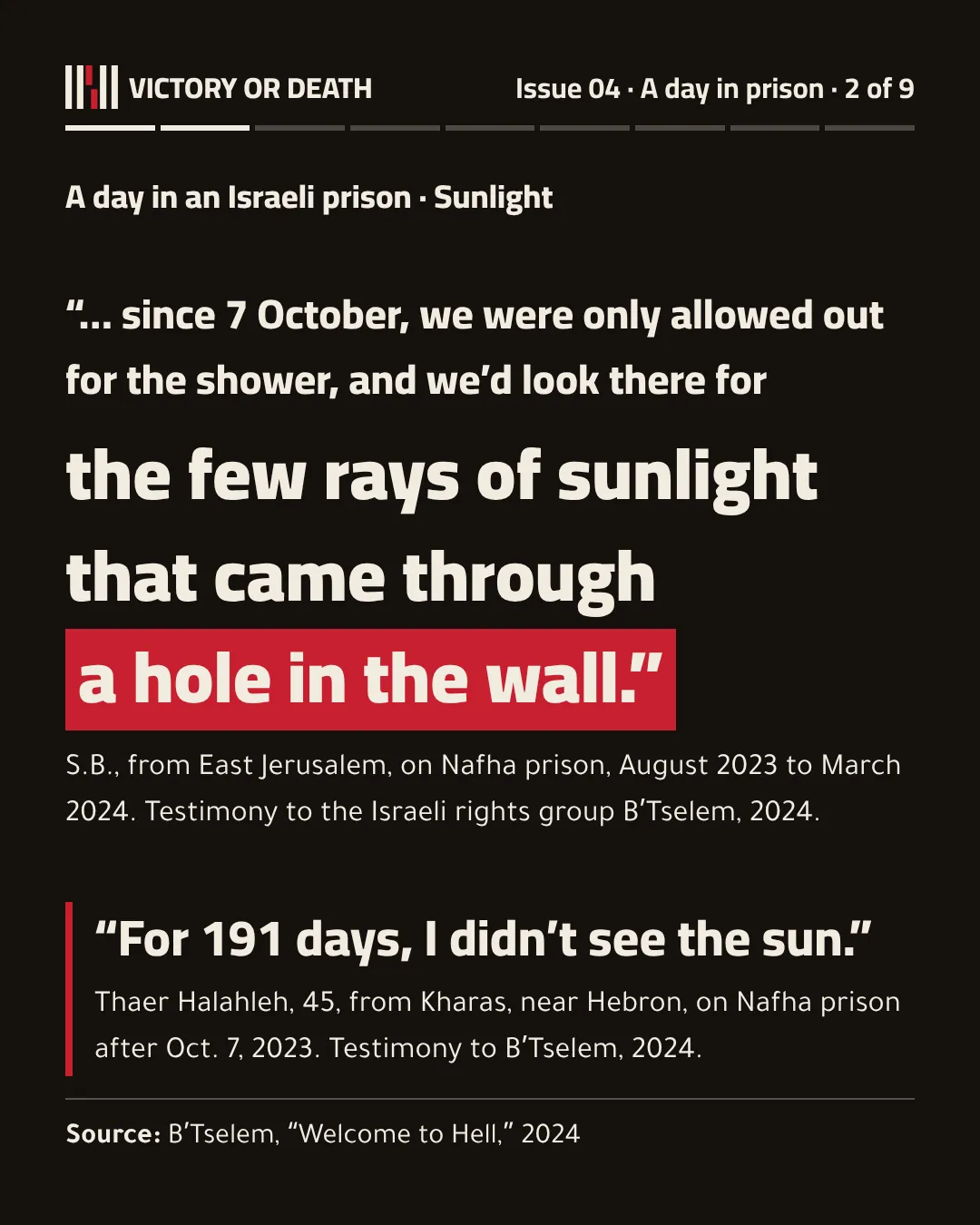
“… since 7 October, we were only allowed out for the shower, and we’d look there for the few rays of sunlight that came through a hole in the wall.”
S.B., from East Jerusalem, on Nafha prison, August 2023 to March 2024. Testimony to the Israeli rights group B’Tselem, 2024.
“For 191 days, I didn’t see the sun.” Thaer Halahleh, 45, from Kharas, near Hebron, on Nafha prison after Oct. 7, 2023. Testimony to B’Tselem, 2024.
In detail
Both testimonies come from Nafha prison. S.B. was held there from August 2023 to March 2024. Thaer Halahleh, a father of four, was in cell 3 on wing 4. After the war began, he says, “we were also forbidden to go outside to the yard, unlike before.”
Until the war, we were allowed out of the cells for 12 hours, between 6:00 A.M. and 6:00 P.M., and could walk in a large lot outside, to be in the sun.
S.B., from East Jerusalem, in testimony to B’Tselem
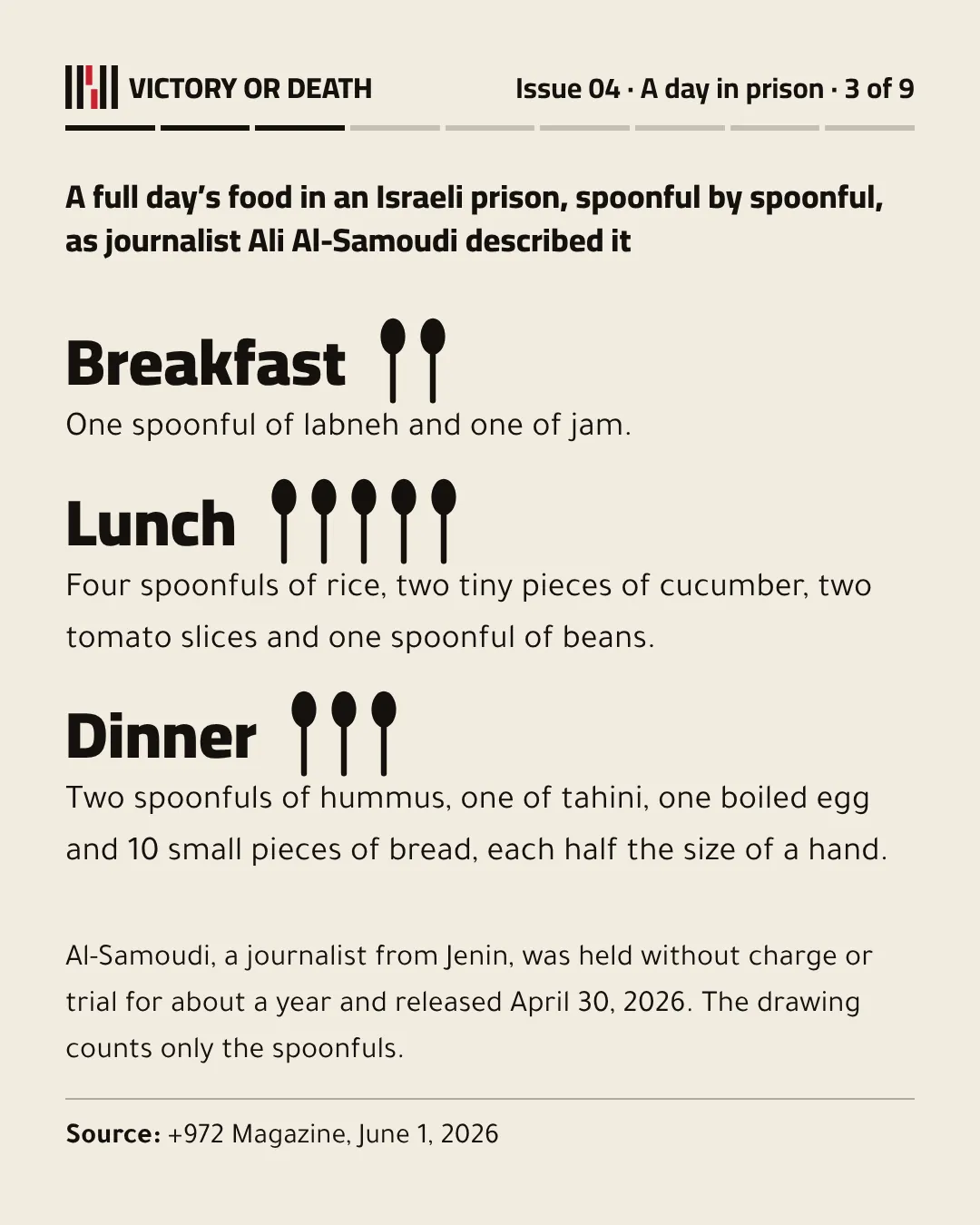
A full day’s food in an Israeli prison, spoonful by spoonful, as journalist Ali Al-Samoudi described it
Breakfast: one spoonful of labneh and one of jam. Lunch: four spoonfuls of rice, two tiny pieces of cucumber, two tomato slices and one spoonful of beans. Dinner: two spoonfuls of hummus, one of tahini, one boiled egg and 10 small pieces of bread, each half the size of a hand.
Al-Samoudi, a journalist from Jenin, was held without charge or trial for about a year and released April 30, 2026.
In detail
Ali Al-Samoudi is 60. He has worked as a correspondent for Al-Quds newspaper and as a cameraman for Al Jazeera. Israeli forces raided his home in Jenin at dawn on April 29, 2025, and arrested him.
Another meal, described in a testimony B’Tselem recorded on Nov. 9, 2025, had to feed about 60 prisoners. J.M., a released prisoner, said it would not have been enough for 10 people: a bag of labneh of about a kilogram, six cucumbers and six slices of bread.
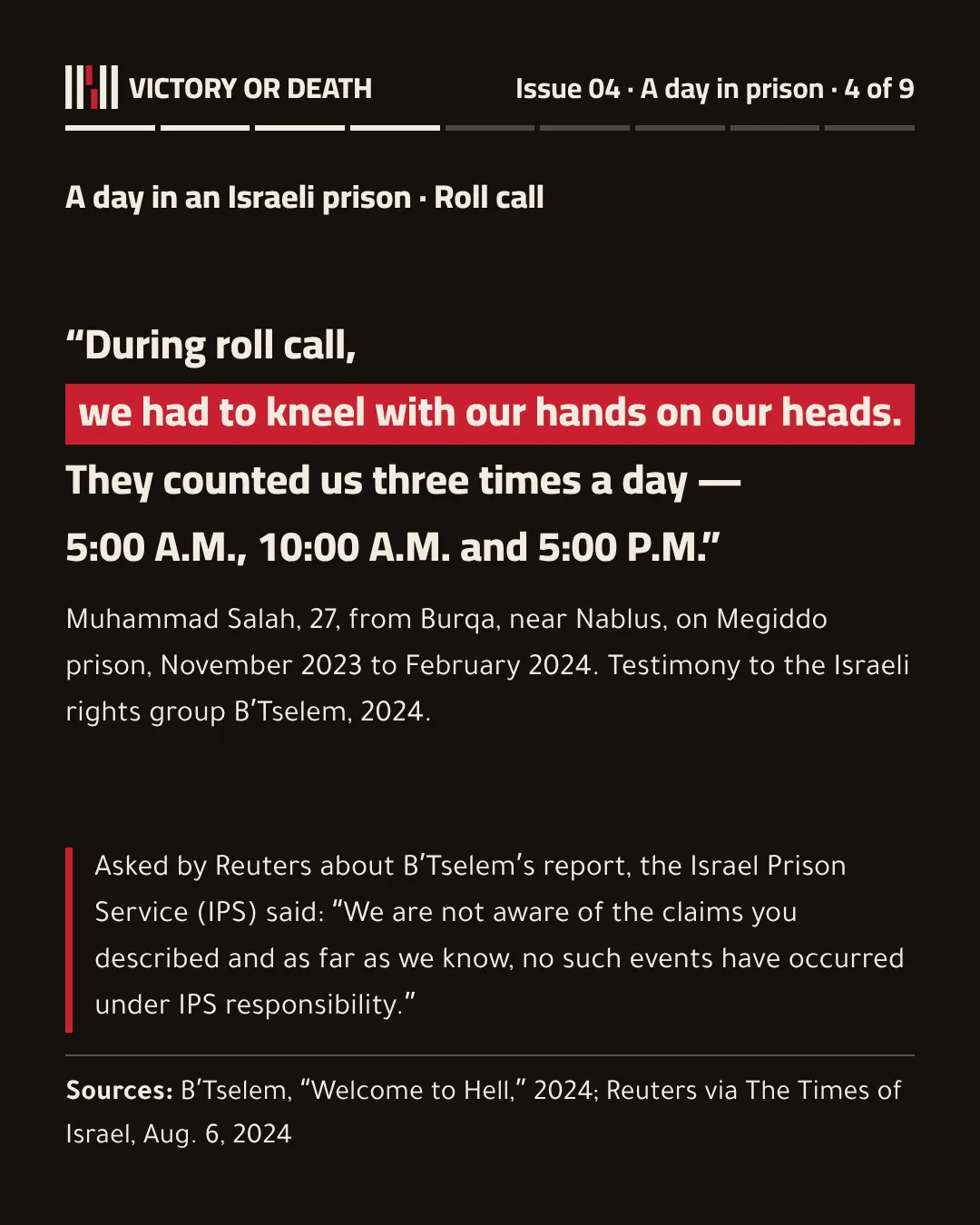
“During roll call, we had to kneel with our hands on our heads. They counted us three times a day — 5:00 A.M., 10:00 A.M. and 5:00 P.M.”
Muhammad Salah, 27, from Burqa, near Nablus, on Megiddo prison, November 2023 to February 2024. Testimony to the Israeli rights group B’Tselem, 2024.
Asked by Reuters about B’Tselem’s report, the Israel Prison Service (IPS) said: “We are not aware of the claims you described and as far as we know, no such events have occurred under IPS responsibility.”
In detail
In Thaer Halahleh’s testimony about Nafha, the count itself changed after the war. Before, prisoners stood in the cell while they were counted. After Oct. 7, the guards drew a line at the cell entrance, barred the prisoners from coming near it, and made them bow down with their hands on their heads.
Musa ’Aasi, 58, a father of five from Beit Liqya, near Ramallah, told B’Tselem that the counting unit came without warning. The prisoners had to wake at once; the guards knocked on the door and ordered them straight onto their knees, heads bowed and hands raised, in a way he called humiliating.
The Prison Service also told Reuters, in August 2024, that all prisoners had been treated according to the law and their basic rights had been fully provided, and that detainees had the right to file complaints that would be fully examined and investigated. A spokesperson said that after the “October 7 attack,” National Security Minister Itamar Ben Gvir ordered that prison conditions be made more strict, to reverse an improvement allowed previously.
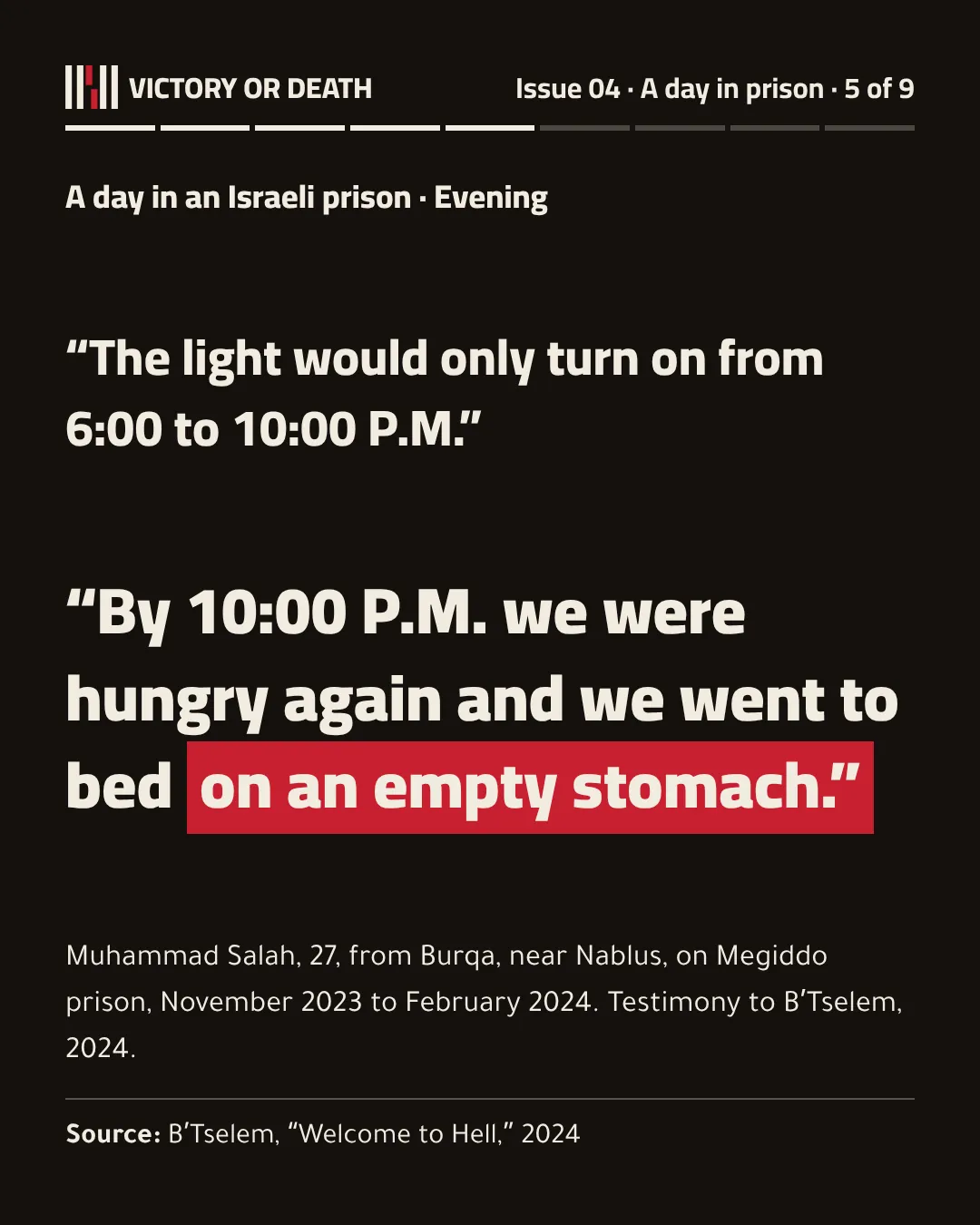
“The light would only turn on from 6:00 to 10:00 P.M.”
“By 10:00 P.M. we were hungry again and we went to bed on an empty stomach.”
Muhammad Salah, 27, from Burqa, near Nablus, on Megiddo prison, November 2023 to February 2024. Testimony to B’Tselem, 2024.
In detail
In Nafha, the power went off and on. In S.B.’s testimony, it was cut during the day at first, then turned back on only between 6:00 and 10:00 P.M., and later left off altogether.
Showers were allowed for one hour every three days, so no prisoner got more than three minutes. After Oct. 7, the prisoners also lost the washing machines.
About eight months before the war, in February 2023, National Security Minister Itamar Ben Gvir told the Prison Service that “security” prisoners would get four minutes to shower and running water only one hour a day, Ynet reported. The new rules were to start in two wings of Nafha prison.
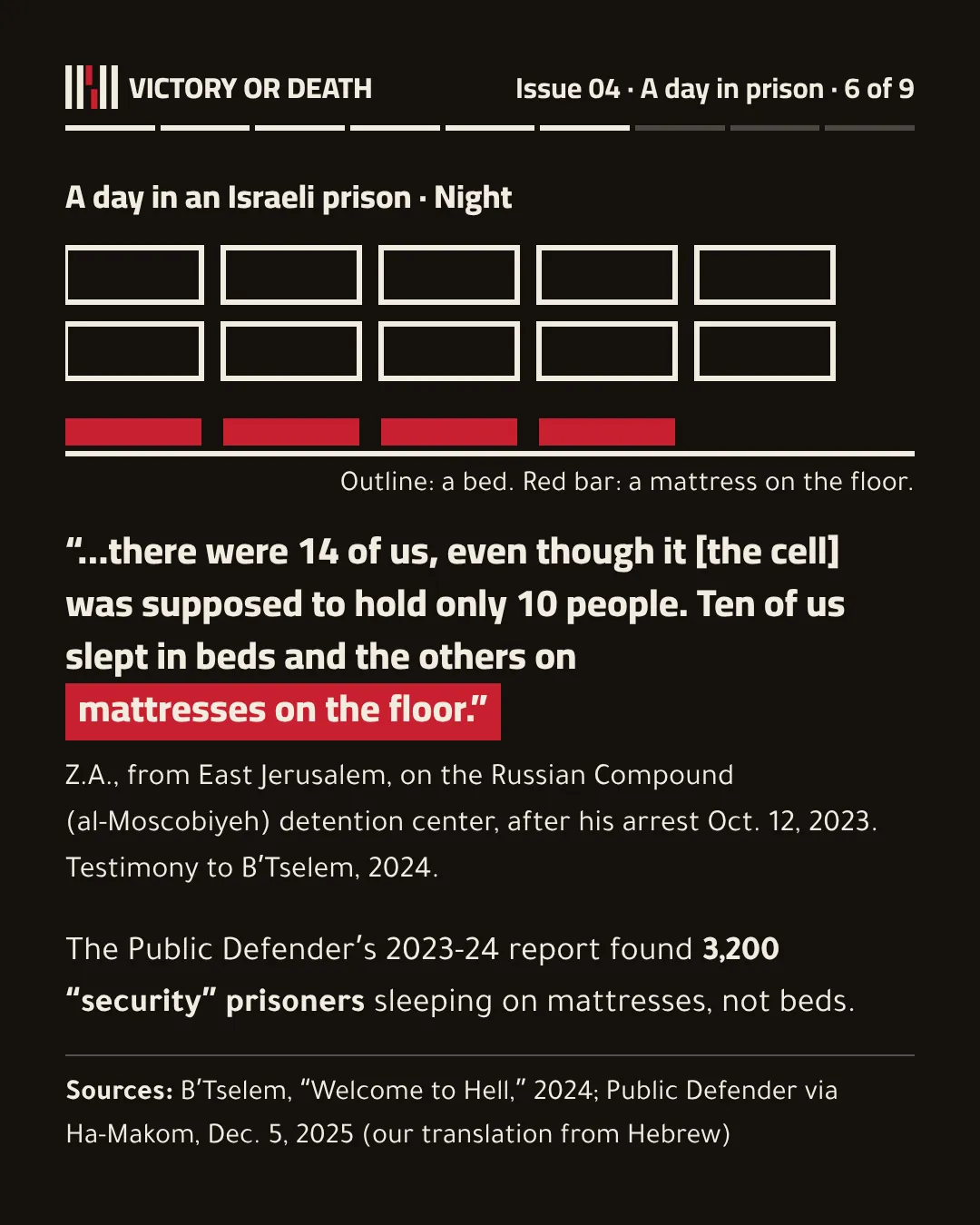
“… there were 14 of us, even though it [the cell] was supposed to hold only 10 people. Ten of us slept in beds and the others on mattresses on the floor.”
Z.A., from East Jerusalem, on the Russian Compound (al-Moscobiyeh) detention center, after his arrest Oct. 12, 2023. Testimony to B’Tselem, 2024.
The Public Defender’s 2023-24 report found 3,200 “security” prisoners sleeping on mattresses, not beds.
Z.A. was arrested on Oct. 12, 2023, and held at the Russian Compound for 13 days. During that time, he says, “they kept putting more detainees in the cell.”
Each prison room contained 10 prisoners and measured seven by three meters. There were only six beds for 10 prisoners, meaning six slept on the beds while four slept on the floor.
Ali Al-Samoudi, a journalist from Jenin, to +972 Magazine
In the Public Defender’s report for 2023–2024, 3,200 “security” prisoners were on mattresses. The report’s figures, as Ha-Makom published them, also show 1,300 criminal prisoners on mattresses. In September 2026, the Association for Civil Rights in Israel said about 19% of all prisoners sleep on mattresses, without a bed.
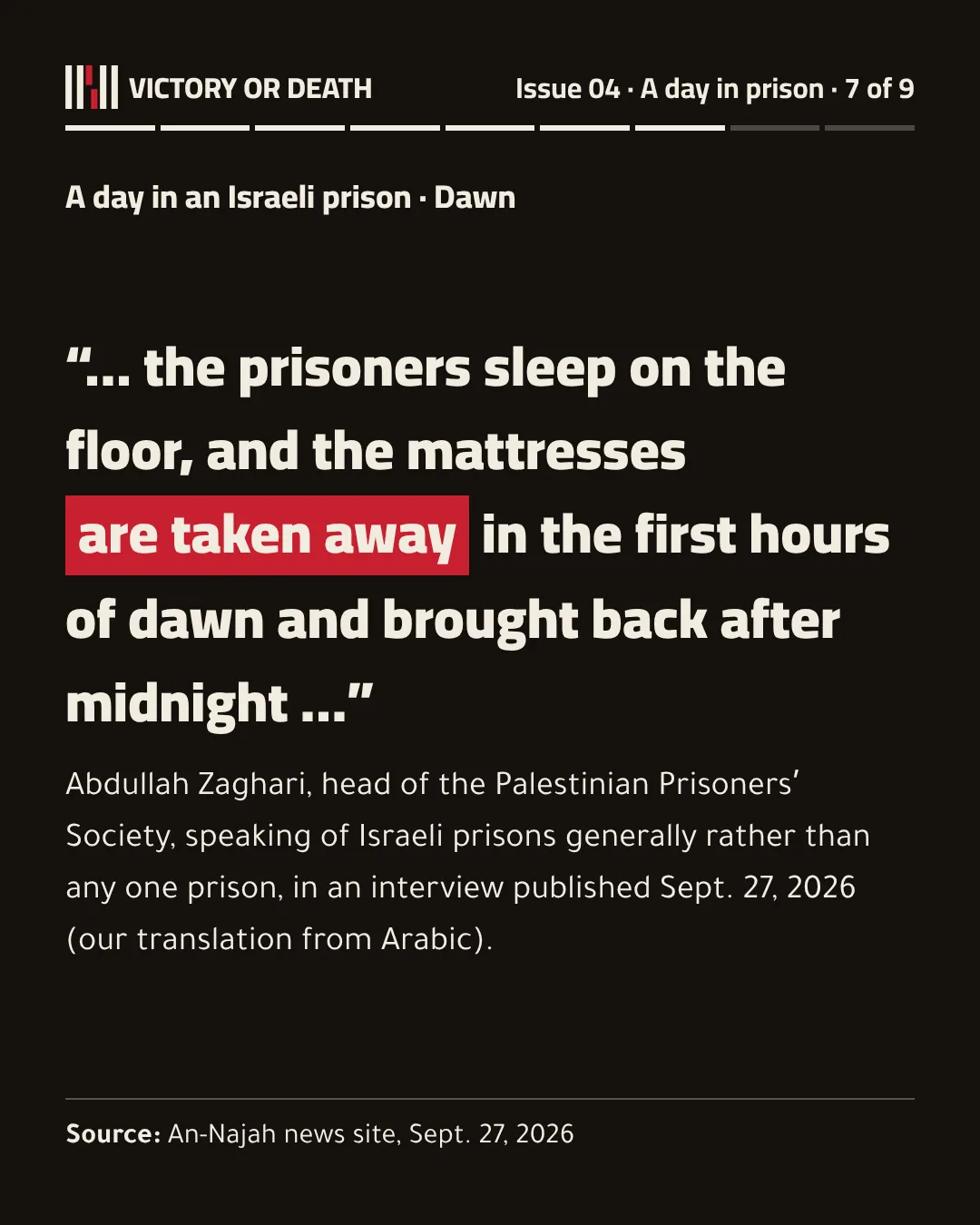
“… the prisoners sleep on the floor, and the mattresses are taken away in the first hours of dawn and brought back after midnight …”
Abdullah Zaghari, head of the Palestinian Prisoners’ Society, speaking of Israeli prisons generally rather than any one prison
In an interview published Sept. 27, 2026.
In detail
Zaghari spoke of the mattresses while describing the prisoners’ health, which he called “difficult and dangerous.” He also spoke of scabies spreading through the prisons.
In S.B.’s testimony about Nafha, on the day the war began the guards confiscated everything in the cells, including “pillows, sheets, blankets and mattress covers.” They left one blanket for each prisoner.
In Thaer Halahleh’s testimony about Nafha, the mattress was among the few things each prisoner kept after the confiscations: “one set of clothes, one pair of shoes, one blanket, a mattress, a bottle of shampoo and a toothbrush.”
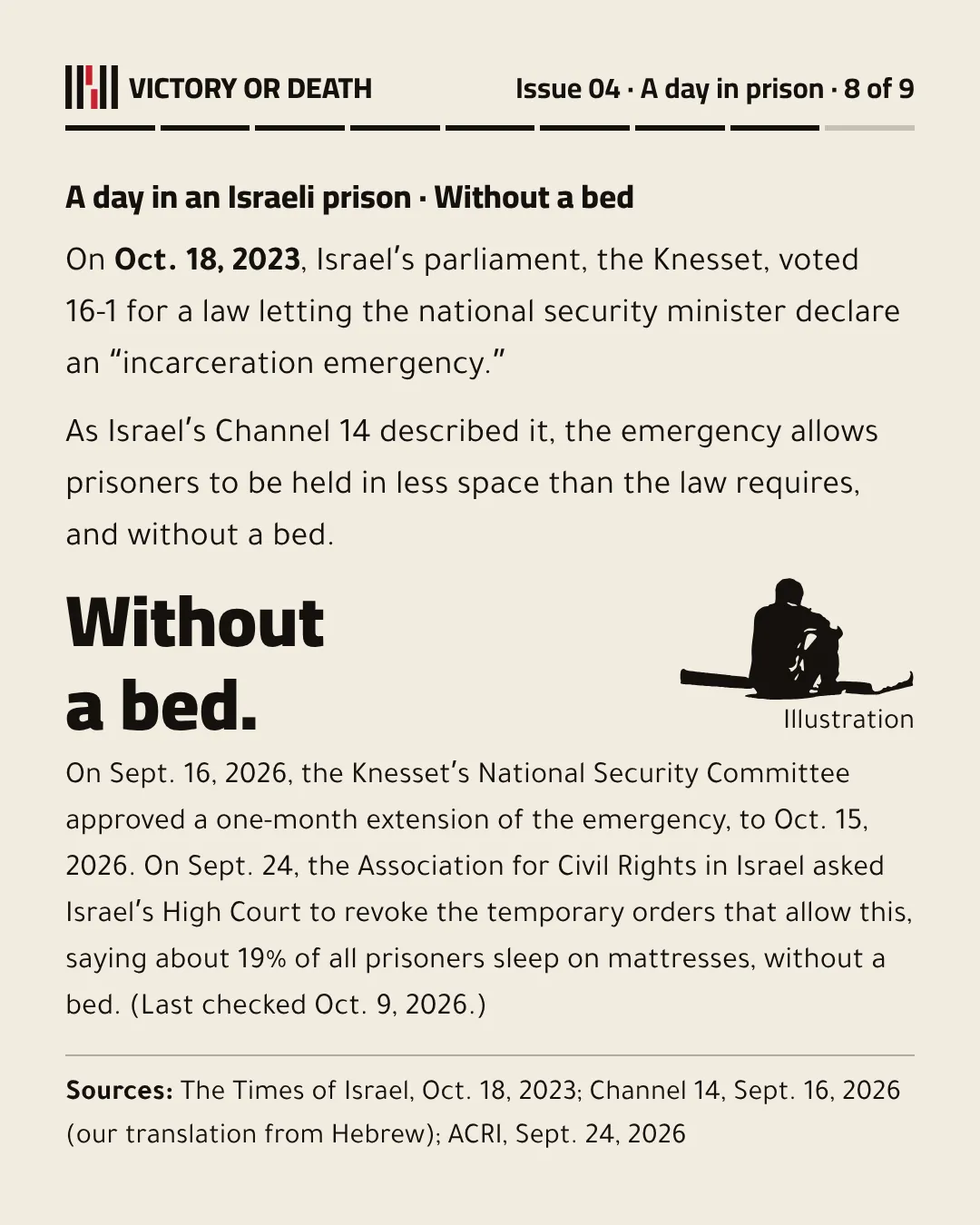
On Oct. 18, 2023, Israel’s parliament, the Knesset, voted 16-1 for a law letting the national security minister declare an “incarceration emergency.” As Israel’s Channel 14 described it, the emergency allows prisoners to be held in less space than the law requires, and without a bed.
On Sept. 16, 2026, the Knesset’s National Security Committee approved a one-month extension of the emergency, to Oct. 15, 2026. On Sept. 24, the Association for Civil Rights in Israel asked Israel’s High Court to revoke the temporary orders that allow this, saying about 19% of all prisoners sleep on mattresses, without a bed.
In detail
On the day the law passed, The Times of Israel wrote that it enabled National Security Minister Itamar Ben Gvir “to worsen the conditions of security prisoners.” Ben Gvir had said he wanted to house Palestinian detainees and prisoners on mattresses rather than in beds.
The latest extension came from the Knesset’s National Security Committee and ran for one month, Channel 14 reported.
We found no extension beyond Oct. 15 and no ruling on the association’s petition (as of Oct. 9, 2026).
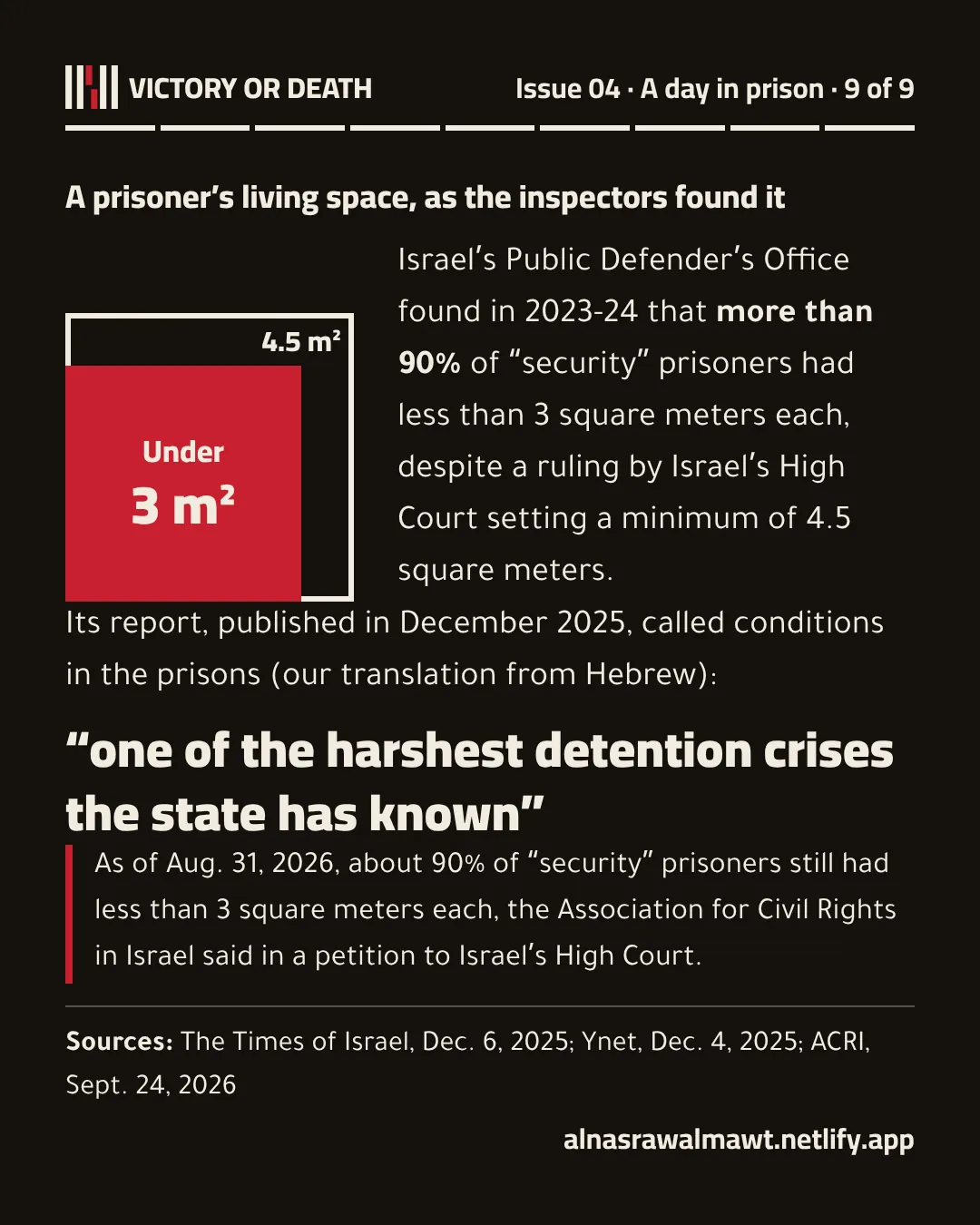
A prisoner’s living space, as the inspectors found it
Under 3 m²
Israel’s Public Defender’s Office found in 2023-24 that more than 90% of “security” prisoners had less than 3 square meters each, despite a ruling by Israel’s High Court setting a minimum of 4.5 square meters.
Its report, published in December 2025, called conditions in the prisons “one of the harshest detention crises the state has known.”
As of Aug. 31, 2026, about 90% of “security” prisoners still had less than 3 square meters each, the Association for Civil Rights in Israel said in a petition to Israel’s High Court.
In detail
The report compared the two groups of prisoners: 35% of criminal detainees lived in less than 3 square meters each, against more than 90% of “security” detainees.
In Megiddo, the inspectors found 520 prisoners over the prison’s approved capacity. Twelve prisoners were held in a cell of 23 square meters, about 2 square meters each.
The report was published on Dec. 4, 2025, after reviews and site visits during 2023 and 2024.
Ze’ev JabotinskyOn the Iron Wall 1923
If it were possible (and I doubt this) to discuss Palestine with the Arabs of Baghdad and Mecca as if it were some kind of small, immaterial borderland, then Palestine would still remain for the Palestinians not a borderland, but their birthplace […]