One blanket, one set of clothes and one pair of shoes for each prisoner: that is what was left in the cells of Nafha prison after Oct. 7, 2023, according to two testimonies given to B’Tselem. In al-Naqab, a detainee said, Qurans and prayer mats were confiscated and prayer was banned, whether in a group or alone. Israel’s national security minister wrote that canteen purchases had been stopped “in line with my policy.” The Israel Prison Service, for its part, said it was not aware of the claims.
This part reflects information available before publication on Oct. 10, 2026.
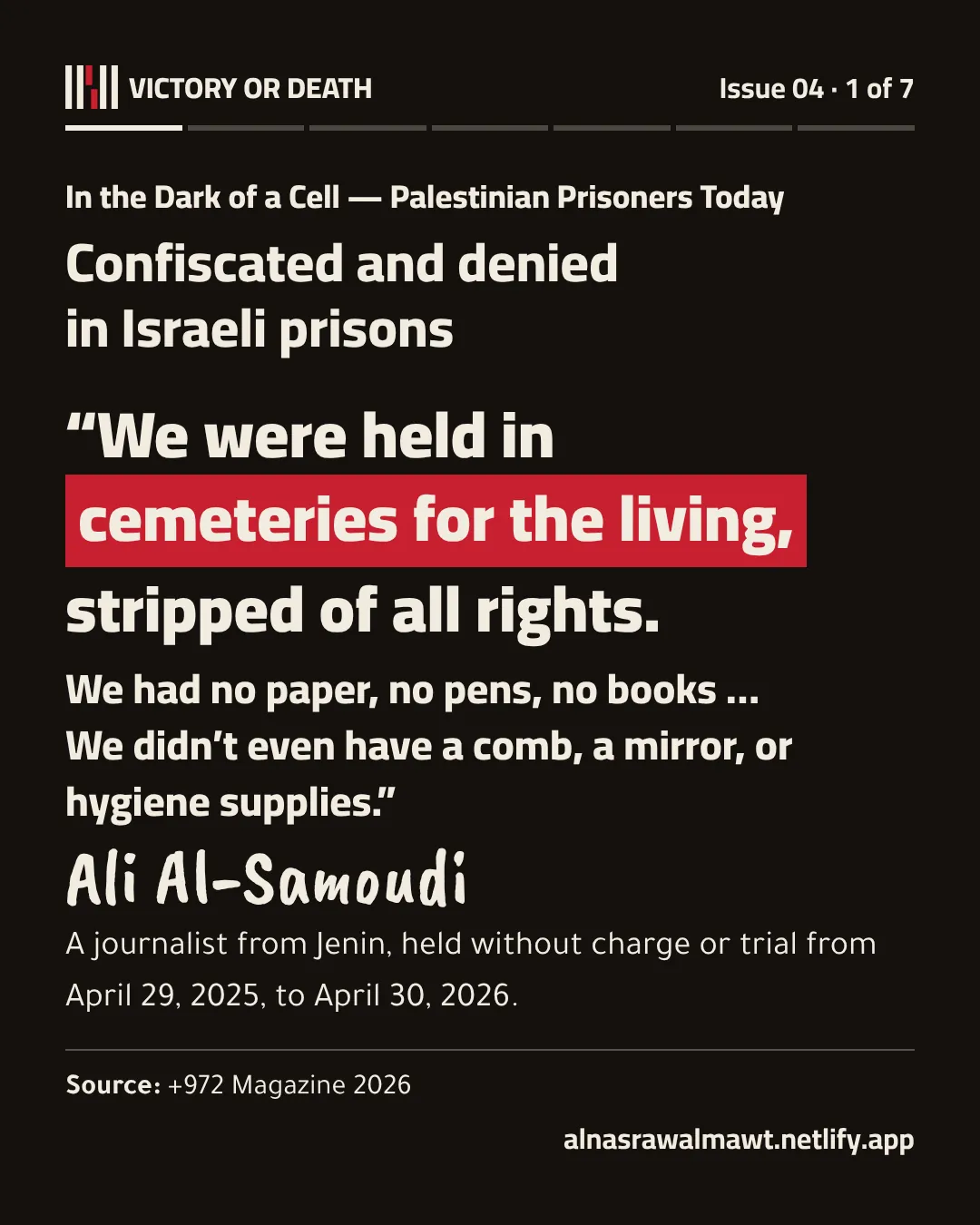
“We were held in cemeteries for the living, stripped of all rights. We had no paper, no pens, no books … We didn’t even have a comb, a mirror, or hygiene supplies.”
Ali Al-Samoudi
A journalist from Jenin, held without charge or trial from April 29, 2025, to April 30, 2026.
In detail
Israeli forces raided Ali Al-Samoudi’s home in Jenin at dawn on April 29, 2025, and arrested him. He was held without charge or trial and released almost a year to the day later, on April 30, 2026.
I know that nothing has changed to this day, because as a journalist I interview prisoners who are released. A prisoner who was released three or four days ago from the prison where I was held told me the situation has gotten even worse.
Ali Al-Samoudi, to Haaretz, October 2026
Al-Samoudi, 60, has documented events in Jenin for four decades, as a correspondent for Al-Quds newspaper and a cameraman for Al Jazeera. +972 Magazine spoke to him shortly after his release; the full list he gave also included “no television, no radio.”
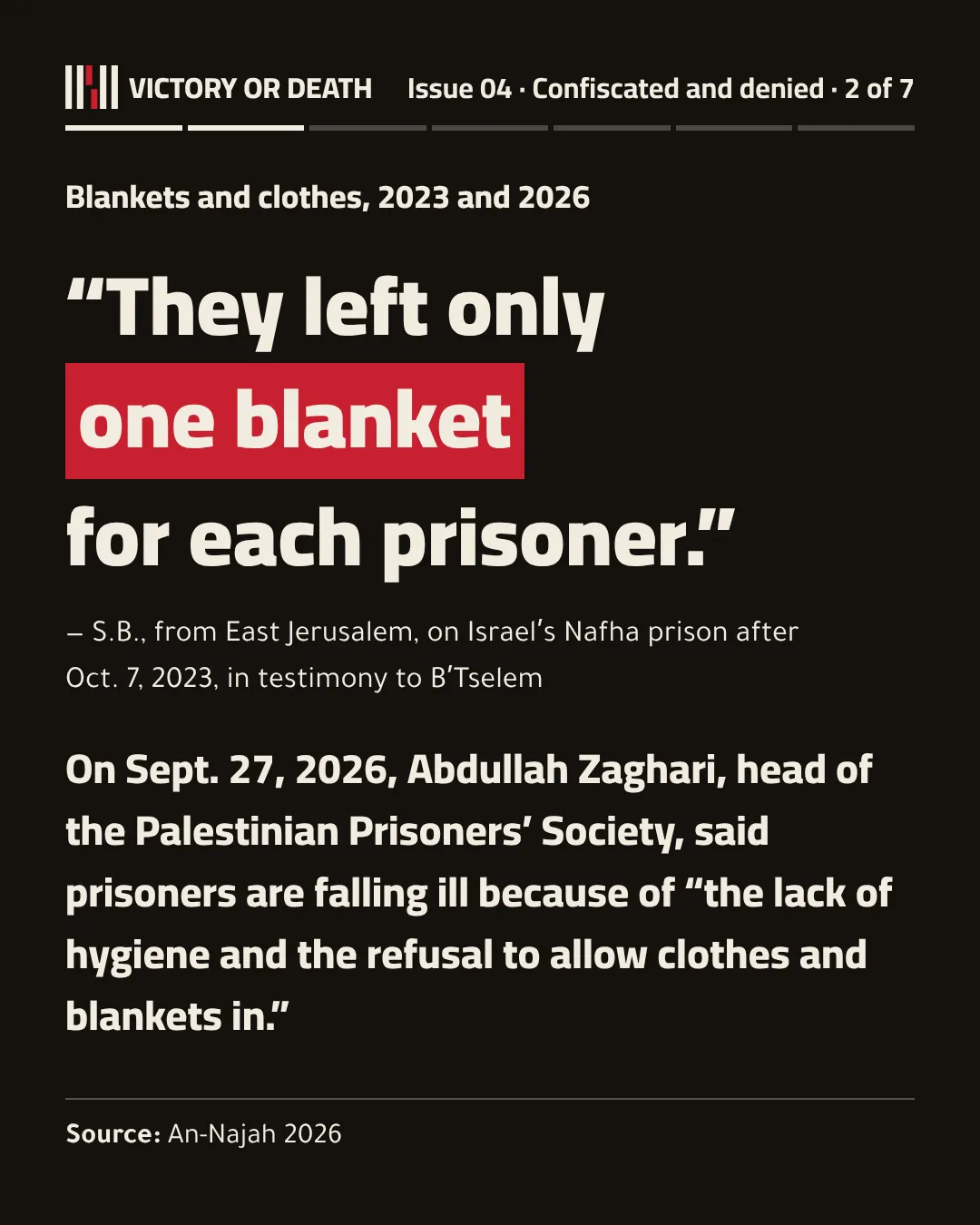
S.B., from East Jerusalem, on Israel’s Nafha prison after Oct. 7, 2023, in testimony to B’Tselem
On Sept. 27, 2026, Abdullah Zaghari, head of the Palestinian Prisoners’ Society, said prisoners are falling ill because of “the lack of hygiene and the refusal to allow clothes and blankets in.”
In detail
S.B. had been held in Nafha since August 2023. On Oct. 7, the prisoners still had televisions in their cells, which is how they learned what had happened that day; the prison administration told them nothing. The confiscations began that same day.
… that day, they confiscated everything in the cells: TVs, electric kettles, hotplates, heaters, fans, pillows, sheets, blankets and mattress covers.
S.B., in testimony to B’Tselem
Speaking on Sept. 27, 2026, Zaghari called the prisoners’ health “difficult and dangerous.” The prisoners sleep on the floor, he said, and “the mattresses are taken away in the first hours of dawn and brought back after midnight,” while scabies spreads through the prisons.
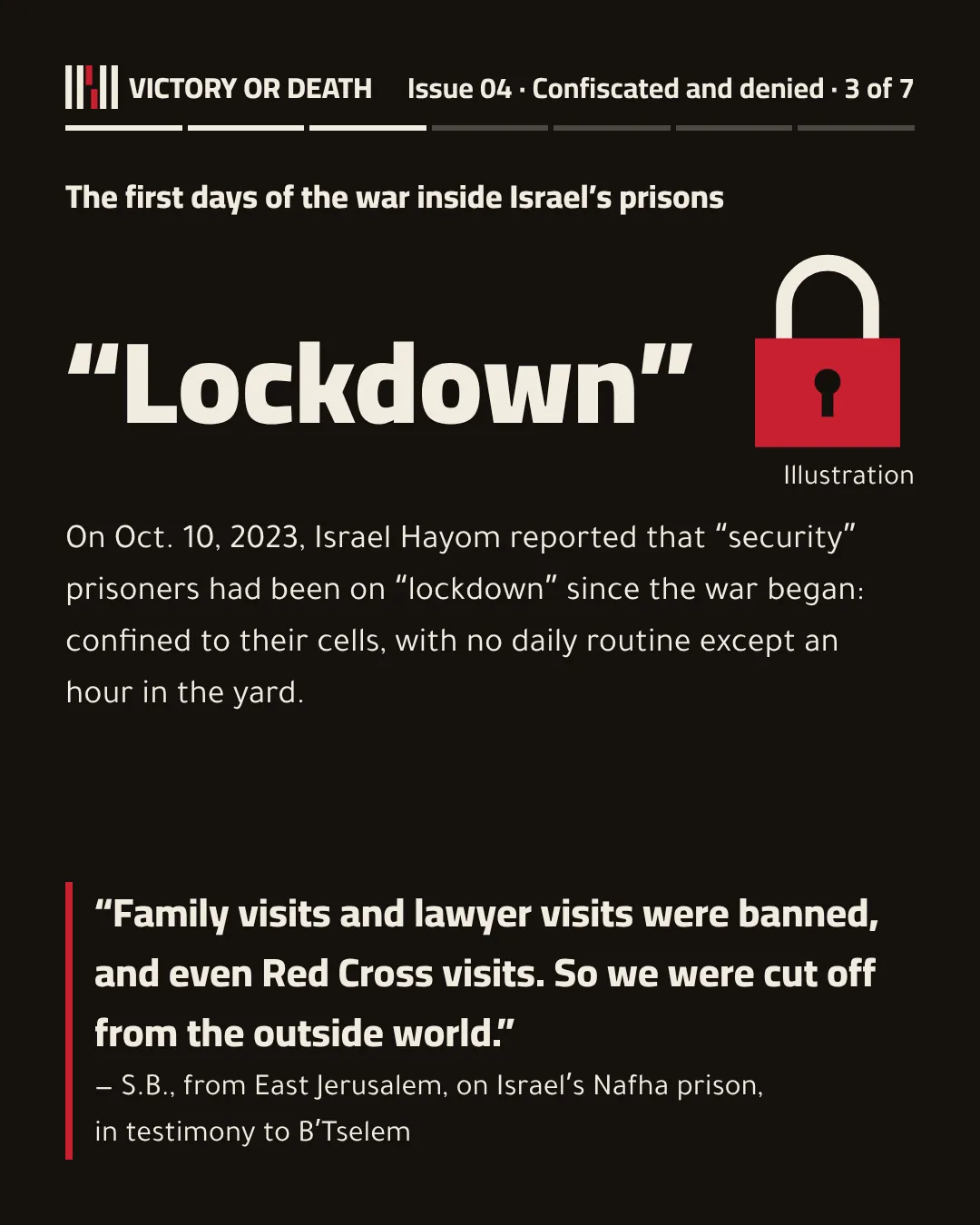
On Oct. 10, 2023, Israel Hayom reported that “security” prisoners had been on “lockdown” since the war began: confined to their cells, with no daily routine except an hour in the yard.
“Family visits and lawyer visits were banned, and even Red Cross visits. So we were cut off from the outside world.” — S.B., from East Jerusalem, on Israel’s Nafha prison, in testimony to B’Tselem
In detail
The same Israel Hayom report said that on that day, a Tuesday, the Israel Prison Service cut off television viewing in the wings holding “security” prisoners. It also removed electrical appliances, such as hotplates and kettles, from the wings and the cells.
On Oct. 7, 2023, the Israel Prison Service had declared an “incarceration emergency,” with a blanket ban on family visits to “security” prisoners, according to the Israeli rights group HaMoked. The ban was later written into an amendment to a temporary order.
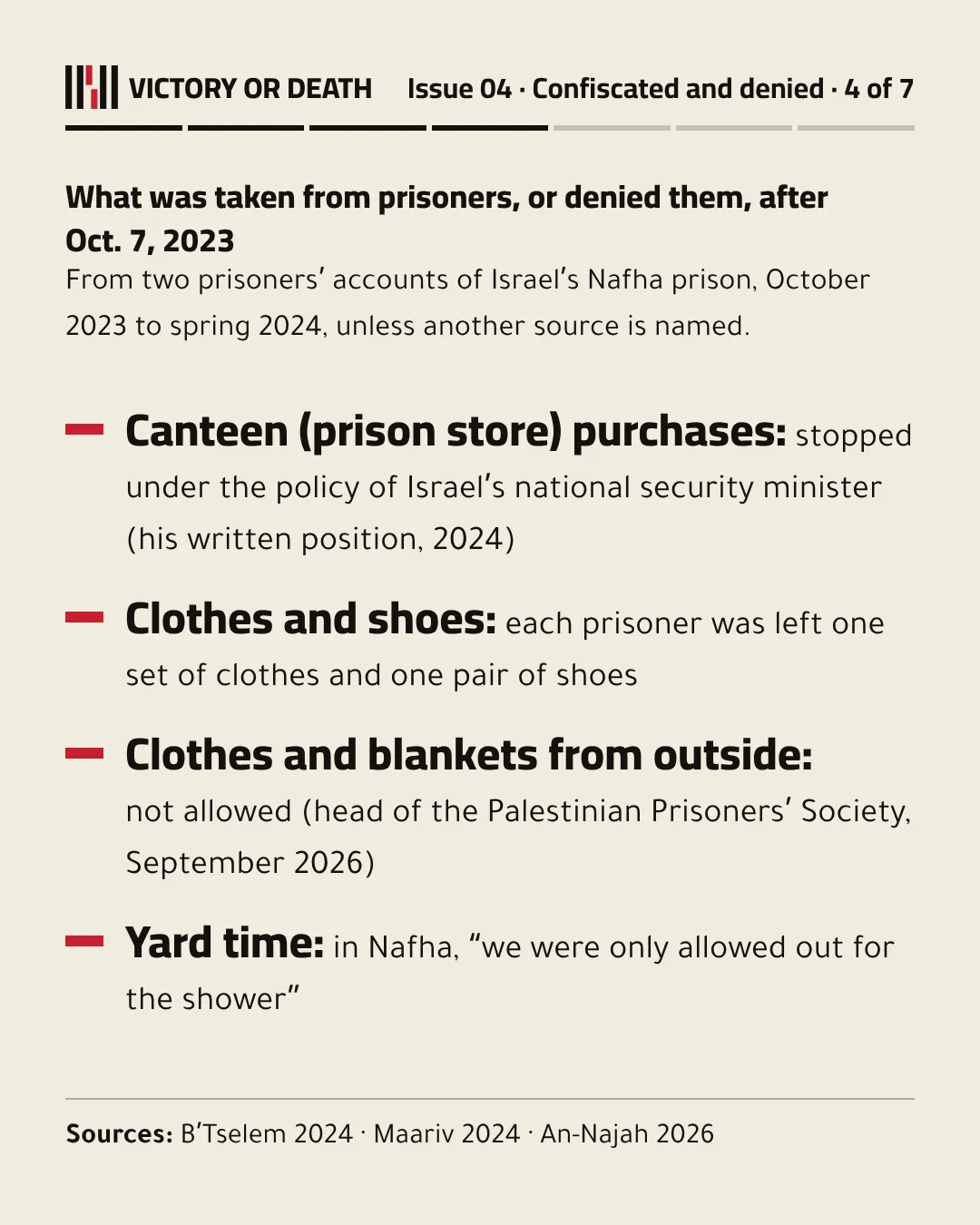
What was taken from prisoners, or denied them, after Oct. 7, 2023
From two prisoners’ accounts of Israel’s Nafha prison, October 2023 to spring 2024, unless another source is named.
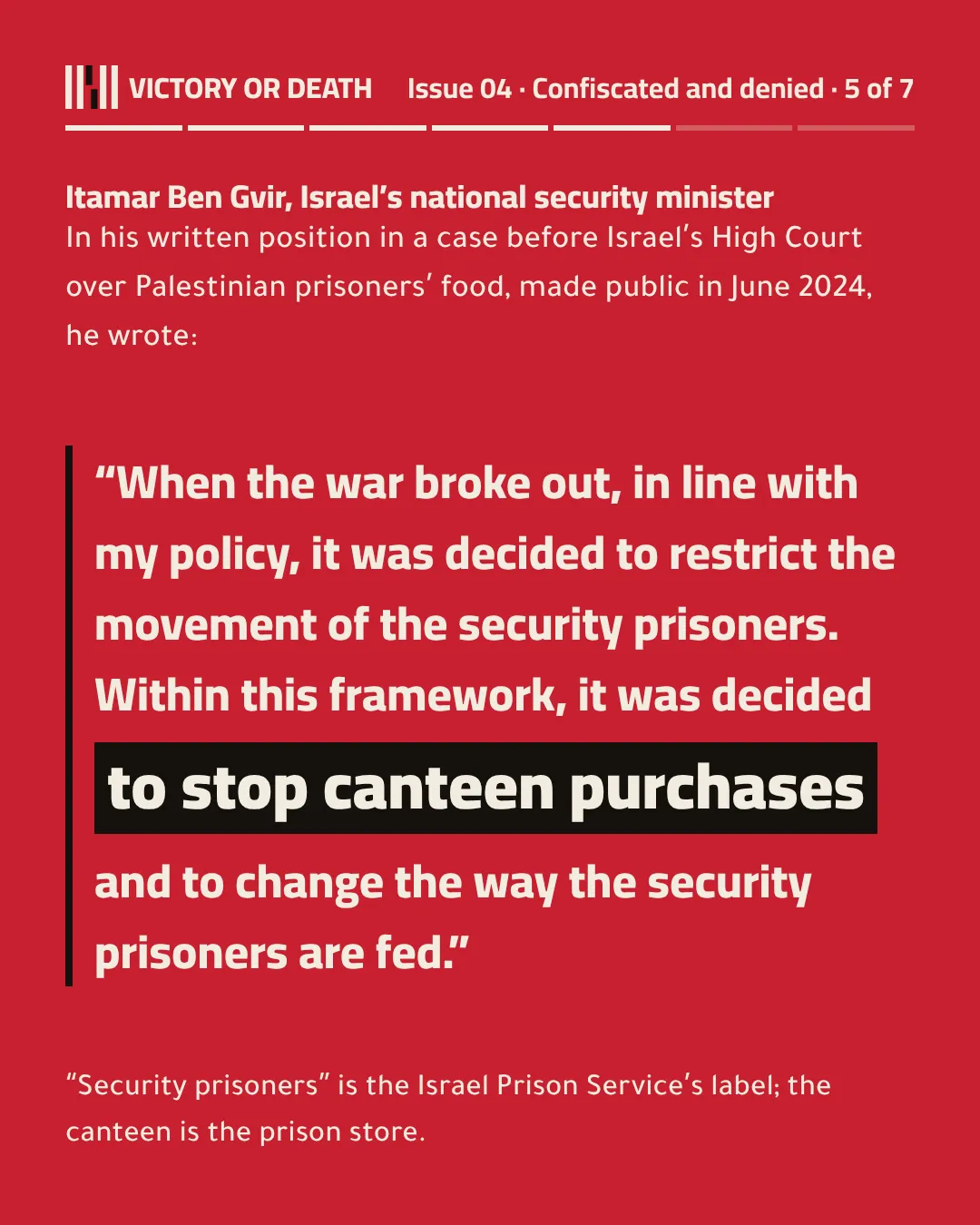
Canteen (prison store) purchases: stopped under the policy of Israel’s national security minister (his written position, 2024)
Clothes and shoes: each prisoner was left one set of clothes and one pair of shoes
Clothes and blankets from outside: not allowed (head of the Palestinian Prisoners’ Society, September 2026)
Yard time: in Nafha, “we were only allowed out for the shower”
In detail
The two prisoners are S.B. and Thaer Halahleh, 45, a father of four from Kharas, near Hebron, who was also held in Nafha. In Halahleh’s words: “They also confiscated everything we had: the TV, hot plate, kettle, and all electrical appliances in the room, as well as our clothes and shoes. They left each of us with one set of clothes, one pair of shoes, one blanket, a mattress, a bottle of shampoo and a toothbrush.”
But since 7 October, we were only allowed out for the shower, and we’d look there for the few rays of sunlight that came through a hole in the wall.
S.B., from East Jerusalem, on Nafha prison, in testimony to B’Tselem
Before the war, S.B. says, prisoners in Nafha were let out of their cells for 12 hours, from 6:00 A.M. to 6:00 P.M., into a large lot outside, in the sun. Halahleh: “For 191 days, I didn’t see the sun.”
S.B. also describes the loss of the washing machines after Oct. 7. Showers were allowed for one hour every three days, so no prisoner got more than three minutes.
The tightening began before the war. In early February 2023, The Jerusalem Post reported that National Security Minister Itamar Ben Gvir had ordered the closure of the pita bakeries in Ramon and al-Naqab (Ketziot) prisons. That same month, he told the Israel Prison Service to cut showers for “security” prisoners to four minutes, starting in two wings of Nafha prison, Ynet reported.
Itamar Ben Gvir, Israel’s national security minister — in his written position in a case before Israel’s High Court over Palestinian prisoners’ food, made public in June 2024, he wrote:
“When the war broke out, in line with my policy, it was decided to restrict the movement of the security prisoners. Within this framework, it was decided to stop canteen purchases and to change the way the security prisoners are fed.”
“Security prisoners” is the Israel Prison Service’s label; the canteen is the prison store.
In detail
At a hearing before Israel’s High Court on June 26, 2024, it was argued that the State Attorney’s Office had left the minister’s position out of the state’s response to the petition. The justices rebuked the prosecution, the Israeli daily Maariv reported.
… before the war, we cooked our own food and had as much as we wanted.
Thaer Halahleh, from Kharas, on Nafha prison, in testimony to B’Tselem
Thaer Halahleh, held in Nafha, described what the change in feeding meant for the prisoners:
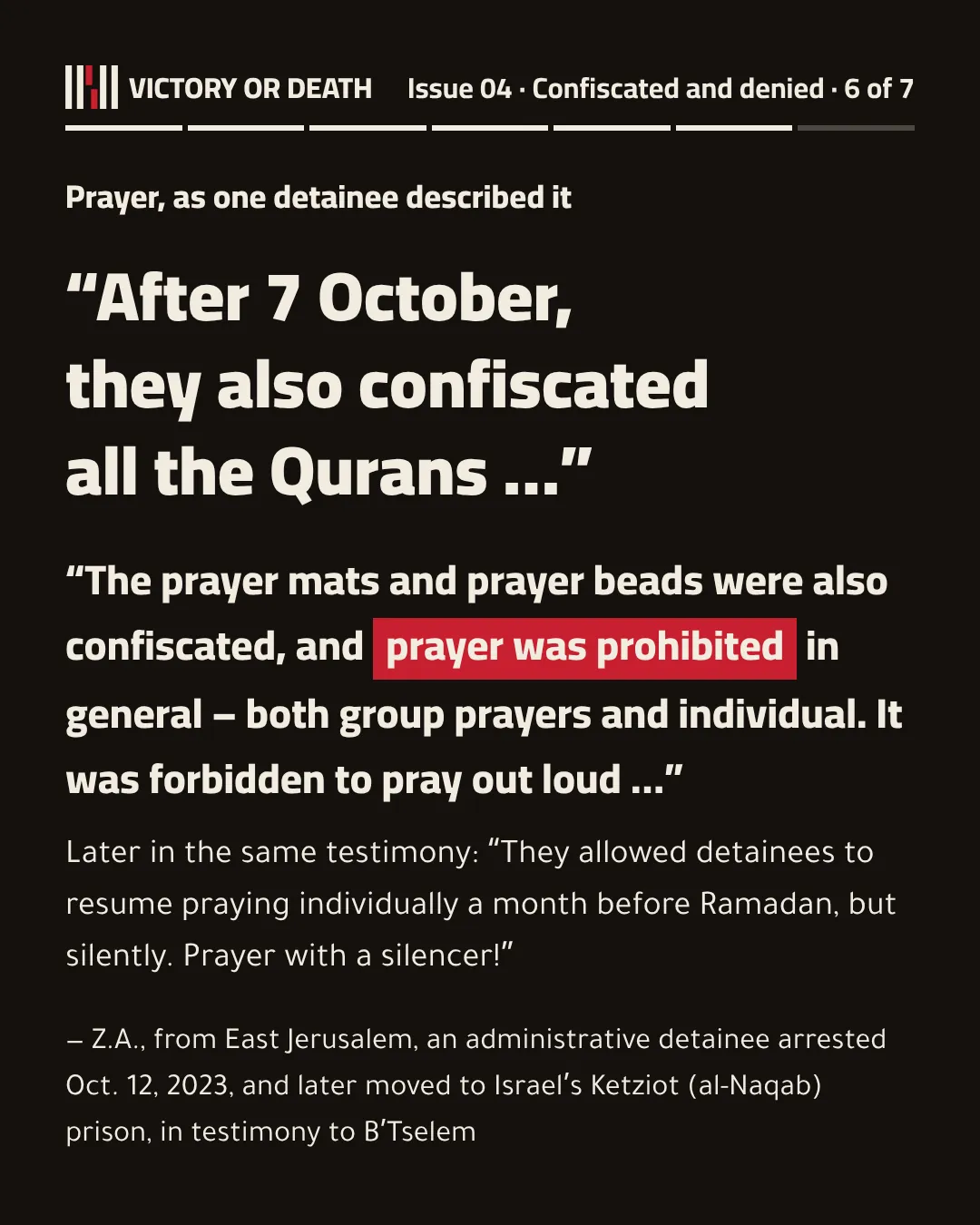
“After 7 October, they also confiscated all the Qurans …”
Z.A., from East Jerusalem, an administrative detainee arrested Oct. 12, 2023, and later moved to Israel’s Ketziot (al-Naqab) prison, in testimony to B’Tselem
“The prayer mats and prayer beads were also confiscated, and prayer was prohibited in general – both group prayers and individual. It was forbidden to pray out loud …”
Later in the same testimony: “They allowed detainees to resume praying individually a month before Ramadan, but silently. Prayer with a silencer!”
In detail
Z.A. was arrested around 1:30 P.M. on Oct. 12, 2023, when an unmarked car blocked his way. He was held for 13 days at the Russian Compound (al-Moscobiyeh), where new detainees were brought in until there were 14 in his cell, which was meant for 10. From there he was moved to Naqab prison with three other detainees; that, he says, is where his ordeal began.
… when the guards found a Quran during a search, they would throw it on the floor and stomp on it.
Z.A., in testimony to B’Tselem
He was held in administrative detention, and the order was extended again and again: first for two months, then for two more, then for another 50 days.
In the same testimony, he describes what happened to the Qurans that remained:
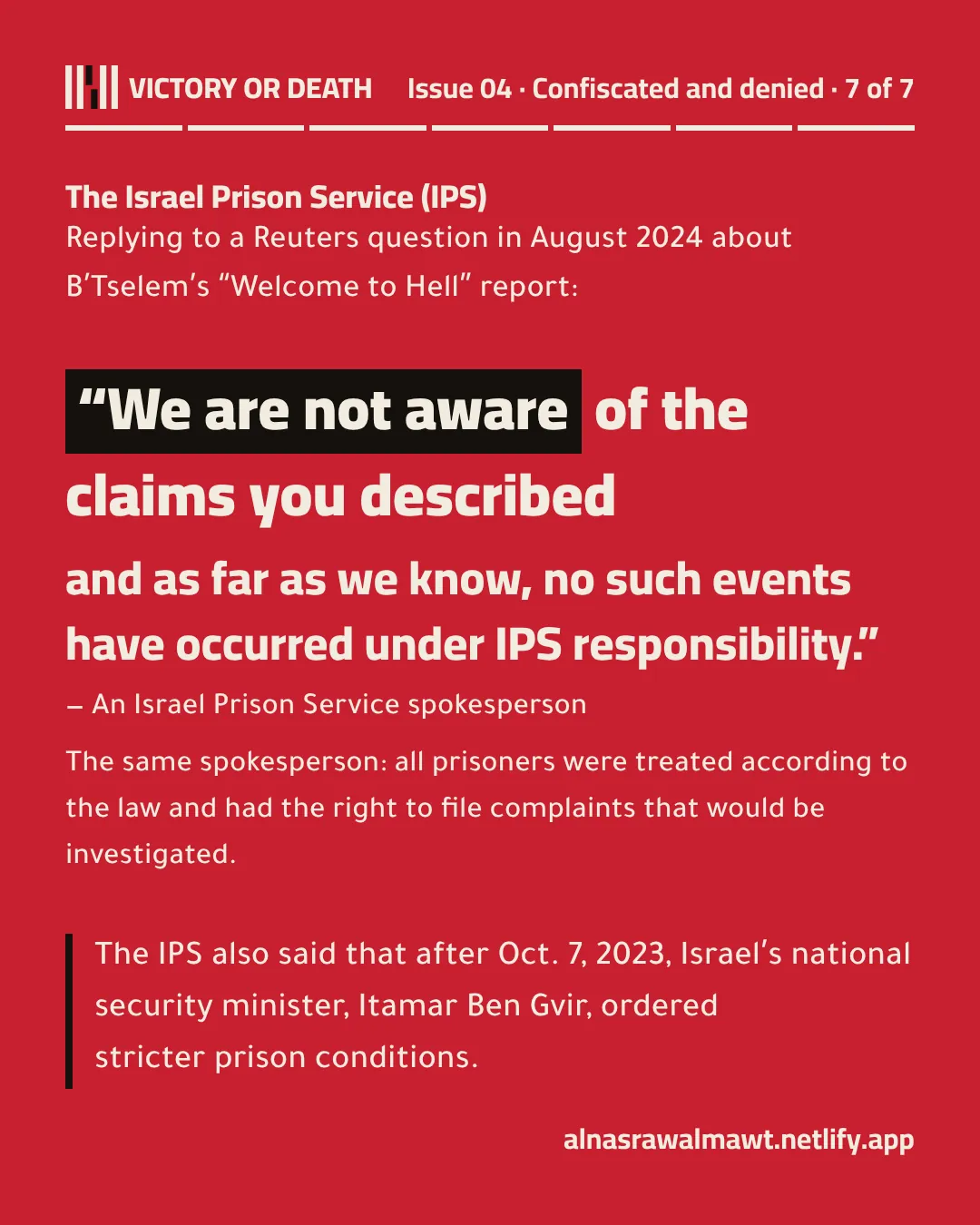
The Israel Prison Service (IPS) — replying to a Reuters question in August 2024 about B’Tselem’s “Welcome to Hell” report:
“We are not aware of the claims you described and as far as we know, no such events have occurred under IPS responsibility.”
An Israel Prison Service spokesperson
The same spokesperson: all prisoners were treated according to the law and had the right to file complaints that would be investigated.
The IPS also said that after Oct. 7, 2023, Israel’s national security minister, Itamar Ben Gvir, ordered stricter prison conditions.
In detail
In the same Reuters report, the Prison Service gave a reason for the minister’s order: the conditions were made stricter “to reverse an improvement in conditions allowed previously.”
The Israeli army, responding in The Guardian to B’Tselem’s report, said it “rejects outright allegations concerning systematic abuse of detainees” and acts “in accordance with Israeli law and international law.” Any claims of abuse are examined thoroughly, it said, and “all incidents in which detainees die are investigated by the Military Police Criminal Investigations Division.”
We found no published official response to B’Tselem’s second report, “Living Hell,” released in January 2026 (as of Oct. 3, 2026).
Palestine Arab Delegationletter to the British Colonial Secretary · 1922
[…] the Jewish National Home undertaking is the cause of depriving us of our natural right of establishing an independent government the same as Mesopotamia and the Hedjaz.